What Does JK Mean in Text? Full Meaning Explained Simply (2026)
JK stands for “Just Kidding.” It is used in texting and social media to signal that what was just said was not meant seriously — a quick retraction that transforms a statement from something that might land heavily into something lighter and more playful. When someone sends JK they are letting the other person know that the previous message was a joke, a tease, or a piece of deliberate exaggeration rather than a genuine statement of fact or feeling.
Quick Definition: JK at a Glance
| Detail | Info |
| Full Form | Just Kidding |
| Type | Tone Clarifier / Retraction Signal |
| Tone | Playful, Light, Sometimes Apologetic, Sometimes Teasing |
| Used On | Text, Snapchat, TikTok, Twitter/X, Instagram |
| Who Uses It | Gen Z, Millennials, and texters of all ages |
| Safe for Work? | Yes |
What Does JK Mean in Text?
JK means Just Kidding and it is one of the most practically useful tone-clarifying abbreviations in modern texting. People use it to signal that a statement was humorous or exaggerated rather than literal — the written equivalent of the “I’m kidding” that people add verbally when they can see from someone’s face that a joke might have landed wrong, or simply to complete the comedic arc of a teasing statement before the other person has a chance to misread it.
What makes JK so valuable in digital communication is that it solves one of the oldest and most persistent problems of text-based conversation — the absence of tone. In spoken conversation, people communicate irony, playfulness, and exaggeration through facial expressions, vocal inflection, and body language. In text, none of those signals are available. A statement that would be obviously playful when said out loud with a grin can read as completely serious — or even hurtful — when stripped of all tonal context. JK fills that gap by making the intended register explicit and immediate.
JK has been part of digital communication since the earliest days of internet chat and SMS texting — one of the foundational abbreviations that developed specifically to address the tonal limitations of written-only communication. It has never gone out of use because the need to signal “that was a joke, not a fact or a criticism” has never diminished. If anything the pervasiveness of text-based communication has made JK more essential than ever.
What Does JK Signal in a Conversation?
JK always clarifies that something was not meant literally but the specific register and emotional purpose varies considerably:
- Completing a playful tease — “You are absolutely the worst friend I have ever had. JK, you are the best”
- Softening a bold or edgy statement — “I cannot believe you did that. JK, it was honestly kind of hilarious”
- Flagging intentional exaggeration for comedic effect — “I am never leaving my house again. JK, see you at seven”
- Retracting something that might have landed too hard — “That was a terrible decision. JK — well, kind of JK”
- Using humor to say something slightly true — “I hate you for making me care about this show. JK, but also not really JK”
- Light sarcasm that needs flagging — “Oh sure, that went perfectly. JK, it was an absolute disaster”
JK Meaning on Different Platforms
What Does JK Mean on Snapchat?
On Snapchat, JK flows naturally in the constant casual banter between close friends where playful teasing is a central mode of communication. Because Snapchat is where people say things quickly and informally with the full context of a close relationship behind them, JK is often used lightly and affectionately — a quick tonal signal that a tease was warm rather than pointed. On Snapchat JK is rarely defensive or apologetic — it is almost always part of the playful rhythm of a conversation between people who know each other well enough that the joke was probably obvious anyway. Adding JK is simply the courtesy of making it explicit.
What Does JK Mean on TikTok?
On TikTok, JK appears in captions, on-screen text, and comment sections where creators and viewers want to flag that a statement was exaggerated or ironic rather than literal. Creators use JK after extreme statements in captions — “I am quitting the internet forever. JK, see you tomorrow” — which becomes a recognizable comedic structure on the platform. In comment sections JK appears when someone has made a bold statement and wants to signal they were joking before anyone takes it seriously or responds defensively. TikTok JK is often paired with emojis that reinforce the playful tone.
What Does JK Mean on Twitter / X?
On Twitter, JK is used both genuinely and performatively — and the difference is worth noting. Genuine JK on Twitter clarifies that a statement was humorous rather than serious in a context where ambiguity could cause real misunderstanding. Performative JK on Twitter is the infamous “just asking questions” use — saying something provocative or pointed followed by JK as a form of deniability while the statement itself still lands and spreads. Twitter culture has become increasingly sophisticated about recognizing when JK is being used as genuine tone clarification versus as cover for statements that were actually meant. Context and relationship matter enormously in reading Twitter JK.
What Does JK Mean in Instagram DMs and Captions?
On Instagram, JK appears in DMs as a casual tone clarifier between friends where something playful needed flagging to avoid misreading. In captions JK is used when a creator has made an exaggerated or ironic statement and wants to make sure the audience reads it in the right spirit — particularly since Instagram captions reach a broad audience with varying levels of familiarity with the creator’s sense of humor. Instagram JK in captions is often part of a self-aware comedic structure where the joke lands before the JK confirms it.
Real Text Conversation Examples
These examples show the full range of JK — from warm affectionate teasing to edgy humor that needed flagging to the slightly-true version where JK does not quite fully retract the original statement.
Example 1 — Warm affectionate tease between close friends
Jordan: You are honestly the most chaotic person I have ever met in my entire life
Alex: JK on the entire life part — there was someone in my sixth-grade class who once ate a crayon on a dare. You are the second most chaotic. JK on that too, you are the first by a comfortable margin
Example 2 — Flagging exaggeration before it lands wrong
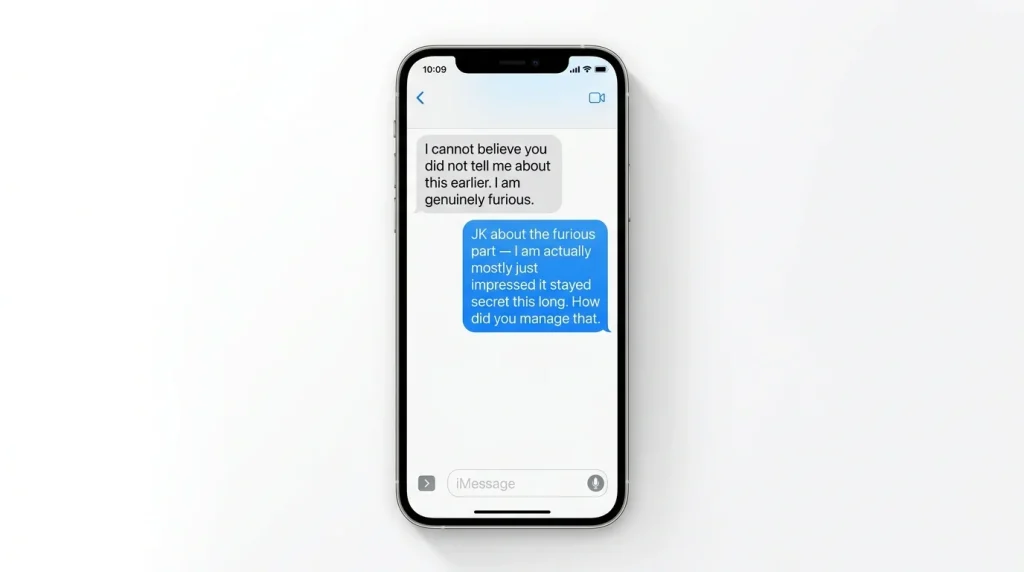
Priya: I cannot believe you did not tell me about this earlier. I am genuinely furious
Dana: JK about the furious part — I am actually mostly just impressed it stayed secret this long. How did you manage that
Example 3 — The comedic exaggeration structure
Tyler: I have decided I am moving to a remote cabin with no WiFi and becoming a person who only reads physical books
Sam: Honestly iconic. When do we visit?
Tyler: Next month. JK I would last three days. Maybe four if I had good snacks
Example 4 — The “kind of JK” that acknowledges partial truth
Keisha: You are the worst at responding to texts
Mia: JK… kind of JK… okay it is more like sixty percent JK. I am working on it
Example 5 — Softeningn something that landed slightly harder than intended
Leo: That was a genuinely terrible idea and I cannot believe anyone thought it would work
Zara: JK about the terrible part — it was ambitious and it almost worked. The almost is doing a lot of work in that sentence but still
Example 6 — Used immediately after a bold statement
Group chat: [someone makes a dramatic declaration]
Immediate follow-up: JK. But also kind of not JK. You will understand when I explain the full situation
How to Use JK Correctly
JK works most naturally immediately after the statement it is retracting or clarifying — either as a standalone follow-up message or attached to the end of the original message. The key is immediacy — JK lands best when it arrives before the other person has had time to react to the original statement in the wrong way.
JK as an immediate follow-up (most natural): “I can’t stand you.” [next message] “JK, you know you’re my favorite.”
JK at the end of the original message: “This is the worst day of my entire life. JK, it is actually fine, just annoying.”
JK with a softened follow-up: “JK — I mean it was a bad idea but not catastrophically bad.”
JK with partial acknowledgment of truth: “JK. Mostly JK. Slightly not JK but we can discuss that part later.”
JK as a pure comedic structure: Bold statement. Pause. JK. — The format itself becomes the joke.
The most important thing about JK is timing and deployment precision. JK that arrives after a significant delay starts to feel like backtracking rather than playfulness. JK used too frequently in serious conversations starts to make everything feel like it might be retracted — which creates its own kind of communication problem. JK works best when the joke was obvious enough that JK is simply confirming what was already legible, or when the statement genuinely needed the clarification to land as intended.
What Is the Difference Between JK and Sarcasm?
JK and sarcasm overlap considerably but they are not the same thing and the distinction matters in practice.
Sarcasm is a rhetorical device where the literal meaning of a statement is the opposite of the intended meaning — “Oh great, another Monday” means the opposite of great. Sarcasm does not always flag itself and relies on the listener detecting the inversion through tone or context.
JK explicitly flags that a statement was not meant as stated — it does the work of making the non-literal intent clear rather than relying on the other person to detect it. JK is the transparency tool. Sarcasm is the device. You can use JK to flag sarcasm — “Oh great, another Monday. JK, obviously” — but JK can also flag exaggeration, teasing, and humor that is not strictly sarcastic. In text communication where sarcasm cannot be detected by tone of voice, JK is often the appropriate companion to any ironic statement that could be misread.
JK vs Similar Abbreviations — What Is the Difference?
| Abbreviation | Meaning | Key Difference |
| JK | Just Kidding | Retracts or flags a previous statement as humorous rather than literal |
| NGL | Not Gonna Lie | Introduces unusual honesty — the opposite of retracting |
| TBH | To Be Honest | Flags a candid statement — also opposite to JK’s retraction |
| LMAO | Laughing My Ass Off | Reacts to something funny rather than flagging that something was meant as funny |
| FR | For Real | Confirms something is serious and literal — the direct opposite function of JK |
| ISTG | I Swear To God | Emphasizes that something is completely serious — maximum opposite of JK |
| SMH | Shaking My Head | A disapproval reaction — not a tone clarifier |
JK is unique in this list because it is the only abbreviation specifically designed to retract or clarify the tone of a previous statement — to signal that something was not meant literally, seriously, or as stated. Every other option either confirms seriousness, reacts to humor, or expresses an emotion. JK is the one that does the specific work of comedic or tonal clarification after the fact.
Is JK Always Innocent or Can It Be Used to Avoid Accountability?
This is the most genuinely complex question about JK and the honest answer is that both uses exist and the difference matters significantly.
When JK is genuinely innocent: Used to flag a clear and obvious joke that needed tonal confirmation to land correctly in text. The humor was the intent all along and JK simply makes that intent explicit. This is JK at its most valuable and most honest.
When JK is warmly teasing: Used after a playful exaggeration between close friends where the teasing is affectionate and the JK completes the comedic arc rather than retracting a genuine criticism. This is JK as part of the natural vocabulary of close friendship.
When JK is used to say something and take it back: The more problematic use where someone makes a pointed, critical, or hurtful statement and then adds JK as cover — getting the impact of the statement while claiming plausible deniability. This use of JK is recognized and resented by most people on the receiving end. “You have really let yourself go. JK” is not a joke with a retraction — it is an insult with a shield.
When JK softens something partially true: The middle ground where a statement was maybe thirty percent joke and seventy percent genuine and the JK is honest about the joke component without denying the rest. “You are genuinely terrible at this. JK — I mean, you are improving” is not fully retracting anything but is accurately flagging that hyperbole was involved.
Frequently Asked Questions About JK
What does JK mean in a text from a girl?
When a girl sends JK she is either completing a playful tease warmly or signaling that something she said was not meant as seriously as it might have read. In a close friendship JK is simply part of the natural comedic rhythm — she said something funny and exaggerated and is confirming the intent. In a developing relationship JK sometimes follows something that was slightly more revealing than she intended — a way of keeping things light while the actual feeling behind the statement hangs in the air alongside its retraction.
What does JK mean in a text from a guy?
When a guy sends JK he is clarifying that something was meant as a joke rather than a serious statement — and in most contexts that is exactly what it is. In playful banter between friends JK is simply part of the comedic exchange. In romantic contexts a JK after something slightly vulnerable or revealing sometimes functions as protection — he said something genuine and is giving himself an exit if the response requires one.
Is JK the same as LOL?
No — they serve different functions despite both being associated with humor. LOL is a reaction to something funny that already exists in the conversation. JK is a declaration that what you just said was meant as humorous rather than literal. LOL responds to humor. JK creates or clarifies it.
Can JK be used sarcastically itself?
Yes — “JK” said about something that was clearly not a joke is itself a sarcastic use of the abbreviation. “Oh totally, that went great. JK.” uses the JK to flag sarcasm in the preceding statement. This meta-use of JK is common and recognizable in digital communication.
What is the difference between JK and kidding?
Functionally they are identical — JK is simply the abbreviation of “just kidding” and carries exactly the same meaning as writing it out. The difference is entirely in register — JK is faster, more casual, and fits the texting rhythm better. Writing “just kidding” in full can sometimes feel slightly more deliberate or emphatic, as though the retraction is more considered. In casual daily texting JK is the natural choice.
Does JK always mean Just Kidding?
Yes — JK universally means Just Kidding across every platform, age group, and digital communication context in mainstream use. It is one of the most stable and consistently understood abbreviations in the entire history of digital communication with no mainstream alternative meanings.
See Also: IKR Mean in Text