What Does BUSSIN Mean in Text? Full Meaning Explained Simply (2026)
BUSSIN means “really good” or “absolutely delicious.” It is used in texting and social media — most commonly about food — to express that something is so genuinely excellent that ordinary positive descriptors would undersell it. When someone says something is bussin they are not giving it polite approval. They are saying it has reached a level of goodness that stops them in their tracks and demands to be acknowledged.
Quick Definition: BUSSIN at a Glance
| Detail | Info |
| Full Form | Bussin (no abbreviation — standalone slang) |
| Type | Quality Descriptor / Strong Approval Signal |
| Tone | Enthusiastic, Emphatic, Genuine, Sometimes Humorous |
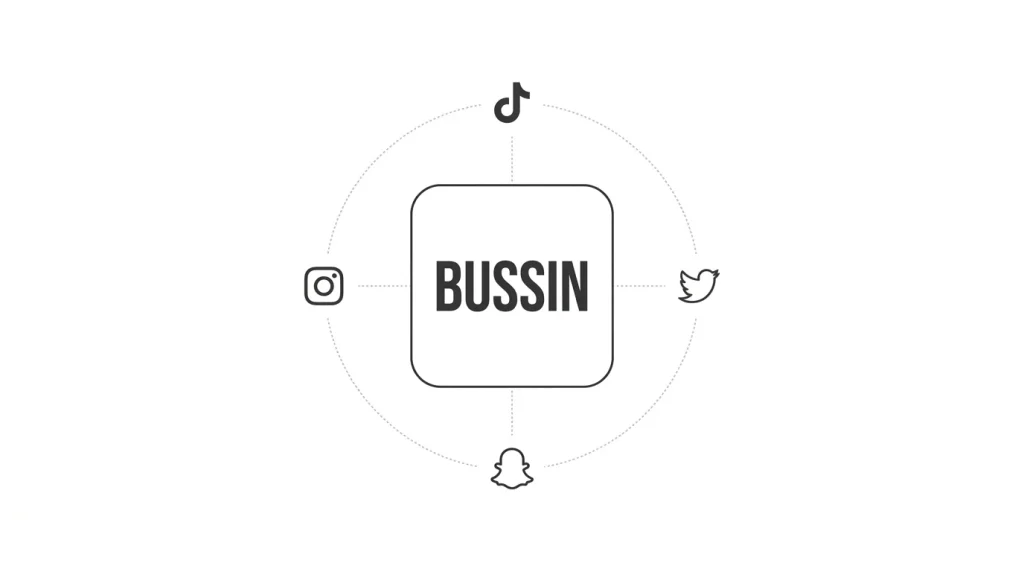
| Used On | Text, TikTok, Twitter/X, Snapchat, Instagram |
| Who Uses It | Gen Z primarily, Millennials, and general texters |
| Safe for Work? | Yes |
What Does BUSSIN Mean in Text?
BUSSIN means really good — and specifically, in its original and most common context, it means food that is so genuinely delicious that a standard positive response would be a disservice to how good it actually is. People use it to describe the specific experience of tasting something that delivers more than you expected, that hits in a way you did not anticipate, or that is simply so good that the reaction it produces is immediate, physical, and impossible to understate.
What makes bussin interesting is how specific and genuine it feels despite being simple vocabulary. There is no ambiguity in bussin — it is not “this is pretty good” or “I am enjoying this” but the full-body enthusiastic recognition of something being excellent. The word carries an energy that more measured praise does not — it is the food equivalent of a standing ovation rather than polite applause.
BUSSIN has deep roots in African American Vernacular English where it has been used as slang for something excellent for decades before it crossed into mainstream internet vocabulary. Like many terms that traveled from AAVE into Gen Z internet culture, its journey into mainstream use happened primarily through social media — particularly TikTok — where food content is enormously popular and where the need to describe genuinely excellent food with genuine enthusiasm created the perfect conditions for bussin to spread from its original community into universal use.
What Does BUSSIN Signal in a Conversation?
BUSSIN almost always describes excellence but the specific context varies:
- Food that genuinely delivers — “This is bussin, where did you get this”
- The highest praise in a food review — “Everything on the menu is bussin, do not sleep on it”
- Extended to non-food excellence — “That playlist is bussin from start to finish”
- Confirming someone else’s recommendation was right — “You were right, it is bussin”
- Reacting in real time to something good — “I am eating this right now and it is bussin fr”
- The self-aware humorous use — “My own cooking is bussin and I will not hear otherwise”
BUSSIN Meaning on Different Platforms
What Does BUSSIN Mean on TikTok?
TikTok is where bussin became ubiquitous. Food content is one of the most-watched categories on the platform and bussin became the essential vocabulary for the specific moment when a food creator takes a bite of something and their reaction cannot be contained. The “is it bussin?” format — where someone tries food and delivers their verdict — became a recognized TikTok content structure. Bussin also exploded specifically when a video went viral of a school principal and a teacher debating whether certain foods were bussin or not, bringing the word to audiences who had never encountered it before and cementing it in mainstream vocabulary overnight.
What Does BUSSIN Mean on Twitter / X?
On Twitter, bussin is used in food discussions, restaurant recommendations, and real-time reactions to eating experiences. “Just had [food] for the first time — it is bussin” is a classic Twitter format that generates genuine engagement from people who share the recommendation or want to debate it. Twitter bussin also extends further from food than on other platforms — appearing in music, film, and culture discussions where something is being praised as genuinely excellent.
What Does BUSSIN Mean on Snapchat?
On Snapchat, bussin appears in the most natural and genuine form — friends sending each other snaps of food with “bussin” as the caption, or reacting to a friend’s recommendation with the same single word. Between close friends who share food experiences regularly, bussin is the efficient and enthusiastic approval that no longer requires explanation. It has become part of the natural vocabulary of food-sharing friendship culture.
What Does BUSSIN Mean on Instagram?
On Instagram, bussin appears in food photo captions, restaurant review content, and food creator commentary. The visual culture of Instagram makes bussin particularly powerful in a caption — you see the beautiful food, you read bussin, and the combination communicates everything necessary about the quality of the experience being shared. In DMs between friends bussin is shared alongside recommendations, screenshots of menus, and all the food-adjacent conversation that close friendships often include.
Real Text Conversation Examples
These examples show the complete range of BUSSIN — from the pure food context to the extended non-food use to the self-aware humorous version.
Example 1 — Pure enthusiastic food reaction
Jordan: I just tried that place you recommended and I need you to know that it is bussin. The thing you told me to order specifically is the best thing I have eaten this month
Alex: I told you. I told you before you went and you did not fully believe me. Now you know. Never doubt me on food
Example 2 — Real-time eating reaction
Priya: I am literally eating this right now and it is bussin fr. How is something this simple this good
Dana: That is what they do. The simple ones are always the ones that get you. What did you order
Example 3 — Extending bussin beyond food
Tyler: That album dropped at midnight and I have been listening since then
Sam: Is it bussin though? Because the singles were promising but I need to know if the full project delivers
Tyler: Every track. Bussin from start to finish. Not one skip
Example 4 — Confirming a recommendation was correct
Keisha: So did you try the place I suggested?
Mia: Bussin. You were completely right and I apologize for doubting your taste. The recommendations from you now have a one hundred percent hit rate
Example 5 — The self-aware humorous version
Leo: I made dinner tonight and I have to say honestly and without any bias — it is bussin
Zara: The confidence of self-reporting bussin. I need pictures and a second opinion before I accept this verdict
Example 6 — Used completely alone as the most complete possible verdict
Group chat: [someone shares a photo of food that looks incredibly good]
Reply: Bussin.
How to Use BUSSIN Correctly
BUSSIN works most naturally as a predicate adjective — “this is bussin” — or as a standalone one-word verdict on something. It does not typically function as a modifier before a noun the way some adjectives do.
BUSSIN as a predicate adjective (most natural): “This is bussin. Period.”
BUSSIN alone as a complete verdict: A photo of food arrives. You reply: “Bussin.”
BUSSIN with emphasis: “This is absolutely bussin, I am not joking.”
BUSSIN with FR for confirmation: “It is bussin fr, I thought it might be overhyped but it is not.”
BUSSIN extended to non-food: “That movie was bussin from the opening scene.”
The most important thing about bussin is that it is a strong positive signal — it is not used for things that are merely acceptable or even just good. Bussin describes genuine excellence, the kind that produces a reaction. Using it for things that are mediocre or just fine dilutes the word’s ability to signal genuine enthusiasm when something actually warrants it.
See Also: DELULU Mean in Text
What Is the Difference Between BUSSIN and SLAPS?
BUSSIN and slaps are both strong positive quality signals but they are associated with different contexts and carry slightly different flavors of approval.
BUSSIN is primarily about food — it is the food excellence term above all others. While it has extended to other contexts, food is its native home and where it carries the most cultural weight and specificity.
SLAPS is primarily about music — something that slaps has a beat, a sound, or a quality that hits hard and demands physical response. Slaps is what you say when a song makes you want to move, turn up the volume, or immediately send it to someone. Both are maximum approval signals but bussin belongs to food first and slaps belongs to music first — though both extend beyond their primary domains in casual use.
BUSSIN vs Similar Terms — What Is the Difference?
| Term | Meaning | Key Difference |
| BUSSIN | Really good — primarily food | Food-native maximum approval — extends to other domains |
| SLAPS | Really good — primarily music | Music-native maximum approval — extends to other domains |
| FIRE | Excellent — broadly applicable | More general than bussin — not food-specific |
| GOATED | All-time great quality | Higher permanence claim than bussin — GOATed is legacy-level |
| HIT DIFFERENT | Affects you more than usual | About personal impact rather than objective quality |
| SLAY | Done excellently | About performance and execution rather than inherent quality |
| W | Win — something good happened | More about outcomes than quality descriptors |
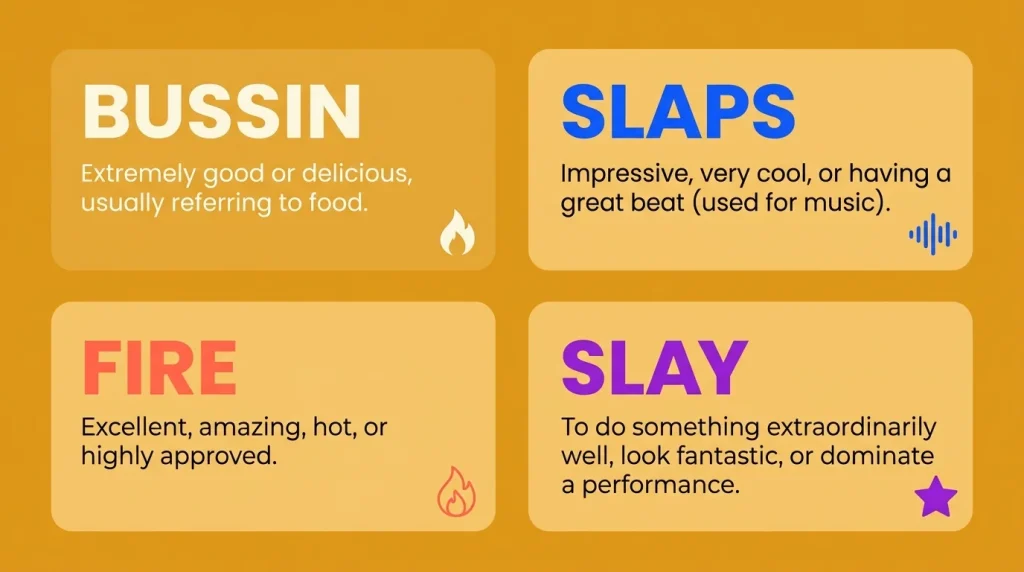
BUSSIN is unique in this list for its specific food-first character — it is the only term that carries genuine cultural weight as a food descriptor while also extending credibly into other quality domains. Every other option is either more general or belongs to a different primary domain.
Is BUSSIN Appropriate in All Contexts?
BUSSIN is extremely casual slang that works perfectly in texting, social media, and informal conversation between people who share a comfort with Gen Z vocabulary. In more formal contexts — professional emails, formal reviews, or communication with people unfamiliar with current slang — bussin would be out of place and might cause confusion.
When bussin is completely natural: Texting friends, social media captions, TikTok food content, casual conversation about food or anything good.
When bussin needs adjustment: Professional communication, formal reviews, talking to people significantly older who might not recognize it, or any context where casual Gen Z slang would feel jarring.
The word has been so widely adopted that it is generally understood by most people who consume any significant amount of internet content — but understanding a word and expecting to encounter it in formal communication are different things.
Frequently Asked Questions About BUSSIN
What does BUSSIN mean in a text from a girl?
When a girl says something is bussin she is giving it genuine maximum approval — she really means it tastes or is excellent. It is one of the more enthusiastic quality signals available and reflects real positive feeling rather than polite compliment.
What does BUSSIN mean in a text from a guy?
When a guy says something is bussin he is expressing the same genuine strong approval — particularly about food. In male friendships bussin often appears in food recommendation exchanges and real-time eating reactions where honest enthusiasm is the whole point.
Is BUSSIN only about food?
Originally and primarily yes — bussin is the food excellence term above all others. But it has extended credibly into music, film, outfits, and anything that genuinely deserves maximum approval. The food context is always the most natural and most resonant use.
What is the opposite of bussin?
There is no single established antonym but “not it,” “mid,” or “trash” serve as the negative counterparts for food that fails to deliver. Mid specifically — meaning mediocre — is the most commonly used contrast to bussin in Gen Z food vocabulary.
Where does BUSSIN come from?
BUSSIN comes from African American Vernacular English where it has been used to describe excellent food for decades before it crossed into mainstream internet vocabulary. Like many AAVE terms, it spread into Gen Z general usage primarily through social media and particularly through TikTok food content.
Does BUSSIN always mean Really Good?
Yes — in texting and social media contexts bussin consistently means really good or excellent, with food being the primary context and other domains as extensions of the same approval. It is one of the most consistently understood quality signals in Gen Z vocabulary.