
What Does HBU Mean in Text? Full Meaning Explained Simply (2026)
HBU stands for “How About You.” It is used in texting and social media to turn a conversation back toward the other person — to invite them to share their own answer, experience, opinion, or situation after the sender has already shared theirs. When someone sends HBU they are not just asking a question. They are practicing one of the most fundamental acts of genuine conversation — showing enough interest in another person to make sure the exchange flows in both directions rather than only one.

Quick Definition: HBU at a Glance
| Detail | Info |
| Full Form | How About You |
| Type | Conversational Reciprocation / Question Redirect |
| Tone | Warm, Curious, Inclusive, Genuinely Interested |
| Used On | Text, Snapchat, TikTok, Twitter/X, Instagram |
| Who Uses It | Gen Z, Millennials, and texters of all ages |
| Safe for Work? | Yes |
What Does HBU Mean in Text?
HBU means How About You and it is one of the most socially generous abbreviations in modern texting. People use it after sharing something about themselves — an answer to a question, an opinion about something, a description of their day, a feeling they are navigating — to signal that they are not just interested in broadcasting their own experience but in genuinely hearing about the other person’s. HBU is the abbreviation of someone who understands that good conversation is a two-way thing.
What makes HBU so meaningful in practice is how it shifts the dynamic of a conversation without requiring any additional words beyond three letters. When someone asks you a question, answers it about themselves, and then adds HBU, they are communicating several things simultaneously — that they were interested enough to answer honestly, that they value your perspective enough to ask for it, and that whatever you say in response has genuine weight with them. HBU is not a formality. It is an invitation.
HBU has been a natural part of digital communication since the earliest days of texting and internet messaging — simply the abbreviation of one of the most natural reciprocating questions in spoken conversation. Asking “how about you?” after sharing something is an instinctive social gesture that crosses cultures, ages, and contexts. When it became an abbreviation in texting culture it retained all of the warmth and social generosity of the full phrase while fitting into the speed and brevity that digital communication demands. Today HBU is used universally — by people who have never thought about what makes a good conversation and by people who think about it constantly — because the impulse to ask is simply human.
What Does HBU Signal in a Conversation?
HBU always turns the conversation toward the other person but the specific context and emotional register of that turn varies considerably:
- Reciprocating after answering a question — “I am doing really well actually, things have felt lighter lately. HBU?”
- Sharing an opinion and inviting theirs — “I thought the first half was much stronger. HBU, what did you think?”
- Describing a situation and checking theirs — “My week has been genuinely chaotic. HBU, how are things going on your end?”
- Expressing a feeling and opening space for theirs — “I have been feeling a weird mix of excited and nervous about it. HBU?”
- Casual daily check-in reciprocation — “Just got home from work, tired but okay. HBU?”
- After sharing plans to ask about theirs — “I am thinking of staying in this weekend. HBU, do you have anything going on?”
HBU Meaning on Different Platforms
What Does HBU Mean on Snapchat?
On Snapchat, HBU is one of the most commonly used reciprocating phrases in the platform’s constant, daily flow of casual conversation. Because Snapchat is where close friends maintain the ongoing texture of each other’s lives through frequent, low-stakes exchanges, HBU appears there in its most natural and warm form. It shows up constantly in response to daily updates — someone shares how their day went, their feeling about something, their plans for the evening — and follows with HBU to close the loop and make sure the other person has space to share theirs. On Snapchat HBU is the conversational breathing room that keeps exchanges genuinely mutual rather than one person narrating to an audience.
What Does HBU Mean on TikTok?
On TikTok, HBU appears most commonly in comment sections where creators or other commenters are sharing their own experience with the topic of a video and using HBU to invite others to do the same. “I always do this when I am stressed — HBU?” or “I genuinely cannot function without coffee in the morning. HBU?” turns a comment from a personal statement into an open question that invites the community to respond. Creators also use HBU in their video captions and in text overlays — sharing something about themselves and then HBU to drive comments and engagement, which TikTok’s algorithm rewards and which turns content into genuine community conversation rather than passive consumption.
What Does HBU Mean on Twitter / X?
On Twitter, HBU appears both in personal direct exchanges where it functions exactly as it does in regular texting and in public tweets where it serves as an engagement tool. A tweet that ends with HBU is inviting followers and the broader Twitter community to share their own perspectives on whatever was just shared — it is the conversational open door that distinguishes a broadcast from a dialogue. “I always work better late at night than early in the morning. HBU?” or “I have been trying to read more this year and it has been genuinely harder than I expected. HBU?” creates immediate engagement because it is specific, personal, and invites a specific kind of response that is easy for anyone to give.
What Does HBU Mean in Instagram DMs and Captions?
On Instagram, HBU appears in DMs as the natural reciprocating move in personal conversation — someone shares something and wants to hear the other person’s equivalent. In captions HBU functions similarly to its Twitter use — a creator shares something personal and uses HBU to invite followers into a genuine exchange rather than a one-way performance. Instagram HBU in captions tends to generate strong comment engagement because it is specific enough to make people feel genuinely invited rather than just prompted by a generic engagement-farming question. “I have been cooking at home way more than usual lately and honestly it has been really good for me. HBU — have you been doing anything differently?” drives real responses.
Real Text Conversation Examples
These examples show the complete range of HBU — from daily casual reciprocation to genuine curiosity about someone’s opinion to emotional check-ins to the light social lubricant use that keeps conversations warm and mutual.
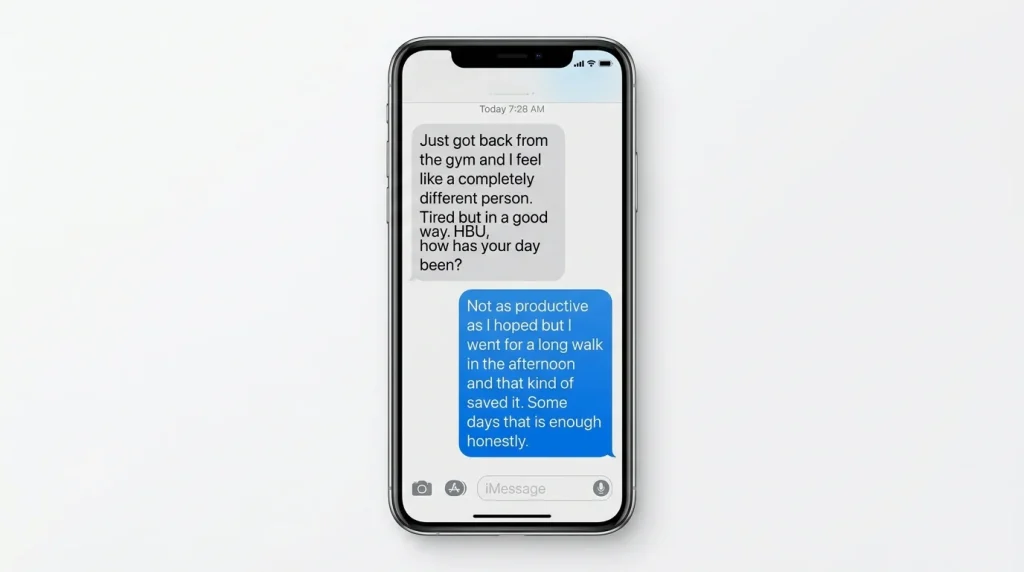
Example 1 — Reciprocating after sharing a daily update
Jordan: Just got back from the gym and I feel like a completely different person. Tired but in a good way. HBU, how has your day been?
Alex: Not as productive as I hoped but I went for a long walk in the afternoon and that kind of saved it. Some days that is enough honestly
Example 2 — Sharing an opinion and genuinely wanting theirs
Priya: I think the second book was actually stronger than the first even though everyone seems to disagree. The characters felt more real to me somehow. HBU, which did you prefer?
Dana: I am actually with you on this one. The first got all the attention because it was the introduction but the second is where the writing actually hit its stride
Example 3 — Emotional check-in that opens space for reciprocation
Tyler: I have been in a weird headspace this week — not bad exactly, just a bit untethered. Hard to explain. HBU, how are you actually doing?
Sam: Honestly similar. I keep waiting for things to feel settled and they just keep shifting slightly. I think it might just be the time of year
Example 4 — After sharing plans to ask about theirs
Keisha: I think I am going to spend the weekend doing basically nothing and I am genuinely excited about it. Sometimes doing nothing is the most productive choice. HBU, do you have anything going on?
Mia: I have one thing on Saturday that I cannot get out of but after that I am free and I intend to fully embrace the nothing alongside you from a distance
Example 5 — Quick casual daily exchange
Leo: Just made coffee and sat down for the first time today. It is almost four in the afternoon. HBU, how is your day going?
Zara: I have been at my desk since seven and I have achieved about forty minutes of actual work. The rest has been existing near my laptop and hoping something happens
Example 6 — Used at the end of a longer message as the final turn
Group chat: [someone shares a long update about something significant in their life and closes with HBU, asking how everyone is doing]
Replies: [Multiple people share their own updates, sparked by the open invitation at the end]
How to Use HBU Correctly
HBU works most naturally at the end of a message — after you have shared something of substance about yourself, your day, your opinion, or your experience — where it functions as a natural pivot that hands the conversational floor to the other person. Placing it last means your own content lands first and HBU then opens the space for their response.
HBU at the end after sharing something (most common and most natural): “I have been obsessed with this new podcast lately, I cannot stop listening. HBU, have you found anything good recently?”
HBU alone after a question has already been asked: Someone asks how you are. You answer genuinely. Then: “HBU?” — Simple, direct, shows you are interested.
HBU mid-message to break up a longer thought: “Work has been intense but honestly I kind of like it when there is a lot going on. HBU, how have things been on your end lately?”
HBU with a more specific question for better conversation: “I have been trying to spend less time on my phone before bed and it has been harder than I expected. HBU, do you have any habits like that you have been working on?”
The most important principle about HBU is that it should be genuine rather than automatic. HBU used reflexively at the end of every message without actually reading or responding to what the other person says in return becomes hollow quickly — it looks like curiosity but does not behave like it. HBU earns its warmth when the person who asks it actually reads the answer and responds to it. The question is only as meaningful as the attention that follows it.
What Is the Difference Between HBU and WYD?
HBU and WYD (What You Doing) are both conversational check-ins that invite the other person to share something about themselves — but they ask for different kinds of information and carry different social energy.
WYD asks about current activity — it wants to know what someone is doing right now and is often used as a conversation opener when the sender does not have prior content to share first. WYD is the question that starts a conversation cold.
HBU is almost always a follow-up rather than an opener — it comes after the sender has already shared something of their own and is using it to reciprocate the conversational exchange. HBU asks for a parallel response to whatever was just shared — if you shared how your day was, HBU invites theirs. If you shared an opinion, HBU invites their opinion on the same thing. HBU is responsive and reciprocal. WYD is initiating and activity-focused. WYD starts conversations. HBU keeps them genuinely mutual once they have started.
See Also: GG Mean in Text
HBU vs Similar Abbreviations — What Is the Difference?
| Abbreviation | Meaning | Key Difference |
| HBU | How About You | Reciprocates by inviting the other person’s parallel response |
| WYD | What You Doing | Asks about current activity — typically a conversation opener |
| WYA | Where You At | Asks for current physical location — coordination focused |
| LMK | Let Me Know | Requests a future update rather than an immediate reciprocal response |
| IKR | I Know Right | Enthusiastic shared agreement rather than an invitation to share |
| NGL | Not Gonna Lie | Introduces personal honesty before a statement — not a question |
| IMO | In My Opinion | Flags a personal perspective without asking for theirs in return |
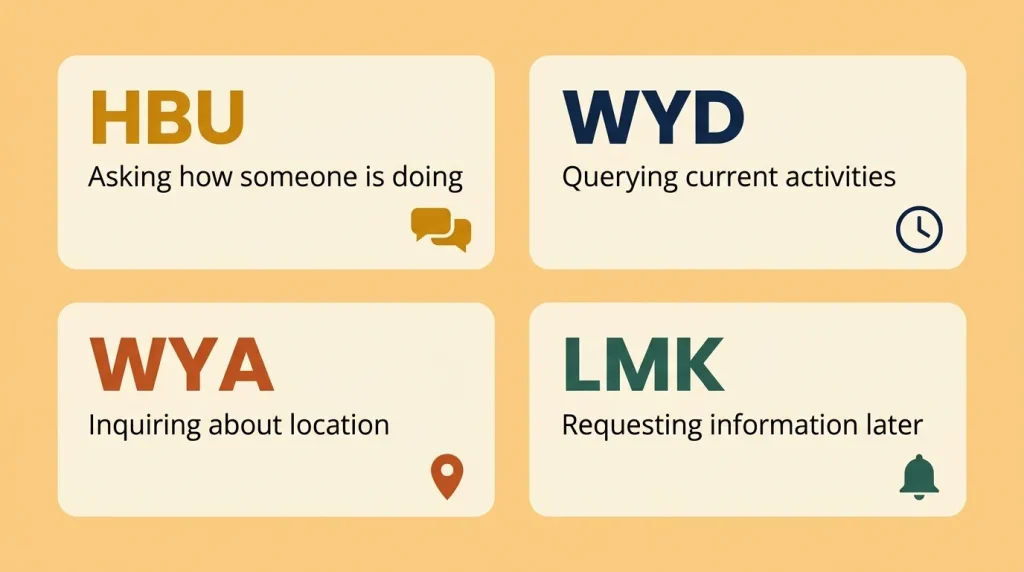
HBU is unique in this list because it is the only abbreviation whose specific function is to reciprocate — to take something the sender has shared and genuinely invite the other person’s equivalent. Every other option is either an opener, a coordination tool, a reaction, or an opinion marker. HBU is the conversational move that keeps exchanges genuinely mutual and is the only abbreviation specifically designed to serve that function.
Is HBU Genuine or Just a Conversational Reflex?
This is one of the most interesting questions about HBU because both versions exist and the difference between them is significant in practice.
When HBU is genuinely curious: The person asks it because they actually want to know the answer — they are interested in the other person’s parallel experience, opinion, or situation and will engage meaningfully with whatever response they receive. This is HBU at its best — a real expression of interest that makes the other person feel seen and valued.
When HBU is a social reflex: The person adds it automatically at the end of messages without strong genuine curiosity behind it — it has become a habitual conversational courtesy rather than a real invitation. The question is asked but the answer receives less attention than a genuine HBU would produce. This version is not dishonest exactly — the social gesture still has value — but it is a weaker and less connecting form of the same abbreviation.
How to tell the difference: The behavior after the HBU is what distinguishes genuine from reflexive. If someone asks HBU and then responds to your answer with real engagement — following up, sharing more, connecting your experience to theirs — the HBU was genuine. If someone asks HBU and then barely acknowledges your answer before pivoting back to themselves, the HBU was reflexive. The question is the same. The quality of listening it precedes is what matters.
Frequently Asked Questions About HBU
What does HBU mean in a text from a girl?
When a girl sends HBU in a text she is genuinely inviting you to share your equivalent of whatever she just shared — her interest is real and the question deserves a real answer rather than a deflective one. HBU from a girl in a close friendship is one of the warmest conversational moves available because it signals that she is not just sharing with you but actively curious about your parallel experience. In a developing romantic context HBU is particularly meaningful because it demonstrates interest in you as a specific person with your own inner life and opinions — not just as an audience for hers. The best response to HBU is always honest, specific, and reciprocal — share something real rather than a vague or deflective answer.
What does HBU mean in a text from a guy?
When a guy sends HBU he is showing genuine interest in your experience or perspective — and for many guys this level of conversational reciprocation requires actual awareness and intention rather than happening automatically. HBU from a guy signals that he is engaged enough in the conversation to want to hear your side of it, which is a meaningful quality in any relationship context. In casual friendships it is simply warm and mutually engaged. In romantic contexts it is one of the clearer signals of genuine interest available in texting because it demonstrates that he is thinking about your experience and not just broadcasting his own.
Is HBU only used after sharing something about yourself?
HBU is most commonly and most naturally used after sharing something about yourself — it is the reciprocating move that completes a genuine exchange. But it does appear in a few other contexts. HBU can open a conversation when preceded by a general statement about the world rather than a personal experience — “The weather has been so strange lately. HBU, is it weird where you are too?” Here HBU opens the exchange rather than reciprocating one. It can also appear as a standalone response to certain questions when the answer is brief — someone asks what you think of something, you give a quick honest answer, and then HBU because you genuinely want their take too. The core function — expressing genuine interest in the other person’s equivalent — is always the same.
Does HBU require a long response?
No — HBU invites whatever response feels honest and proportionate to what was shared before it. If someone shares a long thoughtful reflection on their week and closes with HBU, a matching thoughtful response honors the exchange. If someone says “just got coffee, feeling good. HBU?” a short, honest, similarly light response is completely appropriate. The principle is that the response should match the register and depth of what preceded the HBU — responding with a five-word answer to a deeply personal HBU can feel dismissive, while writing three paragraphs in response to a casual one can feel disproportionate. HBU calibrates the expected response length through what came before it.
What is the difference between HBU and asking “how are you”?
HBU and “how are you” are closely related but meaningfully different questions. “How are you” is a general welfare question — it asks about someone’s overall state of being, their mood, their wellbeing. It is broad and can produce any kind of answer from the most surface-level to deeply personal. HBU is a parallel question — it asks for the other person’s equivalent of something specific that was just shared. If you shared your opinion about a movie, HBU asks for their opinion about the same movie. If you shared how your week has been, HBU asks how their week has been. HBU is more focused and more reciprocal than a general “how are you” — it is responding to the specific shape of the conversation rather than asking an open-ended welfare question.
Does HBU always mean How About You?
Yes — HBU universally means How About You across every platform, age group, and digital communication context currently in use. It is one of the most stable and consistently understood abbreviations in modern texting with no mainstream alternative meanings and no platform-specific variations. Whether you see HBU in a personal text, a social media DM, a comment section, or any other digital communication context, it means How About You every single time without exception.