What Does IMS Mean in Text? Full Meaning Explained Simply (2026)
IMS stands for “I Miss Someone.” It is used in texting and social media to express a general, sometimes unnamed longing for a person — the feeling of missing someone without necessarily directing that admission directly at them or even publicly identifying who is on your mind. When someone sends IMS they are sharing a feeling of absence and longing that is real enough to name but that they have chosen to keep slightly private about who exactly is occupying their thoughts.
See Also: No Cap Meaning In Text
Quick Definition: IMS at a Glance
| Detail | Info |
| Full Form | I Miss Someone |
| Type | Emotional Expression / Unnamed Longing Signal |
| Tone | Wistful, Vulnerable, Sometimes Mysterious, Sometimes Openly Sad |
| Used On | Text, Snapchat, TikTok, Twitter/X, Instagram |
| Who Uses It | Gen Z, Millennials, and general texters |
| Safe for Work? | Yes |
What Does IMS Mean in Text?
IMS means I Miss Someone and it is one of the most emotionally honest and simultaneously most private abbreviations in modern texting. People use it when they are experiencing the specific ache of missing a specific person — but when they are either not ready to say who, not able to say it directly to the person themselves, or simply want to share the feeling without sharing all the context that would come with a more specific disclosure. IMS names the emotion without naming the person.
What makes IMS so interesting compared to its close relative IMY (I Miss You) is the deliberate vagueness of the “someone.” IMY is directed — it is said to the person being missed and carries the full vulnerability of that direct address. IMS is oblique — it shares the feeling with an audience or a friend without requiring the speaker to be fully exposed. IMS is longing made visible without longing made completely transparent.
IMS occupies a particular space in the emotional vocabulary of digital communication — the place where something is too significant to leave unspoken but too tender or complicated to be said in full. It allows the feeling to exist in the shared space of a conversation or a social media post without the complete vulnerability of identifying exactly who it is about or saying it directly to them.
What Does IMS Signal in a Conversation?
IMS always expresses unnamed longing but the specific register and context varies considerably:
- Vague emotional admission to close friends — “IMS tonight and I do not want to talk about who”
- Posting publicly when the feeling is too present to ignore — [Story caption] “IMS”
- Hinting without fully revealing — “IMS in a way that I probably should not be”
- Shared vulnerability between people who understand each other — “IMS and it keeps catching me off guard”
- The feeling after a relationship ends — “IMS even though I know I should not be”
- Missing someone who is gone in a different sense — “IMS who I cannot reach anymore”
IMS Meaning on Different Platforms
What Does IMS Mean on Snapchat?
On Snapchat, IMS appears both in direct close friend conversations and in Stories posted to a limited audience. In direct conversations IMS is almost always about a real specific person and is often the opening to a fuller conversation — the friend who receives “IMS tonight” knows they are being invited to ask follow-up questions and create space for whatever needs to be said. In Stories, a simple “IMS” caption reaches the small circle of people who follow closely enough to notice and who might understand the context without needing it explained. Snapchat IMS is intimate and selective.
What Does IMS Mean on TikTok?
On TikTok, IMS appears in video captions and comment sections in the context of content about longing, nostalgia, lost relationships, and the particular ache of missing someone specific. Creators use it in captions under content that evokes the feeling — a song, a memory, a particular atmosphere — where the audience understands the emotional territory even without knowing who is being missed. In comments IMS appears under videos that perfectly capture the feeling of missing someone, signaling genuine personal resonance rather than general appreciation for the content.
What Does IMS Mean on Twitter / X?
On Twitter, IMS appears in standalone tweets and in responses to content that evokes nostalgia or longing. A simple “IMS” tweet functions as a vulnerability signal — the person is sharing something real without providing the full context. The deliberate vagueness is part of the communication — it says “I am feeling this strongly enough to say something but I am not ready or able to say everything.” Twitter IMS sometimes generates a wave of warm responses from followers who have felt the same thing and who recognize the particular texture of that unnamed longing.
What Does IMS Mean in Instagram DMs and Captions?
On Instagram, IMS appears in Stories as a simple, emotionally resonant caption that signals something is being felt without fully explaining what. In DMs between close friends IMS functions exactly as it does in texting — the opener to a more complete conversation about who and why, shared in the safety of a trusted relationship. Instagram IMS often accompanies aesthetic content — late night photos, certain songs referenced in Stories, particular places — that captures the mood of longing without naming the source.

Real Text Conversation Examples
These examples show the complete range of IMS — from the simple admission that opens a conversation to the bittersweet version that does not need more words to the specific longing that is too complicated to name directly.
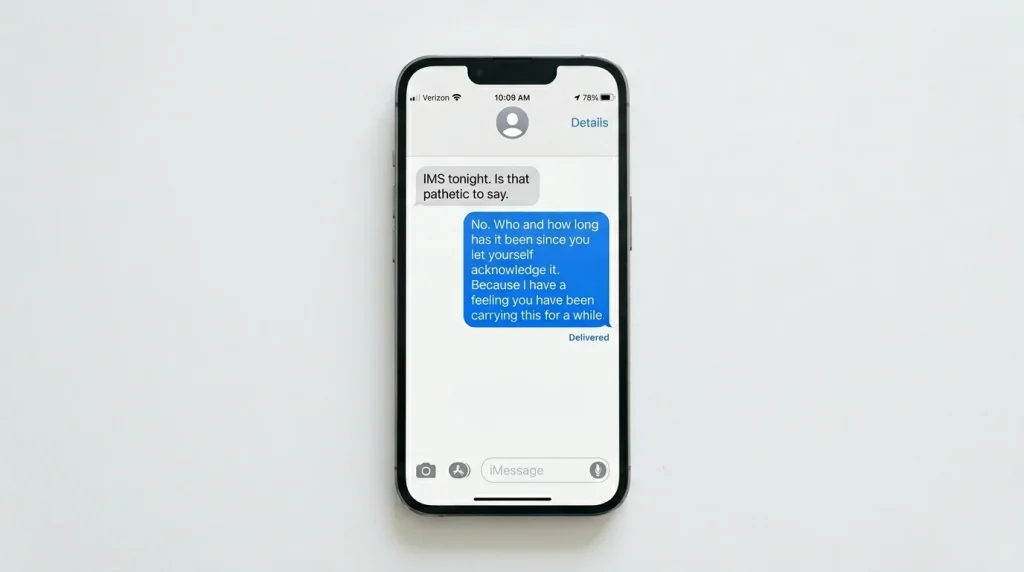
Example 1 — Opening a conversation with a close friend
Jordan: IMS tonight. Is that pathetic to say
Alex: No. Who and how long has it been since you let yourself acknowledge it. Because I have a feeling you have been carrying this for a while
Example 2 — A Story caption that says everything without saying anything
[Snapchat Story posted at 11pm with no other caption]: IMS
[Three close friends reply asking if they are okay]
Example 3 — The version where the feeling should not be there
Priya: IMS and I know I should not be and I am trying to figure out whether to be kind to myself about that or to push through it
Dana: You are allowed to miss someone even when it is complicated. Missing them does not mean you made a wrong decision. It just means they mattered
Example 4 — Missing someone in a way that keeps catching off guard
Tyler: IMS in a way I was not expecting today. Something completely unrelated just reminded me and then I spent the next hour being useless
Sam: Those unexpected reminders are the hardest. There is no way to prepare for them and they hit differently than the times when you are already thinking about them
Example 5 — The version that does not need more explanation
Keisha: IMS
Mia: I know. I have noticed. Do you want to talk or do you just want to not be alone with it for a minute
Keisha: The second one please
Example 6 — Used completely alone as a complete emotional admission
[Late night text to a close friend]: IMS.
[The friend knows exactly who and exactly why and responds with presence rather than questions]
How to Use IMS Correctly
IMS works most naturally either completely alone — where the feeling itself is the complete message — or as the opener to a fuller conversation that the sender is inviting but not yet able to begin. It is almost always better at the start or as a standalone than buried in a longer message.
IMS alone as a complete emotional admission: The feeling is present and you want to name it. You send: “IMS.”
IMS as a conversation opener: “IMS tonight. Can we talk?”
IMS with a brief honest addition: “IMS and I am not sure what to do with that.”
IMS as a public Story caption: Simple, raw, and directed at no one and everyone simultaneously.
IMS with honest complexity: “IMS in a way that I know is not productive but that I cannot quite make stop.”
The most important thing about IMS is the honesty behind it. IMS used genuinely — to name a real feeling of missing a real person — is one of the most vulnerable and most human things someone can share. IMS used as a performance of emotion or as a deliberate hint to a specific person who follows the account is a different kind of communication with different stakes. Both exist — the genuine version is worth sending.
What Is the Difference Between IMS and IMY?
IMS and IMY (I Miss You) are closely related but they describe different modes of the same feeling and make fundamentally different choices about direction and disclosure.
IMY is directed — it is said to the person being missed and carries the full vulnerability and intimacy of that direct address. IMY says “I am missing you and I am telling you that directly.” It requires both the feeling and the courage to share it with the specific person.
IMS is oblique — it shares the feeling without sharing it with the source of the feeling. IMS says “I am missing someone and I am naming the feeling without naming the person.” It allows the emotion to exist in the open without the complete exposure of a direct admission. IMY requires a recipient. IMS can be sent to anyone — a friend, a following, even into the void — because the “someone” stays deliberately unnamed.
IMS vs Similar Abbreviations — What Is the Difference?
| Abbreviation | Meaning | Key Difference |
| IMS | I Miss Someone | Unnamed longing — shares the feeling without identifying the person |
| IMY | I Miss You | Direct longing — said to the specific person being missed |
| IMYSM | I Miss You So Much | Amplified direct longing — maximum intensity version of IMY |
| ILY | I Love You | Deeper emotional declaration — where missing someone sometimes leads |
| GN | Good Night | The close that sometimes carries IMS energy without naming it |
| OOMF | One Of My Followers | Sometimes who IMS is actually about — unnamed but present |
| NGL | Not Gonna Lie | Often precedes the fuller honest admission behind an IMS |
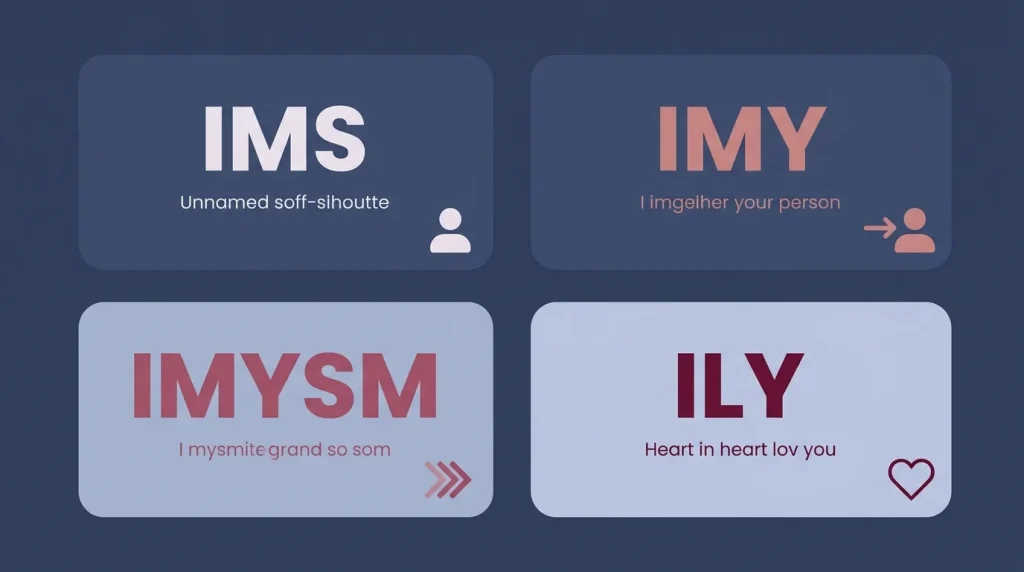
IMS is unique in this list because it is the only abbreviation that expresses longing for a specific unnamed person — keeping the feeling visible while keeping the person private. Every other option either directs the feeling at a named or identified person or serves a different emotional function entirely.
Is IMS Always About Romantic Longing?
IMS leans toward romantic contexts in popular usage but the feeling it describes — missing a specific person — is not exclusively romantic and the abbreviation genuinely applies to every kind of meaningful connection.
When IMS is romantic: Missing someone you have feelings for, someone you were with, someone you cannot be with. This is the most common usage and the context most people assume when they see IMS.
When IMS is about a friendship: Missing a close friend who has moved away, grown distant, or changed in ways that created distance. The longing is just as real and just as worth naming.
When IMS is about loss: Missing someone who is gone in a way that cannot be changed — a person who has died, a relationship that ended, a version of someone that no longer exists. IMS in these contexts carries the particular weight of irreversibility.
When IMS is about estrangement: Missing someone you are no longer in contact with by choice or circumstance — where the missing is complicated by the reason for the absence. This version of IMS often carries the most emotional complexity.
Frequently Asked Questions About IMS
What does IMS mean in a text from a girl?
When a girl sends IMS she is sharing a genuine feeling of missing someone — and the fact that she is being deliberately vague about who tells you she is not quite ready or able to say everything. The most supportive response is to create space for more without demanding it.
What does IMS mean in a text from a guy?
When a guy sends IMS he is being emotionally honest about a feeling of longing — which often requires genuine intention. The vagueness may be protective but the sharing is real and deserves to be received with care rather than immediately interrogated for details.
Why does IMS keep the person unnamed?
Sometimes because the person cannot be named — they are someone the speaker cannot reach, someone the situation makes it complicated to admit missing publicly, or someone who follows the account and would see the post. Sometimes because naming them would require a fuller conversation than IMS alone opens. The vagueness is always meaningful.
Is IMS the same as being sad?
IMS is more specific than general sadness — it is the particular feeling of absence when someone specific is not present. You can miss someone without being sad broadly and you can be sad without missing anyone specifically. IMS names a precise emotional experience rather than a general mood.
Should you tell someone you sent IMS about them?
That depends entirely on the relationship, the situation, and what you actually want from the admission. Sometimes saying it directly — “IMY” — is the right and honest move. Sometimes IMS is as far as it is healthy to go right now. The question is always whether being honest about the feeling serves both people or only provides temporary relief for one.
Does IMS always mean I Miss Someone?
Yes — IMS means I Miss Someone in texting and social media contexts. It is worth noting that IMS can also appear in professional contexts standing for other terms — Internal Mail System and similar — but in any casual texting or social media conversation IMS means I Miss Someone without exception.
See Also: ILYSM Mean in Text