What Does MK Mean in Text? Full Meaning Explained Simply (2026)
MK stands for “Mmm Okay.” It is used in texting and social media to express a response that is somewhere between casual agreement and mild skepticism — an acknowledgment that is slightly more nuanced than a plain okay but slightly less committed than a genuine yes. When someone sends MK they are communicating that they have received what was said, they are technically going along with it, but there is something in the way they are going along with it that suggests they are not entirely convinced, not particularly enthusiastic, or simply processing rather than fully endorsing.
Quick Definition: MK at a Glance
| Detail | Info |
| Full Form | Mmm Okay |
| Type | Soft Agreement / Mild Skepticism Signal |
| Tone | Neutral, Slightly Unconvinced, Casually Skeptical, Sometimes Playful |
| Used On | Text, Snapchat, TikTok, Twitter/X, Instagram |
| Who Uses It | Gen Z, Millennials, and general texters |
| Safe for Work? | Yes |
What Does MK Mean in Text?
MK means Mmm Okay and it is one of the most subtly loaded abbreviations in modern texting. People use it when they want to communicate agreement without full enthusiasm — when they are going along with something but want to leave a small gap between their response and a complete, wholehearted yes. MK is the texting equivalent of someone nodding slowly with one eyebrow slightly raised — present, acknowledging, but not quite sold.
What makes MK so interesting is how much it communicates through what it withholds rather than what it says. A plain “okay” closes a conversational loop cleanly. MK opens a small crack of ambiguity — it says yes while simultaneously hinting that the yes might not be the full story. That gap between technical agreement and genuine enthusiasm is exactly the emotional register MK is built for. It is the reply of someone who is being diplomatic, someone who is genuinely neutral, or someone who has a reservation they have not quite decided to voice yet.
MK grew out of the natural phonetic representation of a common spoken response — the “mmm” that people make when processing something before landing on an answer, combined with the “okay” that follows. In spoken conversation this sound is universally understood as something less than wholehearted agreement — it is the sound of someone thinking things through rather than immediately and enthusiastically responding. When texting compressed that vocal pattern into two letters, MK captured exactly that quality — the processing pause, the mild reservation, the not-quite-committed okay. Today MK is used fluently across every platform and demographic as one of the most efficient ways to communicate that particular subtle register.
What Does MK Signal in a Conversation?
MK always expresses some form of agreement or acknowledgment but the specific emotional undertone varies considerably depending on context:
- Mild skepticism about something claimed — “MK, if you say so”
- Soft agreement with something not entirely convincing — “MK, I guess that makes sense”
- Casual neutral acknowledgment — “MK, noted”
- Processing something without strong reaction — “MK. Let me think about that”
- Playful disbelief between friends — “MK sure, that is definitely what happened”
- Polite but unenthusiastic agreement — “MK, we can do it that way if you want”
MK Meaning on Different Platforms
What Does MK Mean on Snapchat?
On Snapchat, MK is one of the most naturally used nuanced agreement signals between close friends — precisely because Snapchat’s intimate, fast-moving culture makes it possible to communicate subtle tones without them being misread. Between people who know each other well, MK carries its full range of meaning clearly. A friend says something slightly questionable and MK communicates “I am not entirely convinced but I am going along with it” in the most efficient possible way. On Snapchat MK is almost always affectionate and playful rather than genuinely skeptical or cold — it is the reply of someone who knows you well enough to communicate doubt without hostility. The relationship provides the warmth that the abbreviation itself withholds.
What Does MK Mean on TikTok?
On TikTok, MK appears in comment sections as a response to content or other comments that the viewer finds mildly questionable, slightly unbelievable, or not entirely convincing. “MK” as a TikTok comment under a video making a dubious claim is a compact and efficient way of registering skepticism without writing a full critical response. Creators also use MK in their own content — in on-screen text, as a reaction to something happening in a video, or as a tonal choice that positions them as cool and discerning rather than easily impressed. On TikTok MK has a slightly sharp quality — it is the response of someone with standards who has seen enough to know when something does not quite add up.
What Does MK Mean on Twitter / X?
On Twitter, MK appears as a concise, somewhat pointed way of responding to claims, takes, or statements that the person finds mildly questionable but does not want to fully engage with. A reply of “MK” to a tweet is one of the most efficient dismissals available — it acknowledges the tweet’s existence without conceding its validity or investing any further energy in engaging with it. Twitter MK often carries a slight edge that its Snapchat version does not — on a platform built around debate and hot takes, a simple MK in response to a strong claim signals “I am not convinced and I am not going to pretend to be” without opening a full argument.
What Does MK Mean in Instagram DMs and Captions?
On Instagram, MK appears in DMs as casual nuanced agreement between people who know each other well enough to communicate subtle tones without misreading them. In captions and Stories it is occasionally used when a creator wants to signal a particular mood — slightly discerning, mildly skeptical, or simply in a lower-energy register than their usual content. Instagram MK in captions is relatively rare compared to messaging platforms because the abbreviation’s subtle tonality is harder to land with a broad audience that lacks the relationship context that gives MK its meaning. In DMs between close friends it is completely natural and effortlessly read.
Real Text Conversation Examples
These examples show the complete emotional range of MK — from genuine mild skepticism to playful disbelief between friends to neutral casual acknowledgment to the slightly pointed version that says more than it appears to.
Example 1 — Mild skepticism about a claim
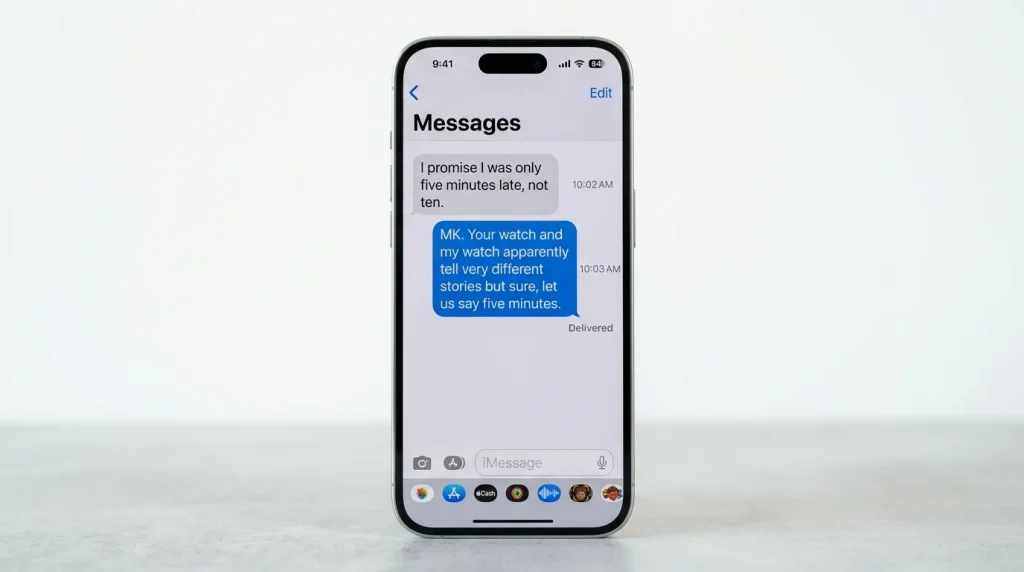
Jordan: I promise I was only five minutes late, not ten
Alex: MK. Your watch and my watch apparently tell very different stories but sure, let us say five minutes
Example 2 — Soft agreement with something not entirely convincing
Priya: I think doing it the complicated way is actually going to save us time in the long run
Dana: MK, I will trust you on that. Though if it does not work out I am going to need a very thorough explanation
Example 3 — Casual neutral acknowledgment without strong feeling either way
Tyler: We changed the venue for Saturday to the place on the other side of town
Sam: MK, I will update my maps. Is parking better there or should I plan to take the train
Example 4 — Playful disbelief between close friends
Keisha: I was not nervous at all, I was completely calm the entire time
Mia: MK bestie. Completely calm. That is why you texted me fourteen times in the hour before it started
Example 5 — Processing something before committing to a fuller response
Leo: I think we should completely restart the project instead of trying to fix what we have
Zara: MK. That is a big call. Let me sit with that for a bit before I respond properly because I have feelings about it
Example 6 — Used completely alone as the most efficient possible soft response
Group chat: [someone makes a claim or suggestion that the group receives with mild collective skepticism]
Reply: MK.
How to Use MK Correctly
MK works most naturally as a standalone reply or at the very start of a message where it sets the tonal register — slight reservation, mild skepticism, or casual neutral processing — before anything else is said. Because its entire value is in the subtlety it communicates, placement matters less than the context it appears in.
MK alone as a complete soft response (most common): Someone says something you are mildly unconvinced by. You reply simply: “MK.”
MK at the start of a message (sets the tone of mild reservation): “MK, I will go along with this but I want it on record that I had doubts from the beginning.”
MK with playful follow-up: “MK sure. Completely believable story. Zero questions from me.”
MK as neutral acknowledgment: “MK, noted. What time are we leaving?”
MK with a slight pause for extra effect: “MK.” — The period amplifies the subtlety — it signals that the matter has been processed and the person is choosing not to make more of it, which itself communicates something.
The most important thing about MK is understanding that its power lies in what it does not say. MK is the reply of someone who has a fuller response available but is choosing not to deploy it — either because the relationship allows for that kind of shorthand skepticism, because they are genuinely neutral and simply acknowledging something, or because they are being diplomatically restrained. Using MK in contexts where the subtlety will not land — with people who do not know you well enough to read between the lines — risks being misread as simple agreement when mild skepticism was intended. MK works best between people who already share enough conversational history to understand the gap between this and a plain okay.
What Is the Difference Between MK and OK?
MK and OK are both agreement signals that can appear in similar situations but they carry meaningfully different emotional registers that make them worth distinguishing.
OK is neutral and complete — it closes a conversational loop with clean acknowledgment and no particular reservation attached. OK can be genuine enthusiasm, genuine neutrality, or genuine reluctant compliance depending on tone — but on its own it does not inherently signal any of those things. It is a blank slate of agreement.
MK is neutral with a hint of something — the “mmm” embedded in it performs the same function as a thoughtful pause or a slow nod in spoken conversation. It signals that the person has considered what was said before landing on an agreement, and that the consideration included something that was not entirely persuasive. MK is agreement that shows its work slightly — it hints at the process of arriving at the response rather than landing cleanly on yes. OK says fine. MK says fine but — and then stops before saying what comes after the but.
MK vs Similar Abbreviations — What Is the Difference?
| Abbreviation | Meaning | Key Difference |
| MK | Mmm Okay | Soft agreement with mild skepticism or reservation embedded |
| OK | Okay | Neutral clean agreement — no particular reservation signaled |
| IGHT | Alright | Casual confident agreement — unbothered and natural |
| OFC | Of Course | Warm emphatic agreement — the answer was never in question |
| IDK | I Don’t Know | Honest uncertainty — not agreement at all |
| NGL | Not Gonna Lie | Introduces personal honesty before a statement |
| TBH | To Be Honest | Flags a candid assessment — sometimes what comes after an MK |
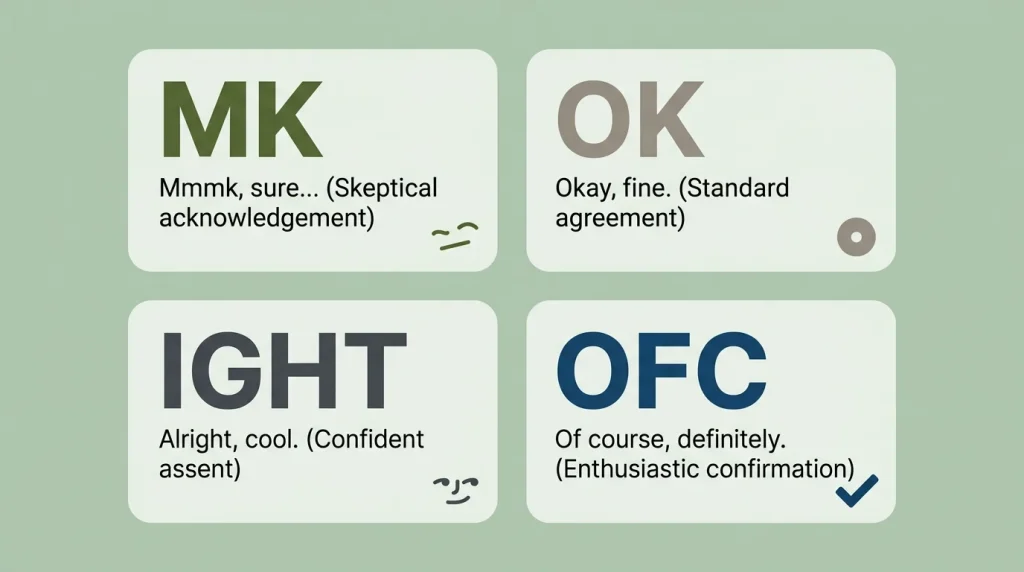
MK is unique in this list because it is the only abbreviation that communicates agreement while simultaneously signaling something less than full conviction. Every other option is either clearly neutral, clearly warm, clearly uncertain, or clearly honest in a different direction. MK is the one that says yes while raising an eyebrow — and that particular combination of technical agreement and embedded reservation is something no other common texting abbreviation quite captures.
Is MK Passive Aggressive?
This is one of the most commonly asked questions about MK and the honest answer is nuanced — it can be, but it most commonly is not, and the difference is entirely about relationship context and intent.
When MK is not passive aggressive: Between close friends who have established enough shared communication shorthand to read MK as playful skepticism rather than meaningful displeasure, MK is completely warm. It is the shorthand for “I am not convinced but I am going along with it and I find this slightly amusing” — which in a close friendship is affectionate rather than pointed.
When MK risks reading as passive aggressive: In relationships where the communication pattern is less established, or in contexts where something genuinely significant has been said and MK is the entire response, the brevity and mild detachment of MK can feel like withholding — like there is more being thought than is being shared and the person does not want to engage fully. In those contexts MK can create a low-level tension even when none was intended.
The key variable: MK reads warmly when the relationship already contains enough warmth to provide context for it. It reads coldly when that warmth is absent or when the situation calls for more genuine engagement than MK provides. The abbreviation itself is neutral — the relationship gives it its final meaning.
See Also: What Does IGHT Mean in Text?
Frequently Asked Questions About MK
What does MK mean in a text from a girl?
When a girl sends MK in a text the emotional meaning depends almost entirely on the relationship and the context. In a close friendship where playful skepticism and shorthand communication are already established, MK is simply her being lightly unconvinced or mildly amused at something — warm and playful rather than pointed. In a newer or more ambiguous relational context, MK as a response to something meaningful might be worth paying attention to — it signals that she has received what was said without fully endorsing it, and there may be something behind that reservation worth gently exploring. The most important thing is to read MK alongside the relationship history rather than in isolation.
What does MK mean in a text from a guy?
When a guy sends MK he is signaling mild skepticism, casual neutral processing, or soft agreement without full enthusiasm — and as with all MK usage, the relationship context tells you which. Between male friends where casual, low-production communication is the norm, MK is simply the efficient shorthand for not-entirely-convinced that suits the communication style. In more personal or emotionally significant contexts a single MK from a guy in response to something important might indicate he is processing something more carefully than the abbreviation suggests, or that he has a reservation he has chosen not to articulate yet.
Is MK dismissive?
MK is not inherently dismissive but it can feel that way in contexts where a more engaged response would have been appropriate. In practical, logistical, or low-stakes conversations MK is a perfectly adequate and natural response. In conversations that carry emotional weight or where something significant has been shared, a bare MK can feel like the message was received but not truly taken seriously — like the other person did not lean in. Adding even a small follow-up after MK prevents this — “MK, are you okay with that though?” or “MK, tell me more about what you are thinking” turns what might feel like a brush-off into genuine engagement with a subtly reserved opener.
What is the difference between MK and the word meh?
MK and “meh” are related in emotional territory but they carry different registers. “Meh” expresses something closer to indifference or mild disappointment — it is a response to something that failed to impress or that feels underwhelming. It is not agreement but a reaction. MK is agreement — it says okay — but agreement with something that has not fully convinced the person. MK goes along with something. Meh registers neutrality or mild disappointment without going along with anything. You say meh when something does not excite you. You say MK when you are agreeing to something you are not entirely persuaded by.
Can MK be used as genuine enthusiastic agreement?
No — and this is the one clear limit of MK as an abbreviation. If you want to communicate genuine, warm, enthusiastic agreement, MK is the wrong choice. Its entire character is built around soft reservation — the “mmm” embedded in it performs too much hedging to read as enthusiastic even with additions like exclamation marks. If you genuinely and wholeheartedly agree with something, “OFC,” “absolutely,” “yes,” or any warmer option will serve better. MK is specifically and only for the space between reluctant compliance and genuine neutrality — it is not a vehicle for enthusiasm and should not be used as one.
Does MK always mean Mmm Okay?
Yes — in texting and casual social media contexts MK consistently means Mmm Okay. It is one of the more stable casual abbreviations in modern digital communication with this meaning being immediately and broadly understood. It is worth noting that MK is also a common abbreviation for Mortal Kombat in gaming contexts and for other proper nouns in various professional settings — but in any casual texting, social media DM, or conversational context, MK means Mmm Okay without exception.