What Does NGL Mean In Text? Full Meaning Explained Simply (2026)
NGL stands for “Not Gonna Lie.” It is used in texting and social media to introduce an honest opinion, confession, or feeling that the person might not normally say out loud. When someone starts a message with NGL, they are signaling that what follows is their genuine, unfiltered thought even if it is slightly uncomfortable, surprising, or vulnerable to admit.
Quick Definition: NGL at a Glance
| Detail | Info |
| Full Form | Not Gonna Lie |
| Type | General / Opinion Marker |
| Tone | Honest, Candid, Sometimes Vulnerable |
| Used On | Text, Snapchat, TikTok, Twitter/X, Instagram |
| Who Uses It | Gen Z, Millennials, and general texters |
| Safe for Work? | Mostly Yes |
What Does NGL Mean in Text?
NGL means Not Gonna Lie and it is one of the most versatile abbreviations in modern texting. People use it as a lead-in before saying something they consider to be a genuine, honest take whether that is a confession, an unpopular opinion, a compliment they feel awkward giving, or a feeling they would not normally put into words.
The key function of NGL is that it softens what comes after it. By saying “Not Gonna Lie” first, the person signals that they are being unusually candid. It creates a small moment of vulnerability or authenticity before the actual statement lands.
NGL started gaining popularity on Twitter and Tumblr around 2010 to 2012 and spread rapidly into everyday texting culture. Today it is used by people of all ages but remains most common among Gen Z and younger Millennials who grew up with social media as a primary communication channel.
What Does NGL Signal Before a Sentence?
NGL does not describe an emotion on its own — it is a framing device that colors whatever comes after it. Depending on the sentence it introduces, NGL can signal several different things:
- An honest compliment — “NGL that outfit actually looks really good on you”
- An unpopular opinion — “NGL I think that movie was overrated”
- A confession — “NGL I have been thinking about quitting for weeks”
- A genuine reaction — “NGL that actually made me tear up a little”
- Mild self-awareness — “NGL I completely forgot about our plans”
The tone shifts based entirely on what follows the NGL.
NGL Meaning on Different Platforms
What Does NGL Mean on Snapchat?
On Snapchat, NGL is used heavily in one-on-one chats where people feel comfortable being candid with close friends. It often introduces small confessions, honest reactions to someone’s story, or real opinions on things friends share. Because Snapchat conversations feel more private and temporary, NGL tends to carry a more personal and vulnerable tone there than on public platforms.
What Does NGL Mean on TikTok?
On TikTok, NGL is extremely common in comment sections and video captions. Creators use it before giving an honest take on a trend, a product, or a situation. In comments, viewers drop NGL before admitting something relatable — “NGL I do this exact thing every single day.” It signals authenticity, which is the currency TikTok runs on.
What Does NGL Mean on Twitter / X?
On Twitter, NGL is used to preface hot takes, unpopular opinions, and candid observations. It signals that the person knows their opinion might be controversial but they are saying it anyway. Tweets that start with NGL often perform well because the framing immediately creates curiosity about what the honest confession is going to be.
What Does NGL Mean in Instagram DMs?
In Instagram DMs and comments, NGL is used in a lighter, more casual way — usually to give a genuine compliment or reaction to something posted. “NGL this is your best photo yet” or “NGL I laughed way too hard at this” are typical Instagram uses.

Real Text Conversation Examples
Seeing NGL in real conversations shows just how many different ways it can be used naturally.
Example 1 — Honest compliment
Maya: How did my presentation come across today honestly
Zara: NGL it was one of the best ones in the whole class. You actually knew your stuff
Example 2 — Unpopular opinion
Jake: Everyone keeps saying that new series is amazing
Leo: NGL I tried three episodes and could not get into it at all
Example 3 — Personal confession
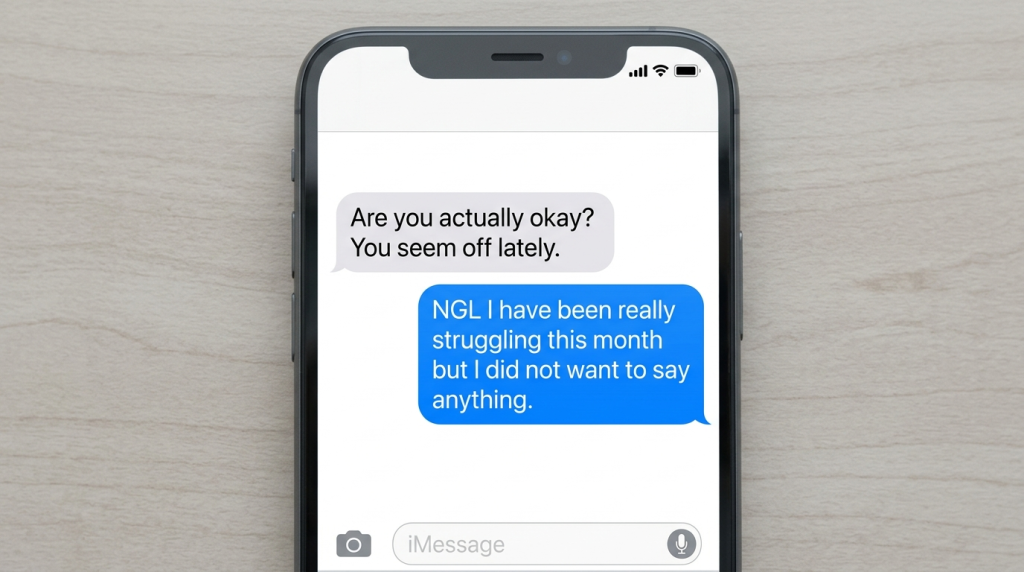
Sam: Are you actually okay? You seem off lately
Riley: NGL I have been really struggling this month but I did not want to say anything
Example 4 — Genuine reaction
Priya: I cannot believe they gave him the award over her
Dana: NGL when they announced the name I literally gasped
Example 5 — Self-aware admission
Tyler: Did you finish the report I sent you last week
Chris: NGL I completely forgot it existed until you just said that
Example 6 — Casual relatable moment
Group chat: Who else has been stress eating all week
Reply: NGL I finished an entire bag of chips watching that finale
How to Use NGL Correctly
NGL almost always goes at the very beginning of a sentence. It is a setup phrase — its entire job is to frame what comes after it as an unusually honest statement. Placing it mid-sentence or at the end is grammatically possible but feels awkward and is much less common.
NGL at the start (most natural): “NGL that was actually really impressive.”
NGL mid-sentence (less common but used): “That movie, NGL, hit way harder than I expected.”
NGL alone (rare, used sarcastically): Someone makes an obvious statement. You reply: “NGL.”
The one thing to watch with NGL is not to overuse it. Because it signals honesty and vulnerability, using it before every single statement in a conversation drains it of meaning. It lands best when used selectively when something genuinely honest is about to be said.
What Is the Difference Between NGL and TBH?
NGL and TBH (To Be Honest) are often used interchangeably, and in most casual conversations they mean essentially the same thing. Both signal that an honest statement is coming. However there is a subtle difference in how they feel.
TBH tends to introduce opinions or assessments about other people or things — “TBH I think you were right in that argument.” NGL tends to introduce personal feelings, confessions, or reactions — “NGL I was kind of hurt by what he said.” NGL feels slightly more vulnerable and self-disclosing. TBH feels slightly more like giving a verdict.
In practice most people do not think about this distinction and use both freely, but if you want to be precise — NGL is for revealing something about yourself, TBH is for giving an honest take about something or someone else.
NGL vs Similar Abbreviations — What Is the Difference?
| Abbreviation | Meaning | Key Difference |
| NGL | Not Gonna Lie | Frames a personal honest confession or genuine opinion |
| TBH | To Be Honest | Gives a candid verdict about someone or something else |
| FR | For Real | Emphasizes that something is true or serious |
| ISTG | I Swear To God | Adds strong emphasis or expresses deep frustration |
| IMO | In My Opinion | Signals a personal viewpoint, more formal than NGL |
| LOWKEY | Secretly / Somewhat | Admits something in a softer, more understated way |
| SMH | Shaking My Head | A reaction of disapproval, not an opinion being shared |
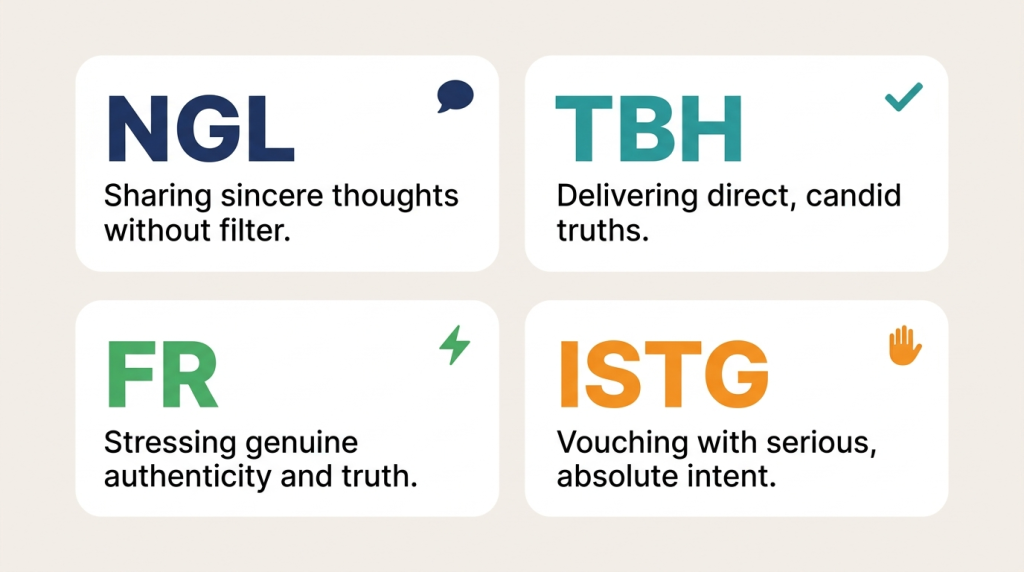
NGL is unique because it is the only one that specifically signals the speaker is about to be more honest than usual — it implies the statement that follows is something they might have kept to themselves otherwise.
Is NGL Positive, Negative, or Neutral?
NGL is completely neutral on its own — the emotion comes entirely from what follows it. The same abbreviation can introduce a glowing compliment, a painful confession, a funny observation, or a cutting criticism. This versatility is why it is so widely used.
When NGL introduces something positive: “NGL you are one of the most talented people I know.”
When NGL introduces something negative: “NGL that was a really bad idea and I knew it from the start.”
When NGL introduces something neutral or funny: “NGL I have watched that video like forty times and it still gets me.”
See Also: SMH Mean in Text
Frequently Asked Questions About NGL
What does NGL mean in a text from a girl?
When a girl sends NGL in a text it means she is about to say something honest that she might not normally put into words so directly. It could be a genuine compliment, a confession about her feelings, an honest reaction to something you said, or an unpopular opinion she wants to share. The key is to pay close attention to what comes after NGL — that is where the real message is. The NGL itself just signals that what follows is her actual unfiltered thought.
What does NGL mean in a text from a guy?
When a guy sends NGL it carries the same meaning — he is flagging that an honest statement is coming. Guys often use NGL before admitting something they find slightly awkward to say directly, like a genuine compliment or an honest reaction to a situation. It lowers the emotional guard just enough to make the honest statement feel natural rather than overly serious.
Is NGL rude?
NGL is not inherently rude but it can introduce a rude or blunt statement. The phrase itself is neutral — it is just a honesty marker. However because it signals that something unusually candid is coming, it can sometimes prepare the reader for criticism. “NGL that was a terrible idea” is honest but could land as harsh depending on context and relationship. NGL in itself is not the problem — what follows it determines whether it comes across as rude.
Can you use NGL in formal or professional settings?
No. NGL is casual slang and has no place in professional emails, formal reports, workplace communications with managers or clients, or any setting where a professional tone is expected. In those contexts, simply write “To be honest” or “I want to be candid” in full. Save NGL for texts, DMs, and social media.
Does NGL always mean Not Gonna Lie?
Yes. Unlike some abbreviations that have multiple meanings across different communities, NGL is almost universally understood to mean Not Gonna Lie in every texting and social media context. There are no common alternative meanings circulating online. If you see NGL in a text or comment, it means Not Gonna Lie without exception.
Is NGL the same as saying “honestly”?
Functionally yes — NGL serves the same purpose as saying “honestly” or “to be real with you” at the start of a sentence. It signals that a genuine, unfiltered thought is coming. The difference is that NGL is faster to type and carries a slightly more casual, self-aware energy that “honestly” does not quite capture in written form.