
What Does OFC Mean in Text? Full Meaning Explained Simply (2026)
OFC stands for “Of Course.” It is used in texting and social media to express obvious agreement, confident confirmation, or emphatic assurance — a way of saying yes to something in a manner that communicates not just agreement but the feeling that the answer was never really in question. When someone sends OFC they are not just saying yes. They are saying yes with the full weight of certainty behind it, often with a warmth that signals the other person should not have needed to ask in the first place.

Quick Definition: OFC at a Glance
| Detail | Info |
| Full Form | Of Course |
| Type | Agreement Marker / Confident Confirmation |
| Tone | Warm, Certain, Reassuring, Sometimes Slightly Exasperated |
| Used On | Text, Snapchat, TikTok, Twitter/X, Instagram |
| Who Uses It | Gen Z, Millennials, and texters of all ages |
| Safe for Work? | Yes |
What Does OFC Mean in Text?
OFC means Of Course and it is one of the most reassuring and affirming abbreviations in modern texting. People use it when a question has such an obvious answer that the full word “yes” feels insufficient — when the answer is not just affirmative but so clearly and naturally affirmative that it carries a warmth of its own. OFC is the reply that tells someone their question was not just answered but answered in a way that makes them feel the asking was never necessary because the answer was always going to be this.
What separates OFC from a plain yes is the relational message embedded in it. When someone asks a question that they are slightly nervous or vulnerable about — “are you still coming tonight?” or “do you still have my back on this?” or “am I being ridiculous?” — a plain yes answers the question. OFC answers the question and simultaneously communicates that they did not need to wonder, that the concern was unnecessary, that whatever they were worried about was never actually in doubt. OFC is agreement with warmth built in.
OFC has been a natural part of digital communication since the early days of internet messaging — simply the abbreviation of a phrase that was already completely common in everyday spoken English. Unlike many abbreviations that emerged from specific online communities or generational slang cultures, OFC maps directly onto a phrase that people of every age group and background already used in speech. That naturalness is why OFC requires no cultural context to understand and has remained consistently in use across every generation of digital communication without ever becoming dated or needing reinvention.
What Does OFC Signal in a Conversation?
OFC always expresses agreement or confirmation but the specific emotional register behind it shifts considerably depending on the context:
- Warm reassurance to someone who was nervous to ask — “OFC I will be there, you do not even need to question that”
- Confident self-affirmation — “OFC I can do that, it is not a problem at all”
- Casual obvious agreement — “OFC that is the better option, it is not even close”
- Gentle exasperation at someone who should already know the answer — “OFC I still care about you, why would you even ask that”
- Enthusiastic confirmation of something exciting — “OFC I want to go, I have been talking about this for weeks”
- Agreeing with something that is just obviously true — “OFC she was right, she is usually right”
OFC Meaning on Different Platforms
What Does OFC Mean on Snapchat?
On Snapchat, OFC is one of the most naturally and warmly deployed abbreviations in close friend conversations. Because Snapchat is where people communicate with the people they are closest to in the most unguarded and immediate way, OFC appears there in its most genuinely reassuring form. Someone asks a question that carries a small vulnerability — about plans, about feelings, about whether they are being too much — and OFC is the reply that removes that anxiety in the most efficient and warmest way possible. On Snapchat OFC is almost always sincere and almost always followed by something that continues the warmth rather than ending the conversation.
What Does OFC Mean on TikTok?
On TikTok, OFC appears in comment sections and captions with a range of registers — from genuinely warm and affirming to slightly sarcastic depending entirely on what it is responding to. When someone in a comment section asks an obvious question about a video’s content, OFC from another viewer carries mild exasperation — “OFC that is what happened, it was right there.” When creators use OFC in captions or responses they are often being warm and direct with their audience — “OFC you can request more of this content, that is literally why I am here.” On TikTok OFC functions as both genuine warmth and a register of obviousness that can shade slightly into gentle impatience with unnecessary questions.
What Does OFC Mean on Twitter / X?
On Twitter, OFC is used as both a confident personal confirmation and a slightly pointed way of agreeing with something that should already be obvious. “OFC she was going to do that” or “OFC this is what happened” in a Twitter context often carries a knowing, unsurprised quality — the person is confirming something that they and presumably the audience already knew or should have known. Twitter OFC can feel mildly smug when used this way — it signals that the speaker saw something coming that others apparently did not. In direct personal exchanges OFC is simply warm and confident agreement.
What Does OFC Mean in Instagram DMs and Captions?
On Instagram, OFC appears in DMs as direct warm confirmation — someone asks something and the reply is immediate, certain, and reassuring. In captions OFC sometimes appears when creators are making a confident statement about themselves, their content, or their position on something — “OFC I tried the viral recipe” or “OFC this is the look I went with.” Instagram OFC in captions often carries a slightly playful self-confidence — the “of course” frames the decision being described as the obvious and natural one, which positions the creator as someone who makes bold, clear choices without much internal debate.
Real Text Conversation Examples
These examples show the complete range of OFC — from warm reassurance to obvious agreement to gentle exasperation to enthusiastic confirmation.
Example 1 — Reassuring someone who was nervous to ask
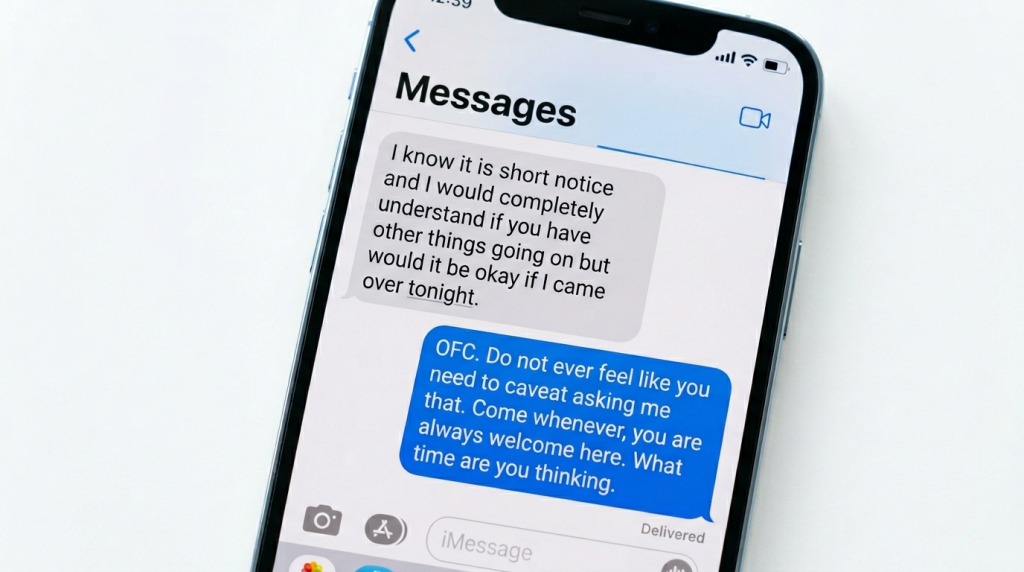
Jordan: I know it is short notice and I would completely understand if you have other things going on but would it be okay if I came over tonight
Alex: OFC. Do not ever feel like you need to caveat asking me that. Come whenever, you are always welcome here. What time are you thinking
Example 2 — Responding to a question with an obviously yes answer
Priya: Is it weird that I am already thinking about what I want to eat when we get there even though we have not even left yet
Dana: OFC not, that is just called being a person who enjoys food. I have been planning my order since yesterday. We are the same
Example 3 — Confident agreement with something obviously true
Tyler: Was she right though, looking back on it
Sam: OFC she was. She was right at the time and she has been right every time since. I think we both knew it then and just were not ready to admit it
Example 4 — Gentle exasperation at an unnecessary question
Keisha: Are you sure you are not annoyed at me for that, you can tell me honestly
Mia: OFC I am not annoyed. We have been friends for ten years. Something like that is not going to change how I feel about you. Please stop worrying about it
Example 5 — Enthusiastic confirmation of something the person clearly wanted
Leo: I know it is a lot to ask but would you maybe want to come with me to the thing next weekend
Zara: OFC I want to come. I have been hoping you would ask. Tell me everything I need to know and what time we are leaving
Example 6 — Used completely alone as the most complete possible confirmation
Group chat: [someone asks if the group is still doing the thing they have all been planning for weeks]
Reply: OFC.
How to Use OFC Correctly
OFC works most naturally as a standalone reply or at the very beginning of a message where it sets the tone of confident, warm agreement before anything else is said. Because its entire function is to communicate that something is obvious and certain, placing it first allows the certainty to land before the details follow.
OFC alone as a complete answer (most common and most reassuring): Someone asks something they were nervous about. You reply simply: “OFC.”
OFC at the start of a message (sets warm certainty before detail): “OFC you can stay, don’t even think twice about asking.”
OFC with emphasis for extra warmth: “OFC!!” — The double exclamation marks amplify the warmth and enthusiasm of the confirmation.
OFC followed by gentle reassurance: “OFC. And I need you to know you never have to wonder about that.”
OFC mid-sentence (adds conversational certainty to a specific point): “I will, OFC, be completely honest with you about how I feel when the time is right.”
The most important thing about OFC is that its warmth is what makes it valuable — it should always reflect genuine certainty and genuine willingness rather than a begrudging or obligatory yes dressed in warm language. OFC used without sincerity behind it is worse than a plain yes because it promises a quality of agreement it does not actually deliver. When OFC is genuinely meant it is one of the most reassuring things someone can receive in a text. When it is performative it creates a disconnect that careful readers will notice.
What Is the Difference Between OFC and IKR?
OFC and IKR (I Know Right) are both strong agreement signals but they agree with completely different things in completely different directions.
OFC is a confirmation directed at the person asking — it responds to their question or statement by affirming that the answer is yes and that the yes was never in doubt. OFC moves from the speaker toward the questioner. It is answering someone’s specific concern or question.
IKR is a validation directed at the person’s statement — it responds to something someone said by enthusiastically confirming that you share the same view or experience. IKR moves from the speaker toward a shared recognition. It is not answering a question but joining someone in a perspective they have already expressed.
You say OFC when someone asks you something and you want to confirm with warmth and certainty. You say IKR when someone says something and you want to enthusiastically agree that your experience or view matches theirs. OFC is an answer. IKR is a meeting in understanding.
OFC vs Similar Abbreviations — What Is the Difference?
| Abbreviation | Meaning | Key Difference |
| OFC | Of Course | Warm confident confirmation — agreement that the answer was never in question |
| IKR | I Know Right | Enthusiastic shared recognition — joining someone in a view they expressed |
| FR | For Real | Confirms sincerity rather than expressing confident agreement |
| NGL | Not Gonna Lie | Introduces unusual personal honesty, not a confirmation signal |
| TBH | To Be Honest | Flags a candid assessment rather than confirming something |
| ISTG | I Swear To God | Intense personal declaration of truth, more emphatic than OFC |
| IDK | I Don’t Know | The direct opposite of OFC — uncertainty rather than certainty |
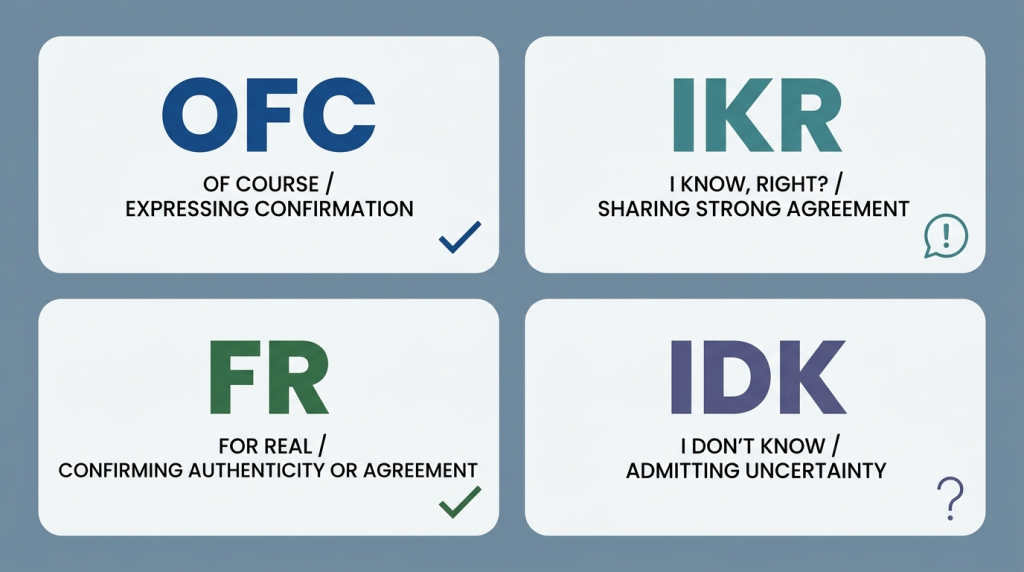
OFC is unique in this list because it is the only abbreviation that specifically communicates that the agreement or confirmation being given was always inevitable — that there was never a real question about whether the answer would be yes. Every other option either introduces an opinion, confirms sincerity, shares recognition, or admits uncertainty. OFC is the one that says the answer was obvious all along and the person asking never needed to wonder.
Is OFC Always Positive?
OFC leans overwhelmingly positive and warm in its emotional register — it is one of the most naturally reassuring abbreviations in texting. But it has emotional nuances that extend beyond simple warmth.
When OFC is genuinely warm and reassuring: “OFC I care about you, please do not ever doubt that.” — Pure positive affirmation delivered with certainty and care.
When OFC carries mild exasperation: “OFC that is what happened, I could see it from the beginning.” — The certainty has an edge of “this should not have been a surprise” that is slightly impatient even while being technically positive.
When OFC validates something obvious: “OFC the first option is better, there was really no competition.” — Agreement with something so clear that the OFC signals the person asking should probably have known the answer already.
When OFC is used sarcastically: “OFC it went wrong, because of course it did.” — Here the “of course” is exasperated rather than warm — things have gone predictably and disappointingly and OFC signals that resigned certainty. This sarcastic use is recognizable from context and is the most negative register OFC can occupy.
When OFC is enthusiastic and joyful: “OFC I am coming!! I would not miss this for anything.” — OFC as pure enthusiasm and delight at the thing being confirmed.
See Also: NSFW Mean in Text?
Frequently Asked Questions About OFC
What does OFC mean in a text from a girl?
When a girl sends OFC in a text she is giving you a confident, warm confirmation — and the emotional weight of it depends on what she is confirming. If she is responding to a question you were nervous about asking, OFC is her way of removing that nervousness completely — she is not just saying yes but communicating that you never needed to worry about the answer. If she is agreeing with something you said, OFC signals that she finds the agreement obvious and natural rather than effortful. OFC from a girl in any context that carries vulnerability is one of the most reassuring responses available — it tells you the thing you hoped was true actually is, and that it was always going to be.
What does OFC mean in a text from a guy?
When a guy sends OFC he is giving you a firm, certain yes — and depending on the context that certainty can mean different things. In practical coordination contexts OFC is simply efficient and clear confirmation. In more personal or emotionally weighted contexts OFC from a guy is significant because it comes without hedging, without qualification, and without the softening that less certain agreement might include. A guy who sends OFC to a question that carried vulnerability is communicating that he does not need to think about it — his answer was always going to be this and the certainty of that is itself a form of care and commitment.
Can OFC come across as dismissive?
Yes — and this is worth understanding because it is a real risk of the abbreviation, particularly in contexts where the person asking needed more than just a quick yes. OFC communicates that the answer was obvious and the question was unnecessary — which most of the time is reassuring but occasionally can land as “why are you even asking, this is obvious” in a way that minimizes the concern that prompted the question in the first place. If someone asked something because they were genuinely uncertain or anxious, a bare OFC without any acknowledgment of the concern that produced the question can feel slightly dismissive even when the intention was warmth. Adding even a few words after OFC — “OFC, and I want you to know you can always ask me things like this” — removes that risk entirely.
Is OFC the same as saying “obviously”?
OFC and “obviously” occupy similar emotional territory but they are not quite the same. “Obviously” tends to carry more edge — it implies that the answer was so clear that the person asking should have known it without needing to ask. Depending on tone it can land as condescending or impatient. OFC carries the same certainty but with notably more warmth — it says the answer is obvious but does so in a way that makes the person who asked feel reassured rather than foolish for asking. OFC is what “obviously” sounds like when it is delivered by someone who cares about the person they are talking to. Both communicate certainty. OFC does it with more grace.
What is the difference between OFC and sure?
OFC and “sure” are both positive responses but they communicate very different qualities of agreement. “Sure” is mild and often somewhat lukewarm — it confirms agreement without particular enthusiasm or certainty. In many contexts “sure” can imply that the person is going along with something rather than genuinely wanting it. OFC is emphatic and certain — it does not leave any room for ambiguity about whether the agreement is genuine and enthusiastic. “Sure I can do that” and “OFC I can do that” are technically both yes but they feel completely different to the person receiving them. Sure is compliance. OFC is genuine, confident, willing agreement. In any context where the quality of the yes matters, OFC is the significantly warmer and more affirming choice.
Does OFC always mean Of Course?
Yes — OFC universally means Of Course across every platform, age group, and digital communication context currently in use. It is one of the most stable and consistently understood abbreviations in modern texting with no mainstream alternative meanings and no platform-specific variations. Unlike some abbreviations that carry different meanings in different communities or contexts, OFC has one meaning, one function, and complete consistency everywhere it appears. Whether you see OFC in a personal text message, a social media DM, a comment section, a TikTok caption, or any other digital communication context, it means Of Course every single time without exception.