What Does OOMF Mean in Text? Full Meaning Explained Simply (2026)
OOMF stands for “One Of My Followers.” It is used in texting and social media to refer to a specific person from your follower list without naming them directly — a way of talking about someone publicly while keeping their identity deliberately vague. When someone posts or says OOMF they are sharing something about a real, specific person in their social media circle while choosing to protect — or tease — their identity by not revealing exactly who they mean.
See Also: BRB Mean in Text
Quick Definition: OOMF at a Glance
| Detail | Info |
| Full Form | One Of My Followers |
| Type | Social Reference / Vague Identifier |
| Tone | Mysterious, Playful, Crushing, Sometimes Petty |
| Used On | Text, Twitter/X, TikTok, Snapchat, Instagram |
| Who Uses It | Gen Z, Millennials, and social media users |
| Safe for Work? | Yes |
What Does OOMF Mean in Text?
OOMF means One Of My Followers and it is one of the most socially loaded and deliberately ambiguous abbreviations in modern digital communication. People use it when they want to talk about a specific person in their online social circle — someone they follow, someone who follows them, or someone they interact with on social media — without actually saying who that person is. The vagueness is not accidental. It is the entire point.
What makes OOMF so fascinating is the tension it creates between disclosure and concealment. The person using it is choosing to share something — a feeling, an observation, a complaint, a crush, a piece of gossip — but is deliberately withholding the one piece of information that would make it fully transparent. That withholding serves many different purposes depending on the situation. Sometimes it protects someone else. Sometimes it protects the speaker. Sometimes it is playful teasing directed at the person being referenced who may well be reading the post. Sometimes it is purely for the entertainment of an audience who enjoys the mystery.
OOMF originated on Twitter in the early 2010s where the public nature of tweets created a need for a way to reference specific people without directly mentioning or tagging them. On a platform where anyone can read your tweets — including the person you are talking about — OOMF provided a perfect middle ground between saying nothing and saying everything.
From Twitter it spread across every major platform and into everyday texting culture where it now appears anywhere people want to reference someone from their social media world without being fully transparent about who they mean.
See Also: TTYL Mean in Text
What Does OOMF Signal in a Conversation?
OOMF always references a specific real person but the nature of what is being said about them and the energy behind the reference varies enormously:
- A secret crush — “OOMF posted a photo today and I had to put my phone down for a minute”
- Vague frustration — “OOMF really needs to think before they post things like that”
- Playful teasing — “OOMF knows exactly what they are doing and I am not okay”
- Admiration posted publicly — “OOMF has been putting out incredible work lately and deserves way more recognition”
- Social observation — “OOMF just went through something I went through last year and I want to reach out but I do not know how”
- Petty subtweet energy — “OOMF really said that with their whole chest and was wrong on every level”
OOMF Meaning on Different Platforms
What Does OOMF Mean on Twitter / X?
Twitter is the birthplace of OOMF and still the platform where it is used most frequently and with the most cultural fluency. On Twitter, OOMF functions as the engine of what the platform calls “subtweeting” — posting about someone without naming them. A tweet about OOMF can be anything from a lovesick admission to a pointed callout dressed in deliberate vagueness. The public nature of Twitter makes OOMF particularly charged there because the person being referenced might be among the thousands of people who see the tweet — and they know. The entire audience knows a specific person is being discussed. Nobody knows who. That dynamic is uniquely Twitter and OOMF was built for it.
What Does OOMF Mean on TikTok?
On TikTok, OOMF appears in video captions, on-screen text, and comment sections where creators want to reference a specific person from their social media world without identifying them directly. It is used in storytelling videos where the creator is narrating something that happened online involving a real person they interact with. Comment sections also use OOMF when viewers want to reference someone specific from their own follower world in a reply without tagging or naming them. On TikTok OOMF often appears in a warmer, more romantic context — used by people talking about someone they are interested in from their online world — compared to the slightly sharper energy it sometimes carries on Twitter.
What Does OOMF Mean on Snapchat?
On Snapchat, OOMF appears in Stories and direct conversations where someone wants to reference a person from their social media world in a way that is recognizable to some friends but not others. A Snapchat Story that says “OOMF just posted something that made me feel a type of way” is shared with your entire friend list — some of whom might know exactly who is being referenced and some of whom will not. In direct messages OOMF is sometimes used when someone is too shy to directly name the person they are talking about — it creates a layer of plausible deniability while still communicating that someone specific is on their mind.
What Does OOMF Mean on Instagram?
On Instagram, OOMF appears in Stories, captions, and DMs as a way of referencing someone from the account’s follower world without direct identification. In captions it is often used for vague but affectionate or admiring posts — “OOMF has been having such a good era lately and it makes me happy.” In Stories it creates exactly the same charged dynamic as on Twitter — specific, public, deliberately concealed. In DMs between close friends OOMF is often used when someone is too nervous to say outright who they are talking about but wants to communicate that someone specific from their online world is occupying their thoughts.
See Also: FYP Mean in Text
Real Text Conversation Examples
These examples show the full emotional range of OOMF — from romantic and admiring to frustrated and petty to warm and supportive.
Example 1 — Classic crush admission
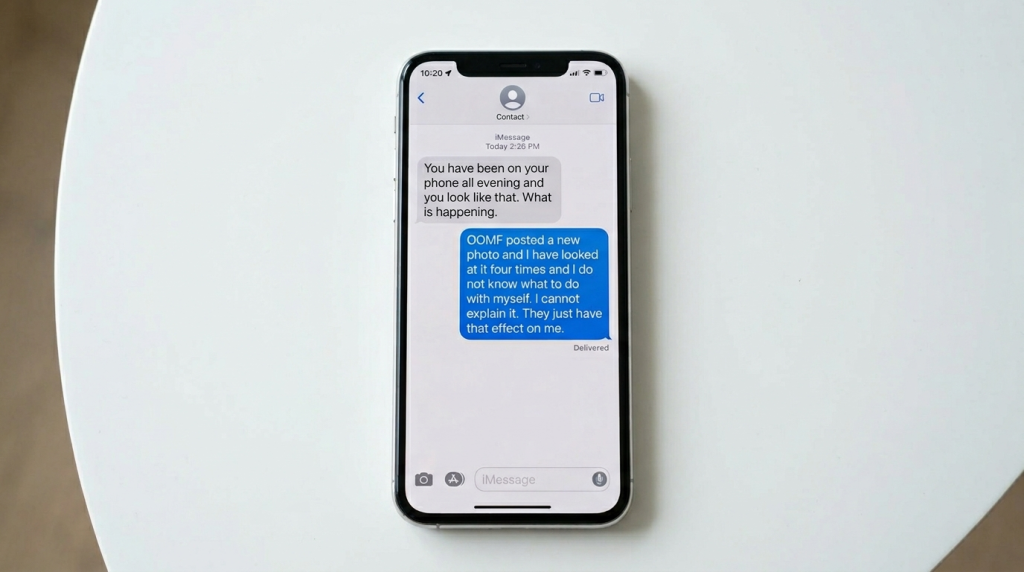
Jordan: You have been on your phone all evening and you look like that. What is happening
Alex: OOMF posted a new photo and I have looked at it four times and I do not know what to do with myself. I cannot explain it. They just have that effect on me
Example 2 — Vague frustration about someone’s behavior online
Priya: Why do you look annoyed, what happened
Dana: OOMF has been posting things for weeks that are clearly aimed at a specific situation and everyone in that group can see it but nobody is saying anything. It is exhausting to watch
Example 3 — Admiration posted publicly that the person might see
[Twitter post]: OOMF has been putting out work that genuinely makes me stop scrolling every single time. They have no idea how talented they are and the right people have not found them yet but they will.
Example 4 — Playful but pointed awareness that the person knows
Keisha: Who are you posting about, multiple people have asked me
Mia: OOMF knows who they are. That is the point. Everyone else can speculate but the one person who needs to understand the message already does
Example 5 — Warm observation about someone going through something
Tyler: I keep seeing someone on my timeline going through something really hard and it hits close to home
Sam: OOMF or someone you actually know personally
Tyler: OOMF but we have talked a few times. I want to reach out but I do not want it to be weird because I am basically a stranger to them
Example 6 — Used as a complete standalone post with no additional context
[Snapchat Story posted at midnight]: OOMF.
[Multiple friends reply]: Who???
How to Use OOMF Correctly
OOMF works most naturally as the subject of a sentence — placed at the beginning where it sets up everything that follows as being about this unnamed specific person. It can also be used as a reply to identify who you are talking about without actually revealing who you are talking about.
OOMF as the subject at the start (most common and most natural): “OOMF posted something today that I have been thinking about for three hours.”
OOMF as a reply that explains without explaining: Someone asks who you are talking about. You reply: “OOMF.”
OOMF in a standalone public post (maximum mystery): No context at all. Just: “OOMF 😭”
OOMF in a longer narrative: “I was scrolling last night and OOMF said something that was so perfectly timed I genuinely wondered if they had been reading my mind.”
The most important thing to understand about OOMF is that the vagueness is always intentional and always meaningful. There is a reason the person chose not to name who they are talking about — and that reason is part of the message. Whether it is protecting someone, teasing someone, keeping the audience guessing, or preserving plausible deniability in a situation where naming someone directly would create consequences, the deliberate concealment of identity is not accidental. It is the whole point of OOMF. Recognizing that intentionality is key to understanding why people use it and what they are communicating when they do.
What Is the Difference Between OOMF and a Subtweet?
OOMF and subtweeting are closely related and often happen at the same time — but they are not exactly the same thing.
A subtweet is any post that is clearly about a specific person without naming or tagging them directly. It is the act of posting about someone in a way that makes it obvious you are referencing them while maintaining plausible deniability. A subtweet can reference a public figure, an ex, a coworker, or anyone in the poster’s world.
OOMF is a specific type of subtweet that signals the person being referenced is a social media follower — someone in your online circle specifically. Not every subtweet uses OOMF but every OOMF is functionally a subtweet. OOMF adds a layer of specificity that a plain subtweet does not have — it tells the audience that the person being discussed exists in the social media world of the poster rather than being, for example, someone from their offline life or a public figure. OOMF narrows the subtweet to the social media sphere and that narrowing is meaningful.
OOMF vs Similar Abbreviations — What Is the Difference?
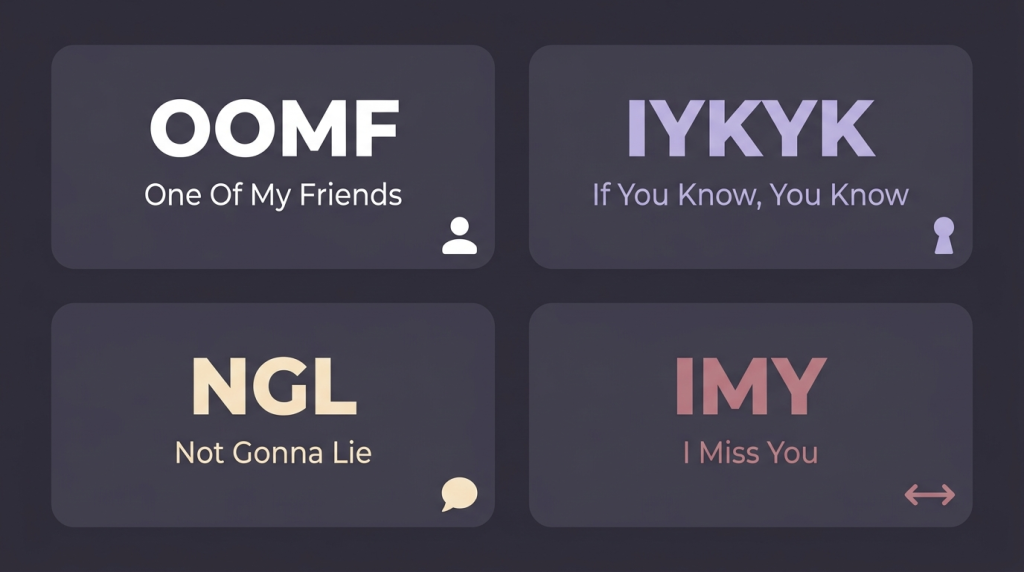
| Abbreviation | Meaning | Key Difference |
| OOMF | One Of My Followers | References a specific unnamed person from your social media circle |
| IYKYK | If You Know You Know | Signals insider knowledge without naming anyone specific |
| NGL | Not Gonna Lie | Introduces personal honest feelings, not a reference to another person |
| HMU | Hit Me Up | An open invitation, not a reference to a specific unnamed person |
| IMY | I Miss You | Direct emotional expression, not vague about who it is addressed to |
| ATP | At This Point | Signals accumulated experience, not a reference to another person |
| FR | For Real | Confirms sincerity, often added after an OOMF post for emphasis |

OOMF is the only abbreviation in this list — and arguably in common texting slang generally — whose entire function is to reference a real specific person while deliberately withholding their identity. Every other abbreviation in the list is either about the speaker themselves, about a feeling, or about shared knowledge. OOMF is uniquely about someone else and uniquely committed to not saying who that someone else is.
Is OOMF Always Romantic?
OOMF is most famous for its romantic usage — particularly the lovesick, soft-launch energy of “OOMF posted something and now I cannot function” — but it covers a much wider emotional range than just crushes and romantic feelings.
When OOMF is clearly romantic: “OOMF smiled in their latest video and I had to close the app and go for a walk.” — Classic, unambiguous crush energy. This is the use most people think of first when they hear OOMF.
When OOMF is admiring but not romantic: “OOMF has been on the most incredible creative run lately and I genuinely want to be in the room when they realize how good they have gotten.” — Deep admiration and appreciation without romantic undertone.
When OOMF is frustrated or petty: “OOMF really thought that take was acceptable and I am genuinely baffled.” — The vagueness protects the poster from direct confrontation while still letting them express their feelings publicly.
When OOMF is warm and supportive: “OOMF went through something really difficult this week and I hope they know that people are rooting for them even if they cannot see it.” — Compassionate and caring, directed at someone who may be struggling.
When OOMF is purely observational: “OOMF has completely reinvented their whole aesthetic in the last three months and the evolution is genuinely impressive.” — A neutral observation about someone’s development with no strong emotional direction.
Frequently Asked Questions About OOMF
What does OOMF mean in a text from a girl?
When a girl uses OOMF in a text or post she is talking about a specific real person from her social media world — and the fact that she used OOMF instead of naming them tells you that she has a deliberate reason for keeping the identity private. If the context around the OOMF reference is warm, soft, or romantic it almost certainly means she has feelings for whoever she is referencing and is not ready or willing to make that fully public. If the context is frustrated or petty it means someone in her online circle did something that bothered her and she wants to express that without creating a direct confrontation. Either way the choice to use OOMF rather than naming someone is a deliberate and meaningful one.
What does OOMF mean in a text from a guy?
When a guy uses OOMF he is referencing someone specific from his online follower world without identifying them. Guys tend to use OOMF slightly less frequently than girls in romantic contexts but it does appear — usually when someone has made an impression on them through their social media presence and they want to acknowledge that feeling without the vulnerability of being direct about who it is. In non-romantic contexts a guy using OOMF is usually either subtweeting someone who frustrated him online or making an observation about someone in his social media circle. The deliberate vagueness always means something — the question is always what kind of something.
How do you know if you are someone’s OOMF?
The honest answer is that you often do not know for certain — which is precisely the point of OOMF. However there are signals that make it more likely. If you notice that a post about OOMF appears shortly after you posted something, if the details in the OOMF post match something about your own situation or content, or if mutual friends start asking you whether you saw a specific post, there is a reasonable chance you are the OOMF being referenced. Sometimes the person posting OOMF genuinely wants the subject to figure it out — the vagueness is performance rather than true concealment. Other times they have no intention of the person ever knowing. Reading the energy of the poster and the details of what they shared is the best available tool.
Is OOMF always about someone the poster follows, or someone who follows them?
Technically OOMF means One Of My Followers — emphasizing people who follow the poster. But in everyday usage OOMF has expanded to mean anyone in the poster’s broader social media circle — people they follow, mutual followers, people they interact with regularly online, or anyone in their digital social world regardless of the exact direction of the follow. Most people do not think carefully about the directional specifics of the follow relationship when they use OOMF — they use it to mean someone from my online world without caring whether they are technically a follower or a following. The broader meaning is the one that has stuck in practice.
Can OOMF be used about someone you know in real life too?
Yes — and increasingly OOMF has expanded beyond its strictly social-media-follower origin to reference anyone someone knows primarily through online interaction, even if that person also exists in their offline world. Someone might use OOMF to reference a classmate or coworker they also follow online when they want to discuss something that person did on social media without naming them. The key distinction is that OOMF always implies the reference is about the person’s online behavior or presence specifically — something they posted, something about how they appear online, or something about their social media persona — rather than something they did offline. The online dimension is always present in OOMF even when the person being referenced is known in person too.
What is the difference between OOMF and just saying “someone I know”?
OOMF is more specific than “someone I know” in a meaningful way. “Someone I know” could be anyone — a family member, a childhood friend, a coworker, a neighbor. OOMF specifically situates the person in the speaker’s social media world. It tells the audience that this is someone they interact with online, someone whose content they see, someone who exists in the digital social ecosystem the poster inhabits.
See Also: TYSM Mean in Text