
Preamp Meaning: What a Preamplifier Does and Why You Need One 2026
If you’ve seen “preamp” on a mixer, an audio interface, a hi-fi component, or a guitar pedal and weren’t quite sure what it actually does, you’re dealing with one of the most fundamental — and most misunderstood — pieces of audio gear. This guide covers what a preamp is, why nearly every audio signal needs one, and how it differs from a regular amplifier.
See Also: WHA Meaning
What Does Preamp Mean?
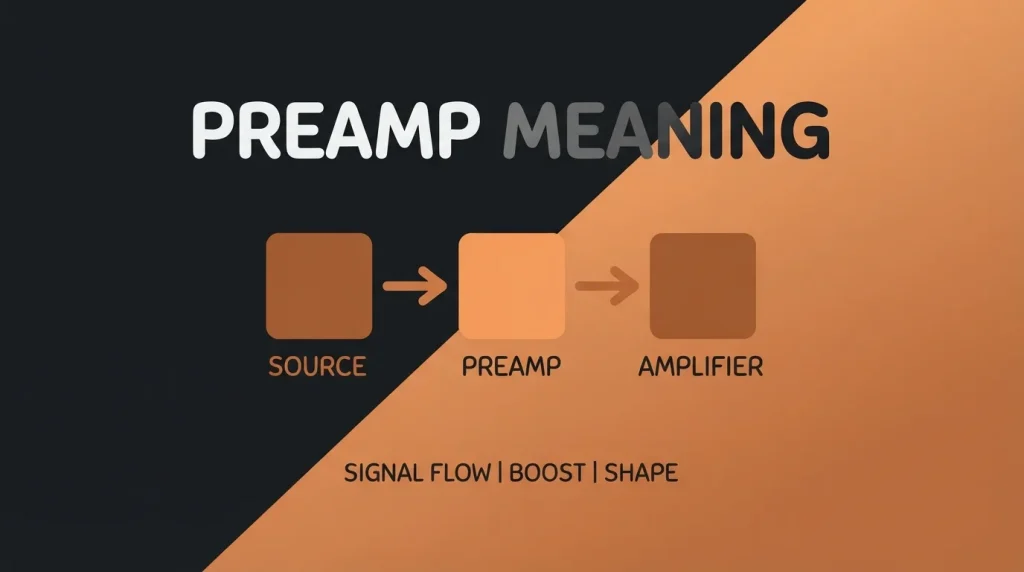
Preamp is short for preamplifier — a device that boosts a weak electrical signal (from a microphone, guitar pickup, turntable needle, or similar source) up to “line level,” the minimum signal strength needed for the rest of an audio system to work with it. As the name suggests, a preamp sits before a power amplifier in the signal chain, preparing the signal so the power amp can do its job properly.
In short: a preamp’s core function is to raise gain — taking a signal too quiet to be useful and boosting it to a level everything downstream can actually process.
Quick Jump
- What Does Preamp Mean?
- How a Preamp Fits Into the Signal Chain
- Preamp vs. Power Amp: What’s the Difference?
- Where Preamps Show Up (Microphones, Guitars, Hi-Fi)
- Tube vs. Solid-State Preamps
- Do You Need a Separate Preamp?
- Common Preamp Terms Explained
- Frequently Asked Questions
How a Preamp Fits Into the Signal Chain
Every step an audio signal passes through on its way to your speakers is called a gain stage — and a preamp is typically the very first one. A basic signal chain looks like this:
Microphone or instrument signal (very weak) → Preamp (boosts to line level) → Power amp (boosts further to drive speakers) → Speakers
Without the preamp stage, a microphone or guitar pickup’s raw output is far too quiet to record or play back meaningfully. Plugging a mic or guitar directly into a laptop or camera, even with the right cable, illustrates the problem immediately — there’s often little to no usable signal without that first boost.
Preamp vs. Power Amp: What’s the Difference?
These two terms get confused constantly, but they handle different jobs:
| Preamp | Power Amp | |
| Job | Boosts a weak signal (mic, pickup, turntable) up to line level | Boosts a line-level signal enough to physically drive speakers |
| Signal handled | Very low-output, often noisy or fragile | Already-usable line-level signal |
| Extra features | Often includes volume, tone controls, EQ, input switching | Primarily focused on raw power output |
| Position in chain | First stage, closest to the source | Second stage, right before the speakers |
Some devices — like an integrated amplifier or an A/V receiver — combine both functions in a single unit. Separates (a standalone preamp and a standalone power amp) are more common in higher-end hi-fi and studio setups, where isolating each stage can improve sound quality and give more flexibility.
Where Preamps Show Up (Microphones, Guitars, Hi-Fi)
Preamps aren’t a single type of device — the term applies across several very different contexts:
- Microphone preamps — Built into mixers, audio interfaces, and standalone units. A mic’s signal is extremely weak on its own, so a mic preamp is essential for any recording setup.
- Guitar and instrument preamps — Boost a pickup’s low-output signal to line level, often built directly into guitar amps, pedals, or bass amps. Some instrument preamps intentionally add coloration or a bit of controlled distortion as part of the tone.
- Turntable/phono preamps — A phonograph needle produces an especially quiet, specially equalized signal (called “phono level”) that needs its own dedicated preamp stage before it can be treated like a normal line-level signal.
- Hi-fi/home theater preamps — Sit between a source (streaming device, CD player, turntable) and a power amplifier, often adding volume control, input switching, and sometimes surround-sound processing.
Tube vs. Solid-State Preamps
Preamps are generally built using one of two underlying technologies, and audio engineers often have strong preferences between them:
- Tube preamps use vacuum tubes to amplify the signal. They’re often prized for adding warmth and pleasant harmonic coloration to a recording, though they run hotter, are more fragile, and are typically more expensive.
- Solid-state (transistor) preamps use transistors instead of tubes. They tend to be smaller, more reliable, generate less heat, and amplify a signal more transparently — meaning with less added coloration.
Neither is objectively “better” — the choice usually comes down to whether an engineer or musician wants a cleaner, more accurate signal (solid-state) or a warmer, more character-rich one (tube).
Do You Need a Separate Preamp?
Most everyday audio gear — audio interfaces, mixers, guitar amps, and modern receivers — already has a preamp built in, so a huge number of people are using one without ever buying a separate unit.
A dedicated, standalone preamp is generally worth considering if:
- You’re recording professionally or semi-professionally and want more control over tone and noise levels than a built-in preamp offers
- You’re building a hi-fi system where separates (dedicated preamp + power amp) can offer better sound quality than an all-in-one unit
- You want a specific tonal “character” — like the coloration of a well-regarded tube preamp — that your built-in gear doesn’t provide
It’s worth noting that a preamp isn’t a fix-all: it amplifies whatever signal it’s given, including any existing noise or flaws. A quality preamp lets you get more out of an already-good source; it won’t rescue a poor one.
Common Preamp Terms Explained
- Gain — How much a preamp boosts the incoming signal’s volume.
- Line level — The standard signal strength most audio equipment expects to receive; the target a preamp is boosting toward.
- Signal-to-noise ratio (SNR) — A measure of how much unwanted noise gets added relative to the actual signal; a key marker of preamp quality.
- Coloration — Any harmonic distortion or tonal character a preamp intentionally or unintentionally adds to a signal (common with tube preamps).
- Phono preamp — A specialized preamp built specifically for the unique, quiet, equalized signal a turntable produces.
Frequently Asked Questions
What does preamp mean in simple terms? A preamp is a device that takes a weak audio signal — like from a microphone or guitar — and boosts it to a usable “line level” signal that the rest of an audio system can work with.
Is a preamp the same as an amplifier? Not exactly — a preamp boosts a weak signal to line level, while a power amplifier takes that line-level signal and boosts it further so it’s strong enough to actually drive speakers.
Do I already have a preamp? Likely yes — most mixers, audio interfaces, guitar amps, and A/V receivers have a preamp built in, even if it isn’t labeled separately.
Why would someone buy a separate preamp? For more control over tone, lower noise, or a specific sonic character (like the warmth of a tube preamp) that a built-in preamp doesn’t offer.
What’s a phono preamp, specifically? A specialized preamp designed for turntables, since a phonograph needle produces a uniquely quiet and equalized signal that a standard line-level preamp isn’t built to handle correctly.
Does a better preamp fix bad audio? No — a preamp amplifies whatever it’s given, flaws included. It can improve on a decent signal but won’t repair a fundamentally poor one.
See Also: hot dog puns