UwU Meaning: What This Emoticon Means and Where It Came From 2026
If you’ve seen “uwu” pop up in a text, a meme caption, or a gaming chat and wondered what exactly it’s supposed to convey, you’re looking at one of the internet’s most recognizable cute-face emoticons. This guide covers what uwu actually represents, where it came from, and how to use it (and its cousin, owo) correctly.
What Does UwU Mean?
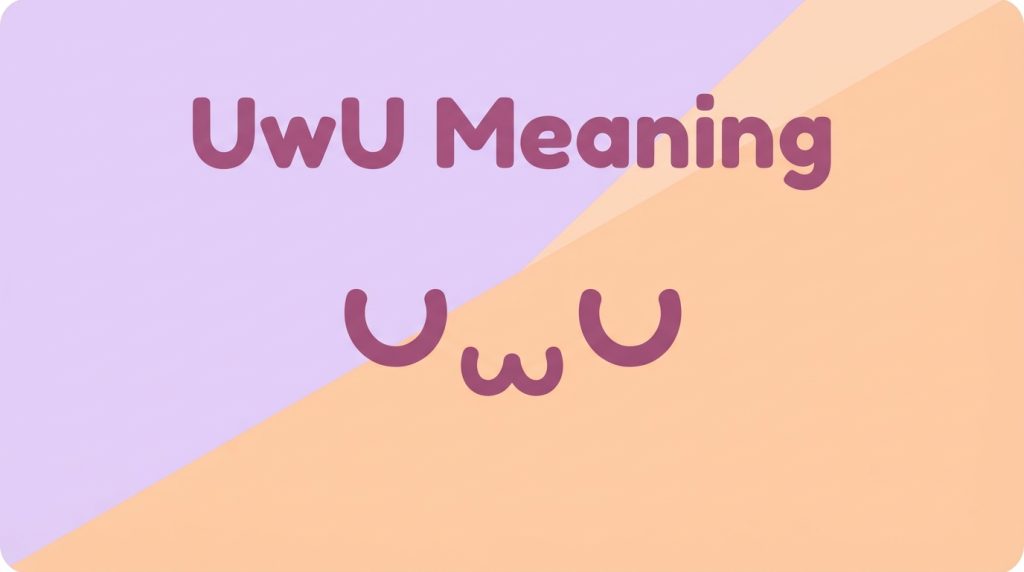
UwU is an emoticon representing a cute, happy, or affectionate facial expression. It’s used to express warmth, happiness, tenderness, or general “aww” energy in digital communication.
Visually, the letters are meant to be read as a face:
- The two U characters represent closed, contented eyes
- The W in the middle represents a small, cat-like mouth
Put together, it resembles a scrunched-up, happy face — similar in spirit to a classic ^_^ emoticon, but with a distinctly cuter, more anime-inspired feel.
Example: “You got me a coffee this morning? uwu, thank you!”
See Also: Estranged Meaning
Quick Jump
- What Does UwU Mean?
- Where UwU Came From
- How UwU Is Used Today
- UwU vs. OwO: What’s the Difference?
- Is UwU Always a Compliment?
- Similar Emoticons
- Frequently Asked Questions
Where UwU Came From
There’s no single confirmed moment when uwu was invented, but its roots trace back to kaomoji — a style of Japanese emoticon (distinct from Western sideways emoticons like :-)) that uses characters to build more detailed, expressive faces, often associated with kawaii (cute) culture, anime, and manga.
One of the earliest documented uses of “uwu” appears in a 2005 anime fanfiction based on Yu-Gi-Oh!, and it also appeared around the same period in furry fandom art communities online. From there, the emoticon spread gradually through anime fandoms, gaming communities, and early internet forums and chat rooms throughout the 2000s and early 2010s.
By around 2014, uwu had jumped from more niche online spaces into platforms like Tumblr, becoming a recognizable piece of broader internet subculture — and its popularity has continued to grow well beyond its original fandom roots since then. Notably, the term has become widespread enough that the Royal Spanish Academy even added it to their word observatory, defining it as an “emoticon used to show happiness or tenderness.”
How UwU Is Used Today
Uwu shows up across a wide range of casual online contexts:
- As a reaction to something cute — a puppy photo, a sweet gesture, an adorable meme
- As an expression of general warmth or happiness — “Finally got the day off, uwu”
- In fandom spaces — especially common in anime, gaming, and furry communities, where it originated
- Playfully or flirtatiously — sometimes used to add a soft, teasing tone to a message
- As a stand-in word entirely — some people use “uwu” as a noun, verb, or modifier rather than strictly an emoticon, as in “don’t uwu at me right now”
It’s overwhelmingly casual and generally has a positive, lighthearted connotation, though excessive or repeated use is sometimes gently mocked online as try-hard or “cringe” — part of the internet’s broader pattern of embracing, then poking fun at, its own trends.
UwU vs. OwO: What’s the Difference?
These two frequently get used together or confused, but they convey slightly different tones:
| Emoticon | Represents | Typical Tone |
| uwu | Closed, content eyes | Warmth, cuteness, affection, contentment |
| owo | Wide, open eyes | Surprise, excitement, curiosity |
A well-known meme phrase, “OwO what’s this?”, became widely used — including, at times, as a way of mocking a stereotype associated with the furry fandom. Some furry communities have since reclaimed the phrase and the emoticon rather than treating it purely as an insult, which is worth knowing as context if you encounter the phrase used in different tones online.
Is UwU Always a Compliment?
Mostly, yes — uwu is overwhelmingly used as a warm, affectionate, or complimentary expression rather than a negative one. That said, a few nuances are worth knowing:
- It can occasionally be used in a smug or condescending way, depending on tone and context.
- Heavy or constant use of uwu (sometimes jokingly called “uwu-fying” text) is sometimes used to poke fun at overly saccharine or performative cuteness, rather than as a sincere expression.
- It’s a casual, informal expression best kept to friendly, low-stakes conversations — it doesn’t fit professional communication, serious topics, or formal writing.
Similar Emoticons
- ^w^ — Represents extreme happiness or “the cutest thing ever,” similar in spirit to uwu but sometimes used for even more intense enthusiasm.
- :3 — A simpler, small cat-like smile, often used similarly to uwu but slightly less intense.
- owo — As covered above, represents surprise or excitement rather than warmth.
- XD — A sideways emoticon representing laughter, distinct in tone from uwu’s softer affection.
Frequently Asked Questions
What does uwu mean in a text? It’s an emoticon representing a cute, happy, or affectionate expression — generally used to convey warmth, tenderness, or an “aww” reaction to something.
Where does uwu come from? It developed from Japanese kaomoji and kawaii (cute) culture, with early documented use in anime fandom and furry art communities in the mid-2000s, later spreading widely through platforms like Tumblr by around 2014.
What’s the difference between uwu and owo? Uwu represents closed, content eyes and conveys warmth or cuteness. Owo represents wide, open eyes and conveys surprise or excitement.
Is uwu only used by furries or anime fans? No — while it originated in those communities, uwu has become mainstream internet slang used broadly across social media, gaming, and casual texting.
Is it okay to use uwu in a professional setting? No — like most internet emoticons and slang, it’s meant for casual, friendly communication rather than professional or formal contexts.
Can uwu be used sarcastically? Yes — while it’s overwhelmingly sincere and affectionate, it can occasionally carry a smug, teasing, or ironic tone depending on the context and relationship between the people texting.
See Also: Keen meaning