What Does TF Mean in Text? Full Meaning Explained Simply (2026)
TF stands for “The F*.”** It is used in texting and social media to express shock, disbelief, confusion, or outrage at something that just happened or was just said. When someone sends TF they are reacting to something that caught them so completely off guard — or struck them as so wrong, so strange, or so unbelievable — that a single sharp exclamation is the only response that properly captures the weight of the moment.
See Also: FYP Mean in Text
Quick Definition: TF at a Glance
| Detail | Info |
| Full Form | The F*** |
| Type | Reaction / Shock and Disbelief Marker |
| Tone | Shocked, Outraged, Confused, Sometimes Amused |
| Used On | Text, Snapchat, TikTok, Twitter/X, Instagram |
| Who Uses It | Gen Z, Millennials, and general texters |
| Safe for Work? | No — casual and close relationships only |
What Does TF Mean in Text?
TF means The F* and it is one of the most visceral and immediate reaction abbreviations in modern texting. People use it when something lands with enough force — whether through shock, absurdity, wrongness, or complete unexpectedness — that a measured or composed response is simply not available in that moment. TF is the abbreviation of someone who has been stopped dead in their tracks by what they just read, heard, or experienced.
What gives TF its particular energy compared to other reaction abbreviations is its directness and its demand. TF is not just an expression of shock — it is almost always also an implicit question. “The f***?” does not just say “I am shocked.” It says “what is this, why is this, how is this, and someone needs to explain this to me immediately.” The shock and the demand for an explanation are fused together into two letters that somehow carry the weight of both simultaneously.
TF grew directly out of the spoken phrase “the f***” which has been used as a reaction in casual conversation for decades. As digital communication compressed emotional expression into shorter and shorter forms, TF emerged as the natural abbreviation of a phrase people were already reaching for constantly when something surprised or baffled them.
It sits in a family with WTF (What The F***) — its older and more famous cousin but carries a slightly different energy that makes it distinctly its own abbreviation rather than just a shorter version of WTF.
See Also: TTYL Mean in Text
What Does TF Signal in a Conversation?
TF is always a strong reaction but the specific flavor of that reaction varies considerably depending on the situation:
- Pure shock at something unexpected — “TF did I just read right now”
- Outrage at something wrong or unfair — “TF do you mean they just decided that without asking anyone”
- Genuine confusion at something that makes no sense — “TF is even happening in this situation”
- Amused disbelief at something absurd — “TF is going on in this video I cannot stop watching it”
- Sharp pushback on something someone said — “TF are you talking about, that is not what happened at all”
- Reaction to something that crosses a line — “TF did you just say that to her”
TF Meaning on Different Platforms
What Does TF Mean on Snapchat?
On Snapchat, TF is one of the most commonly fired-off reactions in close friend conversations and Story replies. Because Snapchat moves fast and informally, TF fits the platform perfectly — it delivers maximum reaction with minimum effort. You will see it constantly in response to shocking stories, unexpected news, confusing situations, and anything that makes someone stop mid-scroll and need to immediately respond. On Snapchat TF is almost always followed by either hysterical laughter or an urgent demand for more context — it is rarely the end of the reaction, it is the start of it. The TF arrives first and then everything else follows.
See Also: BRB Mean in Text
What Does TF Mean on TikTok?
TikTok is where TF reaches its most visually and comedically expressive form. Comment sections under videos that reveal something shocking, absurd, unexpected, or completely baffling are flooded with TF — sometimes as a standalone reaction, sometimes as the opening of a longer confused or amused comment. Creators use TF in their own video captions and on-screen text when they are reacting to something in real time — a trend, a news story, a piece of content that genuinely stopped them. On TikTok TF often slides into comedy because the platform’s culture of absurdist humor means that shock and amusement exist on the same spectrum. A TF on TikTok is just as likely to be delighted as it is to be genuinely outraged.
What Does TF Mean on Twitter / X?
Twitter is where TF gets deployed with the most pointed and sometimes confrontational energy. A reply that is just “TF?” on Twitter is almost always challenging something — asking someone to account for what they said, expressing genuine disbelief at a take or a news story, or signaling outrage at something happening in the world. Twitter’s culture of direct engagement and public disagreement gives TF a sharper edge there than anywhere else. On Twitter TF is less about personal shock and more about social and political reaction — it is the abbreviation someone reaches for when the world does something they cannot believe they are watching.
What Does TF Mean in Instagram DMs and Captions?
On Instagram, TF appears primarily in DMs between close friends where someone shares something shocking, confusing, or completely unbelievable and the only possible immediate response is TF. In captions it is used more sparingly — usually when a creator is reacting to something genuinely surprising in a way they want their audience to share in. Because Instagram’s aesthetic culture tends toward more polished expression, TF appears slightly less frequently in public-facing content than on Twitter or TikTok, but between close friends in DMs it is just as natural and immediate as anywhere else.

Real Text Conversation Examples
These examples show the complete emotional range of TF — from pure shock to amused confusion to sharp outrage to genuine disbelief.
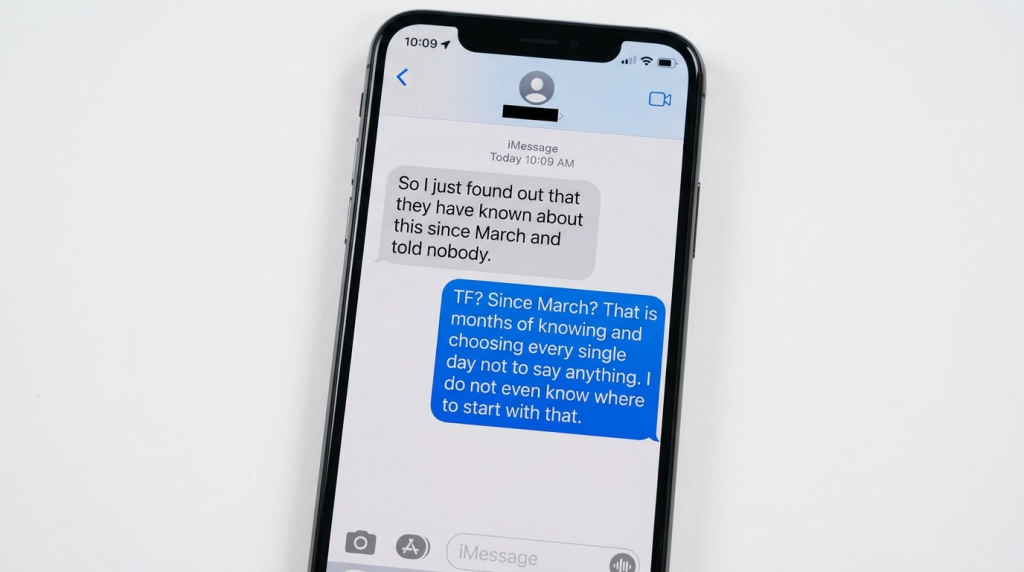
Example 1 — Pure shock at unexpected news
Jordan: So I just found out that they have known about this since March and told nobody
Alex: TF? Since March? That is months of knowing and choosing every single day not to say anything. I do not even know where to start with that
Example 2 — Outrage at an unfair decision
Priya: They gave the promotion to someone who has been there for six months instead of you after three years
Dana: TF do you mean they gave it to him? I have been there longer, I have better results, and I have covered for everyone in that team at some point. How is that even a decision that gets made
Example 3 — Confused reaction to something absurd
Tyler: I just watched a fifteen minute video of a man explaining why rectangles are actually a form of oppression
Sam: TF did you just send me. I need you to explain how you found that, why you watched all fifteen minutes, and what your life choices are looking like right now
Example 4 — Amused disbelief at something chaotic
Keisha: My cat knocked my entire dinner off the counter, looked me directly in the eye, and then walked away
Mia: TF 😭 The eye contact is what gets me. It was not an accident. That was a deliberate decision made with full awareness of the consequences
Example 5 — Sharp pushback on something that misrepresents the facts
Leo: Someone in the group chat is saying you were the one who started the whole situation
Zara: TF are they talking about? I was not even there when it started. Whoever said that knows exactly what the truth is and is choosing something else entirely
Example 6 — Used completely alone as the only possible response
Group chat: [someone shares information so shocking it defies explanation]
Reply: TF.
How to Use TF Correctly
TF works most powerfully at the very beginning of a sentence or completely alone as a standalone reaction. Its job is to express the first moment of shock before anything else — the pause-and-recoil response to something that landed hard. Placing it first means the reader absorbs the full force of the reaction before they even get to whatever analysis or question follows.
TF at the start of a sentence (most natural and most common): “TF do you mean the whole thing has been cancelled with two days notice?”
TF alone as a complete reply (maximum shock, no words available): Something lands that stops you completely. You reply: “TF.”
TF as a question standing alone: “TF?” — With just a question mark it becomes a pure demand for explanation.
TF in the middle of a longer reaction: “I read it twice and, TF, I still cannot process what I just read.”
One important thing to know about TF specifically is how it differs from WTF in placement and feel. WTF almost always starts a sentence — it is the full question “what the f***?” compressed. TF is more flexible — it can stand alone, start a sentence, or appear mid-thought — and it functions as both the question “what the f***?” and the exclamation “the f***!” simultaneously. That dual nature gives TF a slightly wider range of use than WTF even though they are closely related.
What Is the Difference Between TF and WTF?
TF and WTF (What The F***) are close relatives and are often used in the same kinds of situations — but they carry different energy and serve slightly different functions in practice.
WTF is a complete question — “what the f***?” It asks for an explanation of something baffling or shocking. The “what” at the front directs the reaction outward and demands a response. WTF always has the energy of a question even when it is used as an exclamation.
TF is more compressed and more versatile. It functions as both a reaction and a question without being fully committed to either. “TF?” is shock and demand fused together. It is slightly more aggressive and slightly more impatient than WTF — it does not give the “what” of WTF which softens things just enough to keep them in question territory. TF just goes straight to the raw reaction. If WTF is stepping back and asking “what on earth is happening here,” TF is taking a sharp breath and staring at whatever just happened with barely contained disbelief.
TF vs Similar Abbreviations — What Is the Difference?
| Abbreviation | Meaning | Key Difference |
| TF | The F*** | Raw shock and disbelief reaction, fuses exclamation and question |
| WTF | What The F*** | Complete shocked question demanding explanation |
| SMH | Shaking My Head | Quiet disapproval, much softer than TF |
| ISTG | I Swear To God | Personal declaration of intensity, not a shock reaction |
| NGL | Not Gonna Lie | Introduces honest opinion, completely different energy to TF |
| IFK | I F***ing Know | Emphatic agreement, not a shock reaction |
| OMG | Oh My God | Surprise and shock but softer and more exclamatory than TF |
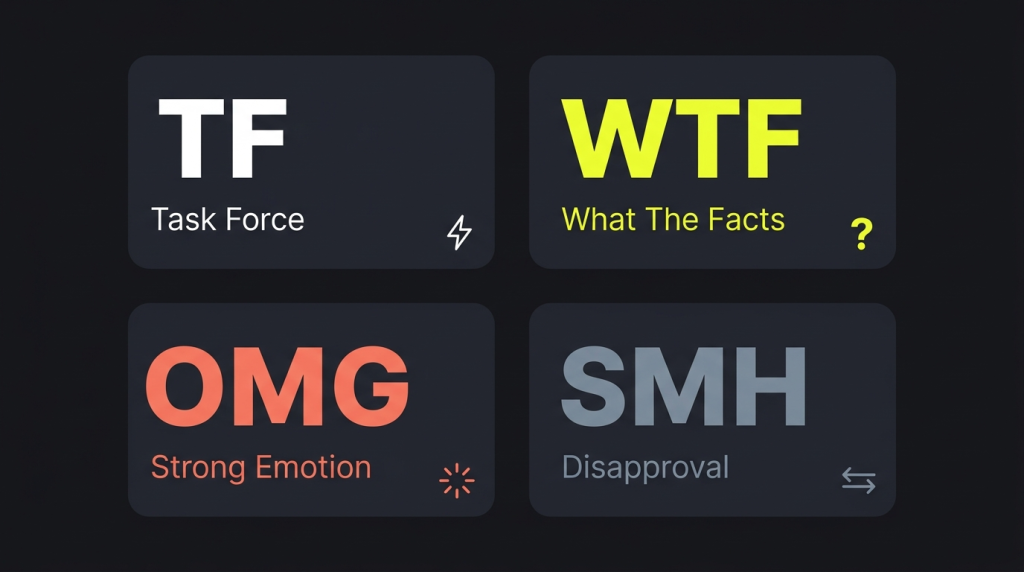
TF occupies a unique space in this list as the abbreviation that delivers maximum shock impact in the fewest possible characters. WTF is fuller and more questioning. OMG is softer and more exclamatory. SMH is quieter and more resigned. TF is the abbreviation that goes straight for the gut reaction with no softening, no framing, and no performance — just the immediate unfiltered response to something that genuinely stopped you.
Is TF Always Negative?
TF leans toward reactions to negative, wrong, or upsetting things — but it is used in response to anything that produces a strong enough surprise reaction to bypass composed expression entirely. That surprise does not always have to come from something bad.
When TF is clearly negative and outraged: “TF do you mean someone took credit for your work in the meeting? That is not okay on any level.” — Shock in service of genuine indignation.
When TF is used for something genuinely confusing: “TF is going on in this video, I have watched it three times and I understand less each time.” — Shock mixed with bewilderment rather than outrage.
When TF is amused and delighted: “TF how are you this talented, this is genuinely not fair to the rest of us.” — The shock comes from being impressed beyond expectation. The disbelief here is warm and joyful.
When TF responds to absurd comedy: “TF did I just watch. I cannot believe this exists and I cannot believe I needed it.” — Pure comedic disbelief without any negative feeling at all.
The common thread across all uses of TF is that something was strong enough or surprising enough to bypass composed expression entirely. Whether that something is good, bad, absurd, or confusing, TF is the abbreviation that captures the exact moment before a considered response is available.
See Also: BRB Mean in Text
Frequently Asked Questions About TF
What does TF mean in a text from a girl?
When a girl sends TF in a text she is reacting to something that shocked her, confused her, frustrated her, or baffled her beyond the point of a composed response. The specific feeling depends entirely on the context. If the conversation before TF involved something unfair or wrong, her TF carries outrage and indignation. If it came after something absurd or funny, her TF is more amused disbelief than anger. If it came after genuinely surprising news, it is pure shock. TF from a girl is almost always followed by more — she has things to say about whatever just prompted that reaction and the TF is the opener, not the full response. Pay attention to what she says after the TF because that is where the actual message is.
What does TF mean in a text from a guy?
When a guy sends TF he has encountered something that bypassed his ability to respond calmly and composed — something that was too shocking, too wrong, too confusing, or too absurd for a measured reaction. Guys often use TF as a sharp, efficient way of expressing strong reaction without going into lengthy explanation of their emotional state — the two letters carry the entire weight of the reaction in a form that feels direct rather than performative. TF from a guy is usually the signal that whatever was just shared has genuinely landed with impact and he has a strong response forming behind those two letters.
Is TF the same as WTF?
TF and WTF are closely related and often used interchangeably but they are not exactly the same. WTF always carries the “what” — it is a complete shocked question. TF is more compressed and can function as both a pure exclamation and a question simultaneously. TF is also slightly more aggressive and impatient in tone than WTF because it skips the questioning framing and goes straight to the raw reaction. In most casual conversations the difference is subtle and many people use them without thinking carefully about the distinction — but if you pay close attention to how people reach for one versus the other, TF tends to appear when the reaction is more visceral and immediate while WTF appears when the shock has the quality of a genuine question about what just happened.
Can TF be used in a funny or lighthearted way?
Absolutely — and this is one of TF’s most common uses in Gen Z communication where shock, absurdity, and humor live very close together. “TF is this song, I have had it on repeat for four hours and I hate that I love it” is entirely lighthearted. “TF how are you real” directed at someone who just did something impressive is warm and complimentary. The shock that TF expresses does not have to come from something negative — it just has to come from something that produced a strong enough reaction to temporarily override composed expression. Comedy, excellence, absurdity, and unexpected goodness all qualify just as much as outrage or confusion.
Is TF rude to send someone?
TF contains profanity which places it firmly in the casual-only category — it is not appropriate in professional settings, with people you do not know well, or in any context where profanity would be out of place or offensive. Between close friends who are comfortable with each other and already communicate casually it is completely natural and carries no rudeness because the shared register has already been established. Sending TF to someone you do not have that kind of established relationship with can feel jarring or aggressive even if that was not the intention. The abbreviation itself is not an insult — it is a shock reaction — but the register it operates in requires that both people are already comfortable with it.
What is the difference between TF and OMG?
TF and OMG both react to shock and surprise but they come from very different emotional places. OMG (Oh My God) is an exclamation that can express shock, delight, horror, or surprise without any particular aggressive edge. It is the most common and widely understood shock abbreviation in English and it reads as accessible and relatively mild even when the shock it is expressing is genuine. TF is rawer, sharper, and harder — it has an edge that OMG does not. OMG is something you might genuinely say in front of your parents. TF is not. OMG expresses that something surprised you. TF expresses that something genuinely stopped you and you need everyone to understand the weight of that reaction immediately.