What Does BRB Mean in Text? Full Meaning Explained Simply (2026)
BRB stands for “Be Right Back.” It is used in texting and social media to let someone know you are stepping away from the conversation temporarily but intend to return shortly. When someone sends BRB they are not ending the exchange — they are pausing it. They are telling the other person that something requires their attention right now but the conversation matters enough to them that they want the other person to know they will be back rather than simply going quiet without explanation.
See Also: TYSM Mean in Text
Quick Definition: BRB at a Glance
| Detail | Info |
| Full Form | Be Right Back |
| Type | Temporary Absence Notice |
| Tone | Casual, Considerate, Sometimes Apologetic |
| Used On | Text, Snapchat, TikTok, Twitter/X, Instagram, Gaming |
| Who Uses It | Gen Z, Millennials, and texters of all ages |
| Safe for Work? | Yes |
What Does BRB Mean in Text?
BRB means Be Right Back and it is one of the oldest, most universally understood, and most consistently useful abbreviations in the entire history of digital communication. People use it whenever they need to step away from an active conversation — whether that is to answer a call, handle something in their physical environment, take a quick break, or deal with something that needs their immediate attention — while signaling clearly to the person on the other end that the conversation is not over and they will return.
What makes BRB so enduringly useful is the courtesy it encodes. In any real-time or near-real-time conversation — whether that is a live chat, a fast-moving text thread, a gaming session, or a video call — going quiet without notice can feel dismissive, confusing, or even rude. BRB solves that problem with three letters. It acknowledges the other person, explains the pause without requiring a lengthy explanation, and communicates the intention to return — all in a single abbreviation that takes less than a second to send.
BRB has one of the longest histories of any texting abbreviation still in common use. It originated in early internet chat rooms and instant messaging platforms in the late 1980s and early 1990s — places like IRC, AOL Instant Messenger, and early online forums where real-time typed conversation was the norm and disappearing without notice was considered a significant social faux pas.
From those early digital communication spaces BRB spread into SMS texting as mobile phones became widespread and has remained a consistent staple of digital communication across every platform and every generation that has come since. Very few abbreviations from that era have survived into modern use unchanged and unquestioned — BRB is one of them.
See Also: OOMF Mean in Text
What Does BRB Signal in a Conversation?
BRB always signals a temporary departure but the reason for that departure and the context around it varies considerably:
- A quick physical interruption — “BRB someone is at the door”
- A brief task that needs handling — “BRB I need to put something on the stove before it burns”
- A phone call interrupting a text conversation — “BRB my mum is calling, two minutes”
- A moment to collect thoughts in an intense conversation — “BRB just need a minute”
- A gaming or online session pause — “BRB grabbing water, do not start without me”
- A polite acknowledgment before a longer absence than expected — “BRB might be a bit actually, something came up”
BRB Meaning on Different Platforms
What Does BRB Mean on Snapchat?
On Snapchat, BRB is used constantly in fast-moving conversations between close friends where the real-time nature of the exchange makes disappearing without notice feel abrupt. You will see it fired off quickly in the middle of an active chat when something requires immediate attention — a parent calling from another room, food that needs to be taken off the stove, a friend arriving at the door. On Snapchat BRB is almost always genuine and almost always short — the person really does intend to come back in a few minutes. When a Snapchat BRB turns into a longer absence the person almost always follows it up with an explanation when they return. The social contract of BRB on Snapchat is taken seriously between close friends.
What Does BRB Mean on TikTok?
TikTok is a consumption-first platform rather than a conversation-first one, so BRB appears there in slightly different contexts than on messaging-heavy platforms. In comment threads under videos where people are actively exchanging responses with each other, BRB gets used to temporarily exit a back-and-forth without ending it. Creators occasionally use BRB in live streams to let their audience know they are stepping away from the camera briefly. In TikTok’s comment culture BRB also sometimes appears humorously — “BRB crying” or “BRB showing this to everyone I know” — where the literal meaning of stepping away is used comedically to express an extreme reaction to the content rather than an actual departure.
What Does BRB Mean on Twitter / X?
On Twitter, BRB appears in two distinct contexts. In direct conversational exchanges — reply threads where two or more people are actively talking — BRB signals a genuine pause exactly as it does in texting. In public tweets, BRB is often used more performatively and humorously — “BRB changing my entire personality based on this video” or “BRB quitting everything and moving to the mountains” where the departure being announced is obviously not real. This ironic use of BRB on Twitter takes the literal stepping-away meaning and applies it to emotional or life-changing reactions for comedic effect. Both the genuine and ironic uses are extremely common on the platform.
What Does BRB Mean in Instagram DMs and Captions?
On Instagram, BRB appears in DMs exactly as it does in regular texting — a quick, courteous signal that the conversation is pausing rather than ending. In public captions BRB is most often used in the same ironic, humorous register as on Twitter — “BRB framing this and putting it on my wall” or “BRB sending this to my entire contacts list” — where it signals an extreme positive reaction through the exaggerated fiction of having to immediately leave and do something in response to the content. In Instagram Live sessions it functions identically to TikTok Live — a host stepping away briefly lets their audience know with BRB.
Real Text Conversation Examples
These examples show the complete range of situations where BRB appears naturally — from practical interruptions to emotional pauses to ironic humorous uses.
Example 1 — Quick physical interruption mid-conversation
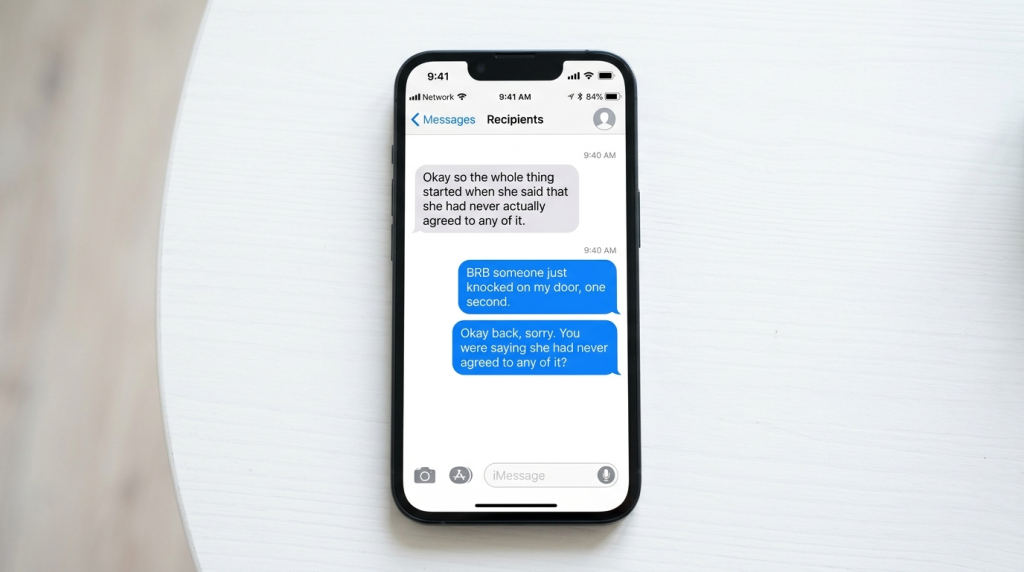
Jordan: Okay so the whole thing started when she said that she had never actually agreed to any of it and I was literally standing there thinking
Alex: BRB someone just knocked on my door, one second
Alex: Okay back, sorry. You were saying you were standing there thinking what exactly
Example 2 — Stepping away during an intense emotional conversation
Priya: I just do not understand why it keeps happening the same way every single time no matter what I do differently
Dana: BRB just need two minutes, I want to give this the proper response it deserves and I got distracted by something. One second.
Dana: Okay. I hear you and I think the reason it keeps happening is
Example 3 — Gaming session pause
Tyler: Are we going again or are you done for tonight
Sam: BRB grabbing snacks and water, do not queue without me. Give me three minutes maximum and I will be back at the desk
Example 4 — Phone call interrupting a text thread
Keisha: And then what happened after that because I need the full story
Mia: BRB my dad is calling and he will keep calling if I do not answer, you know how he is. Two minutes and I am back with the rest of the story
Example 5 — Ironic humorous use in reaction to something
Leo: [sends a video of a dog doing something completely ridiculous and surprisingly skilled]
Zara: BRB showing this to every single person in my life and then watching it forty more times by myself. This is the best thing I have seen all month
Example 6 — Used alone as the most efficient possible pause signal
Group chat: [conversation in full flow when one person suddenly needs to step away]
Reply: BRB.
How to Use BRB Correctly
BRB works most naturally as a standalone message sent quickly in the middle of an active conversation — its job is to be fast and efficient, not elaborate. The whole point of BRB is that it communicates everything necessary in three letters so that no explanation is required. Adding a brief reason after BRB is common and considerate but never mandatory.
BRB alone (fastest and most common): Mid-conversation, something requires your immediate attention: “BRB.”
BRB with a quick reason (considerate and informative): “BRB phone call.” or “BRB door.” or “BRB one sec.”
BRB with a timeframe (most considerate option): “BRB five minutes, just need to sort something.” — Telling the other person roughly how long means they can decide whether to wait or do something else in the meantime.
BRB followed by return acknowledgment (closes the loop properly): After coming back: “Back.” or “Okay back.” or “Sorry about that.” — Letting someone know you have returned honors the implicit promise that BRB makes.
The most important unspoken rule about BRB is the return it promises. BRB makes an implicit contract with the person you are talking to — it says “I will be back.” Sending BRB and then not coming back for hours, going to sleep without saying anything, or ending the conversation without acknowledgment breaks that contract. In close relationships this is a small but real thing. If you say BRB and realize you will be much longer than expected, following up with “sorry that took way longer than I thought” when you return is the social equivalent of keeping your word.
What Is the Difference Between BRB and GTG?
BRB and GTG (Got To Go) are both departure signals in digital communication but they promise very different things and the distinction between them matters.
BRB promises a return. It is explicitly temporary. When you send BRB you are communicating that the conversation is not over — you are pausing it with the clear intention of resuming. The other person is invited to wait and the expectation is that you will be back shortly.
GTG signals a real ending to the current conversation. When you send GTG you are communicating that you need to leave and the conversation is closing for now. There is no promise of return built into GTG — it says goodbye rather than “wait for me.” GTG can be followed by a later continuation of the conversation but it does not carry the same immediate return expectation that BRB does.
The social contract difference between them is meaningful in active real-time conversations. Sending BRB when you actually mean GTG — when you are genuinely leaving for the evening and not coming back for hours — is a small breach of the trust those abbreviations establish. BRB and GTG are not interchangeable. They signal genuinely different things about what happens next in the conversation.
See Also: TF mean in text
BRB vs Similar Abbreviations — What Is the Difference?
| Abbreviation | Meaning | Key Difference |
| BRB | Be Right Back | Temporary pause with promise of quick return |
| GTG | Got To Go | Signals the conversation is ending for now, no immediate return |
| AFK | Away From Keyboard | Signals absence without specifying duration or return time |
| TTYL | Talk To You Later | Closes the current conversation for a longer period |
| TTYS | Talk To You Soon | Closes with a warmer promise of relatively soon continuation |
| NVM | Never Mind | Withdraws a previous statement, not a departure signal |
| HMU | Hit Me Up | Invites future contact rather than signaling a current departure |
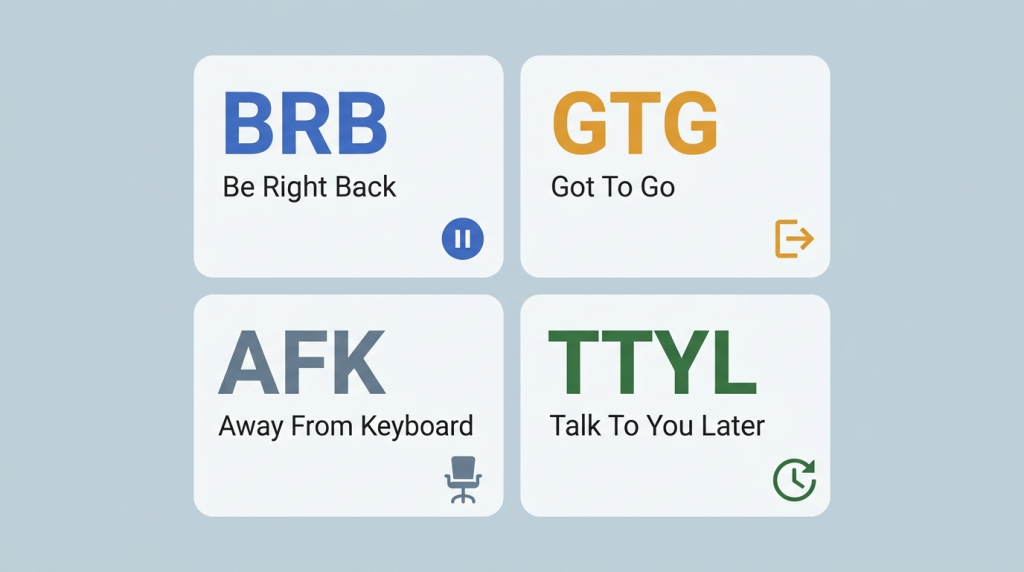
BRB is the only abbreviation in this list that is specifically a short-term departure with an explicit promise of immediate return. GTG closes. AFK states absence without commitment. TTYL and TTYS close for longer periods. BRB is uniquely about the briefest possible pause that still warrants acknowledgment — and the promise of coming right back is the thing that makes it distinct from all of them.
See Also: TF mean in text
Is BRB Still Relevant or Is It Old-Fashioned?
This is a genuinely interesting question because BRB is one of the oldest texting abbreviations still in regular use and its relevance has sometimes been questioned as communication styles have shifted. The honest answer is that BRB remains completely relevant and in active daily use — but the way it is used has evolved alongside changing communication norms.
Where BRB is still completely alive and natural: In any fast-moving real-time conversation — gaming sessions, active group chats, live video streams, quick back-and-forth text exchanges — BRB is exactly as useful and natural as it has always been. The need to signal a brief pause has not disappeared just because the platforms have changed.
Where BRB has become slightly more ironic or nostalgic: In casual social media use, BRB sometimes carries a light retro quality — a nod to early internet culture that younger users deploy with self-awareness. “BRB crying” or “BRB quitting my job” uses the abbreviation humorously rather than literally. This ironic affection for BRB actually reinforces its presence in modern language rather than undermining it.
Where BRB has been replaced by simply going quiet: In asynchronous messaging where nobody expects instant replies, BRB becomes less necessary because there is no real-time expectation to manage. If you are texting someone and a reply might come hours later anyway, explaining a brief departure becomes less important. But in genuinely real-time exchanges BRB has lost none of its usefulness.
See Also: Tf mean in text
Frequently Asked Questions About BRB
What does BRB mean in a text from a girl?
When a girl sends BRB in a text she is letting you know that something has momentarily taken her attention away from the conversation but she is coming back. In casual friendly exchanges it is purely practical — something needed immediate handling and she is being considerate enough to let you know rather than just going quiet. In a conversation with romantic undertones, BRB can also carry a small signal of investment — she cares enough about the exchange to acknowledge the pause rather than simply disappearing. The most important thing BRB communicates from anyone is that the conversation matters enough to them to manage the interruption transparently rather than letting it go unexplained.
What does BRB mean in a text from a guy?
When a guy sends BRB he is signaling a brief departure from an active conversation while making it clear he intends to return. In practical terms it means exactly what it says — something came up and he will be back shortly. In close friendships and romantic contexts a BRB followed by a prompt return and a smooth continuation of the conversation signals reliability and consideration. Guys sometimes use BRB in gaming contexts more than almost any other abbreviation — it is one of the foundational phrases of online gaming communication where stepping away from a session briefly requires clear, fast communication to the rest of the group.
How long is “right back” in BRB?
This is one of the most commonly asked questions about BRB and the honest answer is that there is no fixed rule — but there is a reasonable social expectation. In most active real-time conversations, BRB implies a return within five to fifteen minutes at the absolute outside. The “right” in “be right back” communicates brevity and immediacy. If you know you will be gone for more than fifteen or twenty minutes, BRB starts to feel misleading and something like “give me a bit” or a more specific timeframe becomes more appropriate. The social contract of BRB is built around the understanding that the absence will be short — when that expectation is consistently not met, BRB loses its meaning and its reliability as a signal.
Is it rude not to respond when someone says BRB?
No — BRB does not require a response. It is a notification rather than a question. When someone sends you BRB the appropriate response is simply to wait for them to return. Acknowledging it with “okay” or “take your time” is a kind option that reassures the person that you received the message and are not going anywhere, but it is not required and the absence of a response to a BRB is not considered rude. What would be considered slightly rude in a close relationship is if you ended the conversation or went offline yourself without letting the person know after they specifically told you they would be right back.
What do you say when someone returns after sending BRB?
There is no required script for when someone returns after a BRB but the most natural responses acknowledge that they are back and continue the conversation smoothly. “Welcome back,” “okay good,” “all good,” or simply picking up exactly where you left off without any formal acknowledgment are all completely appropriate depending on how close the relationship is and how long the pause was. The person who sent the BRB will often signal their return themselves — “back,” “okay back,” or “sorry about that” — which closes the loop they opened and reassures you that the conversation can continue. If they return without saying anything and simply continue the conversation that is also completely normal and requires no special acknowledgment.
Does BRB always mean Be Right Back?
Yes — BRB universally and exclusively means Be Right Back across every platform, age group, and digital communication context currently in use. It is one of the most stable and consistent abbreviations in the entire history of online communication. There are no alternative meanings for BRB in mainstream texting or social media — no competing interpretations, no platform-specific variations, no generational rereadings.