What Does TTYL Mean in Text? Full Meaning Explained Simply (2026)
TTYL stands for “Talk To You Later.” It is used in texting and social media to close a conversation warmly while signaling that the exchange is not permanently over — just paused until a future point. When someone sends TTYL they are not saying goodbye forever. They are saying goodbye for now, with a built-in promise that the connection continues beyond this particular conversation.
Quick Definition: TTYL at a Glance
| Detail | Info |
| Full Form | Talk To You Later |
| Type | Conversation Closer / Warm Farewell |
| Tone | Friendly, Warm, Casual, Sometimes Affectionate |
| Used On | Text, Snapchat, TikTok, Twitter/X, Instagram |
| Who Uses It | Gen Z, Millennials, and texters of all ages |
| Safe for Work? | Yes |
See Also: tysm mean in text
What Does TTYL Mean in Text?
TTYL means Talk To You Later and it is one of the warmest and most relationship-affirming ways to end a digital conversation. People use it when a conversation needs to close but the relationship does not — when something calls them away or the natural end of an exchange has been reached, but they want the other person to know that the door is open and the connection is ongoing. TTYL is fundamentally an optimistic farewell. It looks forward.
What separates TTYL from a plain goodbye is the promise embedded in the word “later.” A simple “bye” closes the conversation. TTYL closes the conversation while simultaneously opening the next one. It tells the other person that you are already anticipating continued contact — that this is a pause in an ongoing relationship rather than a conclusion. That small but real difference in what TTYL communicates is why it has remained one of the most commonly used conversation closers in digital communication for over three decades.
TTYL is one of the oldest abbreviations in digital communication, originating in early internet chat rooms and instant messaging services in the late 1980s and early 1990s alongside BRB, LOL, and a handful of other foundational abbreviations that shaped the language of online conversation.
From those early chat platforms TTYL spread into SMS texting as mobile phones became mainstream and has survived completely intact into the modern era — used just as naturally and frequently today as it was when it first appeared. Very few abbreviations from that era have maintained such consistent relevance across every generation of digital communication that followed.
What Does TTYL Signal in a Conversation?
TTYL always closes a conversation but the specific feeling and context it carries varies depending on the relationship and situation:
- A natural end to a good conversation — “This has been so good to catch up, TTYL”
- Stepping away because something needs attention — “I have to go deal with something but TTYL”
- Closing a practical exchange warmly — “Okay that is everything sorted, TTYL”
- Ending a late-night conversation — “I need to sleep but TTYL tomorrow”
- A warm close after a difficult or emotional exchange — “Take care of yourself, TTYL”
- Casual sign-off in an ongoing thread — “Anyway I have to run, TTYL”
TTYL Meaning on Different Platforms
What Does TTYL Mean on Snapchat?
On Snapchat, TTYL is one of the most frequently used conversation closers between close friends precisely because Snapchat conversations are often ongoing, casual, and deeply familiar. The platform’s culture of constant low-stakes contact makes TTYL a natural fit — it closes the current exchange without any sense of formality or finality. You will see it fired off at the end of a long back-and-forth chat, at the tail end of a late night conversation when someone needs to sleep, or whenever real life temporarily pulls someone away from their phone. On Snapchat TTYL is warm, quick, and completely comfortable — the digital equivalent of a casual wave goodbye to someone you will absolutely see again soon.
What Does TTYL Mean on TikTok?
TikTok is primarily a content consumption platform rather than a direct messaging one, so TTYL appears there in slightly different contexts than on conversation-heavy platforms. In active comment thread exchanges between people who have been going back and forth, TTYL closes the thread without abruptness. It also appears occasionally in creator captions or live stream sign-offs — a creator wrapping up a live session who wants to close warmly uses TTYL to signal to their audience that they are leaving for now but the connection continues. On TikTok TTYL sometimes also appears with a nostalgic or ironic quality — a nod to early internet culture that younger creators use with self-aware affection for the abbreviation’s long history.
What Does TTYL Mean on Twitter / X?
On Twitter, TTYL appears in both genuine and performative contexts. In direct conversation exchanges it closes a thread warmly when two people have been genuinely talking and one needs to step away. In public tweets TTYL is often used in a broader, sometimes humorous sense — “TTYL going to go think about this for the rest of the day” or “TTYL I need to call my therapist after reading that” — where the departure being announced is real but the phrasing is used for comedic emphasis on how impactful something was. Twitter’s culture of wit and wordplay gives TTYL a lighter, more ironic register in public posts while keeping its genuine warmth in direct exchanges.
What Does TTYL Mean in Instagram DMs and Captions?
On Instagram, TTYL appears in DMs as a natural, affectionate conversation closer between people who talk regularly. It signals the end of the current exchange without any coldness or distance — just the practical reality that something else needs attention now and the conversation will pick up again. In public captions TTYL functions similarly to Twitter — sometimes used genuinely when a creator is stepping back from posting for a while, sometimes used humorously when reacting to something in a way that implies they need to temporarily leave the internet to process it. In either context TTYL reads as warm and connected rather than distant or final.

See Also: oomf mean in text
Real Text Conversation Examples
These examples show the complete range of situations where TTYL appears naturally — from casual everyday sign-offs to warm closes after meaningful exchanges to humorous performative uses.
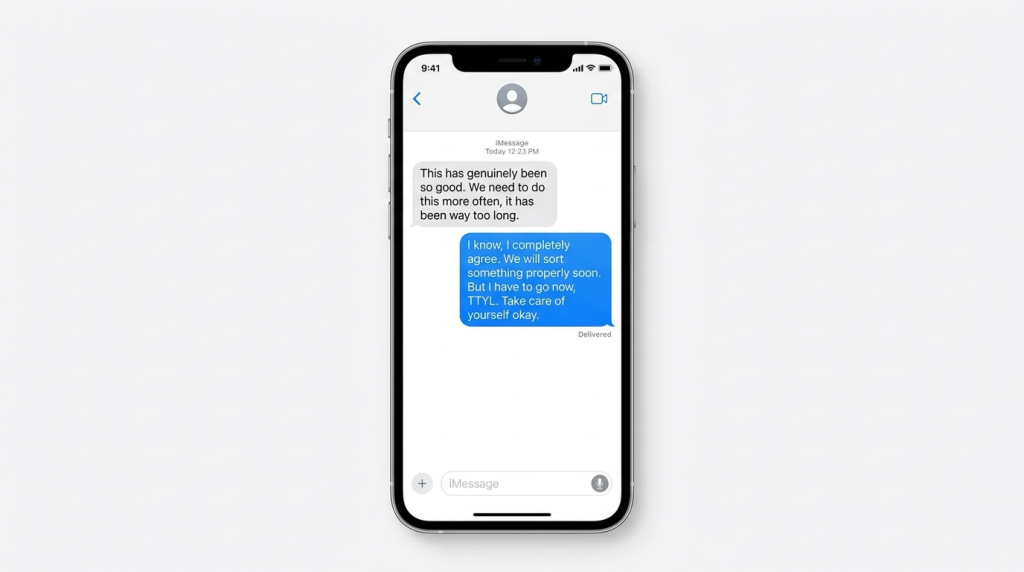
Example 1 — Natural close after a good catch-up
Jordan: This has genuinely been so good. We need to do this more often, it has been way too long
Alex: I know, I completely agree. We will sort something properly soon. But I have to go now, TTYL. Take care of yourself okay
Example 2 — Stepping away because life is calling
Priya: Wait so what ended up happening after that
Dana: Okay I genuinely have to tell you the full story but I literally have to leave right now or I am going to be late. TTYL and I promise I will finish this tonight when I am back
Example 3 — Closing a late-night conversation
Tyler: It is almost two in the morning and I have to be up at six which is genuinely my own fault at this point
Sam: Same honestly. We always do this. Okay TTYL, get some sleep and text me tomorrow when you are human again
Example 4 — Warm sign-off after a difficult emotional conversation
Keisha: I think I just needed to say all of that out loud to someone who would actually hear it. Thank you for listening
Mia: Always. Any time, genuinely. Go rest now and be kind to yourself today. TTYL, and I mean it about reaching out whenever you need to
Example 5 — Quick practical close after sorting something out
Leo: Okay so we have the time, the place, and everyone is confirmed. I think that is actually everything
Zara: Perfect. That was easier than I expected honestly. Okay TTYL, see you Saturday
Example 6 — Used alone as the most complete and efficient close
Group chat: [conversation winding down naturally after everyone has said what needed to be said]
Reply: TTYL everyone 👋
How to Use TTYL Correctly
TTYL almost always goes at the very end of a message — its entire function is to close the exchange, so placing it anywhere else in a sentence would undercut the very job it is meant to do. It can be a standalone message or the final line of a longer closing message, but it always belongs at the end.
TTYL as a standalone message (most common and most efficient): The conversation has reached its natural close. You send simply: “TTYL.”
TTYL at the end of a longer closing message (warmest option): “It was so good catching up and I am really glad we talked. TTYL.”
TTYL with a timeframe (most informative option): “TTYL tomorrow” or “TTYL this weekend” — adding when you expect to talk next makes the “later” in TTYL feel concrete rather than vague.
TTYL with a soft addition (most affectionate option): “TTYL, take care.” or “TTYL, thinking of you.” — These small additions turn a functional close into a genuinely warm one.
The single most important thing about TTYL is the genuine intention behind it. TTYL makes a soft promise — it says this connection continues and we will talk again. Using TTYL when you have no real intention of continuing the relationship or following up on the conversation makes it hollow. In close relationships where the ongoing connection is real and assumed, TTYL lands with warmth and zero ambiguity. In more fragile or uncertain relationships the “later” in TTYL can feel either genuinely hopeful or somewhat hollow depending on whether the relationship has established enough trust to make that promise feel real.
What Is the Difference Between TTYL and GTG?
TTYL and GTG (Got To Go) are both conversation-ending abbreviations but they serve different purposes and leave the conversation in a very different emotional place.
GTG is purely functional — it signals that the person needs to leave and the conversation is closing. It handles the practical reality of departure efficiently and without additional emotional content. GTG is the right choice when you need to leave quickly and the most important thing to communicate is that you are leaving.
TTYL adds a relational layer on top of the practical departure. It does not just say “I am leaving” — it says “I am leaving and we will talk again.” The promise of future contact is built into TTYL in a way that GTG simply does not carry. GTG is departure. TTYL is departure plus continued connection. In close friendships and ongoing relationships TTYL is almost always the warmer and more relationship-affirming choice. GTG works perfectly when efficiency is the priority. TTYL works better when warmth and continuity are.
TTYL vs Similar Abbreviations — What Is the Difference?
| Abbreviation | Meaning | Key Difference |
| TTYL | Talk To You Later | Warm conversation close with implied promise of future contact |
| GTG | Got To Go | Functional departure signal with no emotional relational layer |
| BRB | Be Right Back | Temporary pause with promise of immediate return, not a close |
| TTYS | Talk To You Soon | Same warmth as TTYL but implies a shorter timeframe before reconnecting |
| GN | Good Night | Closes a specific late-night conversation rather than the relationship generally |
| HMU | Hit Me Up | Invites future contact rather than signaling a current departure |
| IRL | In Real Life | References the offline world rather than signaling departure |
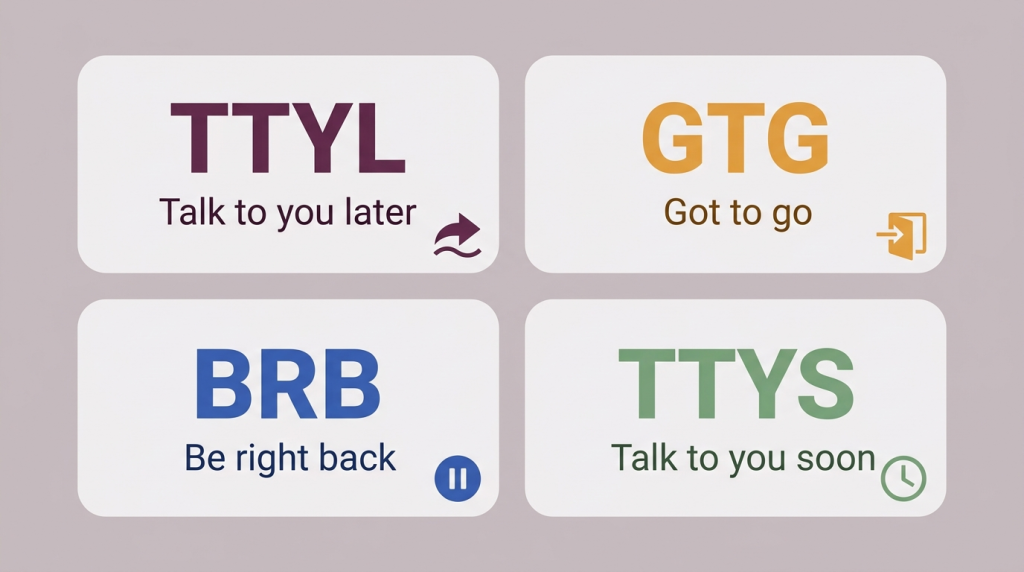
TTYL is unique in this list because it is specifically a warm relational close — it ends the current exchange while actively signaling that the connection and relationship continue beyond this conversation. GTG ends the exchange. BRB pauses it. GN closes a specific nighttime window. TTYL closes this conversation while keeping the broader relationship explicitly open and ongoing.
Is TTYL Still Relevant in 2026?
TTYL is one of the oldest surviving texting abbreviations and its longevity raises a fair question — does it still feel natural or has it become dated? The honest answer is that TTYL remains in active, genuine use across all age groups while simultaneously having acquired a nostalgic quality that some people lean into deliberately.
Where TTYL is completely natural and modern: In real-time or near-real-time conversations between people who are actually talking and need to sign off, TTYL is exactly as useful and natural as it has always been. The need to close a conversation warmly while signaling ongoing connection has not changed just because the platforms have.
Where TTYL carries nostalgic warmth: For people who grew up using AIM, MSN Messenger, or early SMS texting, TTYL carries a genuine emotional resonance that newer abbreviations simply do not have. Using TTYL in those contexts is not dated — it is genuinely warm in a way that comes from the history behind the abbreviation.
Where TTYL has an ironic or retro quality: Some younger users deploy TTYL with a self-aware nod to early internet culture — not because it has become uncool but because its vintage quality is part of the appeal. TTYL in that register is affectionate rather than archaic.
The bottom line is that TTYL has earned the rarest status an abbreviation can reach — it started as slang and became genuinely timeless.
See Also: FYP Mean in Text
Frequently Asked Questions About TTYL
What does TTYL mean in a text from a girl?
When a girl sends TTYL in a text she is closing the current conversation while signaling that the relationship and connection continue beyond this exchange. In a close friendship context it is simply a warm, comfortable sign-off between people who talk regularly and the TTYL is as natural as waving goodbye to someone you will see tomorrow. In a conversation with someone she is getting to know or someone she has romantic interest in, TTYL carries slightly more intentional weight — she is choosing to close with something that points forward and affirms continued contact rather than a more neutral or final-feeling goodbye. The warmth of TTYL is never accidental. It is always a small signal that the other person matters enough to close with something more than a plain goodbye.
What does TTYL mean in a text from a guy?
When a guy sends TTYL he is closing the conversation while keeping the connection open — and in many cases he is choosing TTYL specifically because a plain “bye” would feel too cold or final for the relationship. Guys often default to efficiency in texting so when a guy chooses TTYL over a shorter or more neutral sign-off it is a small but real signal that the relationship and the conversation mattered to him. In romantic or developing relationship contexts TTYL from a guy is often his way of making it clear that this is not the end — that he wants there to be a next time — without having to state that explicitly in a way that might feel too vulnerable or forward.
How long is “later” in TTYL?
Like BRB’s “right back,” the “later” in TTYL is deliberately imprecise — which is both a feature and occasionally a source of confusion. In most close friendship contexts “later” means sometime today or tomorrow — a return to contact within a natural social timeframe. In more casual acquaintance contexts “later” can mean whenever the next natural occasion to talk arises, which might be days or weeks. The relationship itself is usually the best guide to how long “later” actually means. If you want to make the timeframe concrete and reduce ambiguity, adding it explicitly — “TTYL tonight” or “TTYL this weekend” — is a small addition that removes the vagueness entirely and makes the promise of future contact feel more specific and real.
Is there a difference between TTYL and TTYS?
Yes — and the difference is specifically in the implied timeframe. TTYS stands for Talk To You Soon and signals that the return to contact will happen relatively quickly — within hours or a day or two at most. TTYL is slightly more open-ended with its “later” — it promises future contact without specifying quite when. In close friendships where contact is constant and daily, the difference between TTYL and TTYS is negligible. In relationships where contact is less frequent, TTYS carries a slightly warmer and more committed feeling because the “soon” is more reassuring than the open-ended “later.” Both are warm, both are relational, and both are conversation closers — TTYS simply makes the return feel more imminent.
Can TTYL be used in professional settings?
TTYL exists in an interesting middle ground when it comes to professional use. In casual professional environments where informal digital communication is the norm — creative agencies, startups, young teams communicating over Slack or Teams — TTYL appears naturally in the same way BRB and LMK do and reads as friendly and human rather than unprofessional. In more formal professional contexts — emails to clients, messages to senior leadership, official correspondence — writing out “talk to you later” or “speak soon” in full is more appropriate. TTYL in a professional context always works best when the relationship already has an established casual, friendly register. In any doubt, use the full phrase — it is always correct and it signals care regardless of the context.
Does TTYL always mean Talk To You Later?
Yes — TTYL universally and exclusively means Talk To You Later across every platform, age group, and digital communication context currently in use. It is one of the most stable and consistently understood abbreviations in the entire history of online communication with no alternative meanings, no platform-specific variations, and no generational rereadings that have changed its meaning. Whether you see TTYL in a personal text, a social media DM, a gaming chat, a live stream comment, or any other digital communication context, it means Talk To You Later every single time without exception.
See Also: tf mean in text