What Does FOMO Mean in Text? Full Meaning Explained Simply (2026)
FOMO stands for “Fear Of Missing Out.” It is used in texting and social media to describe the anxious, restless feeling that something important, exciting, or meaningful is happening somewhere else at an event you are not at, in a group you are not part of, or in a life that is not yours and that by not being present for it you are falling behind, being left out, or missing something that would have made your life better, fuller, or more interesting.
Quick Definition: FOMO at a Glance
| Detail | Info |
| Full Form | Fear Of Missing Out |
| Type | Emotional State / Cultural Concept |
| Tone | Anxious, Restless, Self-Aware, Sometimes Humorous |
| Used On | Text, Snapchat, TikTok, Twitter/X, Instagram |
| Who Uses It | Gen Z, Millennials, and general texters of all ages |
| Safe for Work? | Yes |
What Does FOMO Mean in Text?
FOMO means Fear Of Missing Out and it is one of the most psychologically rich and culturally significant abbreviations in modern digital communication. People use it to name a feeling that has almost certainly existed as long as humans have lived in social groups — the awareness that other people are having experiences you are not having, and the anxiety that produces — but that social media has amplified into something qualitatively different from anything that existed before.
What makes FOMO particularly interesting is that it is the only commonly used texting abbreviation that describes a psychological state with a clinical-adjacent quality. FOMO is not just a casual feeling — researchers have studied it, therapists discuss it with clients, and there is genuine empirical evidence linking high FOMO to lower life satisfaction, increased social media use, reduced sleep quality, and higher rates of anxiety and depression.
The fact that this psychological phenomenon has its own widely understood abbreviation used casually in everyday texts is a marker of how completely it has been absorbed into the texture of modern life.
FOMO was formally named and defined in academic literature in the early 2010s the term is generally credited to marketing strategist Dan Herman who first described it in 2000 but it exploded into mainstream vocabulary through social media culture, particularly as platforms like Instagram and Facebook made it possible to see in real time exactly what you were not present for.
The combination of constant connectivity and persistent documentation of others’ experiences created the perfect conditions for FOMO to become not just an occasional feeling but an ambient, chronic state for many people who spend significant time on social media.
What Does FOMO Signal in a Conversation?
FOMO always describes some form of anxiety about missing something but the specific context and intensity varies considerably:
- Genuine social anxiety about being left out — “Everyone seems to be at that event right now and the FOMO is real”
- Regretting a decision not to attend something — “I stayed home instead of going and now I have full FOMO looking at everyone’s Stories”
- The specific anxiety of social media exposure — “I need to get off Instagram because the FOMO from seeing everyone’s summer is getting to me”
- Using FOMO to explain an impulsive social decision — “I was not going to go but the FOMO got to me so here I am”
- Acknowledging the feeling with self-aware humor — “FOMO is the only thing that gets me out of the house at this point”
- The broader anxiety of life choices not taken — “FOMO about the career path I did not choose is starting to feel like something I need to actually address”
FOMO Meaning on Different Platforms
What Does FOMO Mean on Snapchat?
On Snapchat, FOMO is both described and actively produced with remarkable efficiency. The platform’s Stories feature — which shows you in real time what people in your network are doing, where they are, and who they are with — is one of the most FOMO-generating mechanisms ever designed. You will see FOMO mentioned constantly on Snapchat both as a description of how watching others’ Stories feels and as a motivation for doing things — “the FOMO from your Story last week is why I am going this time.” On Snapchat FOMO is honest and personal because the small, close-friend audience makes it feel safe to admit anxiety about social exclusion without the performance that public platforms require.
What Does FOMO Mean on TikTok?
TikTok is where FOMO reaches its most analyzed and culturally examined form. Creators make videos specifically about FOMO — its causes, its relationship to social media use, how it drives behavior, and how to manage it. These videos generate enormous engagement because the experience being described is so universally recognizable. In comment sections and captions FOMO appears both as a genuine emotional admission and as a self-aware observation about social media’s particular power to make ordinary life feel insufficient compared to the curated highlights of other people’s lives. TikTok also generates a specific type of FOMO around viral trends — the feeling of having missed a trend, a sound, or a cultural moment that your FYP served you too late.
What Does FOMO Mean on Twitter / X?
On Twitter, FOMO is used with more analytical and cultural distance than on more personal platforms. Twitter users discuss FOMO as a cultural phenomenon, critique the social media structures that produce it, and examine its relationship to consumer culture, the attention economy, and mental health. In personal tweets FOMO appears when someone is watching something happen online or in culture that they are not part of and wants to name that feeling publicly. Twitter FOMO is often tied to cultural events — a concert, a cultural moment, a conversation that everyone seems to be part of — rather than to social events involving specific friends.
What Does FOMO Mean in Instagram DMs and Captions?
Instagram is widely considered the most FOMO-generating social media platform ever built — its entire aesthetic is organized around presenting the most aspirational, beautiful, and enviable version of life possible. FOMO on Instagram is therefore both a feeling that the platform produces and a meta-observation about the platform’s effect. In captions it appears when someone is acknowledging that what they are posting might trigger FOMO in others — sometimes with pride, sometimes with self-aware guilt. In DMs it appears when someone is explaining why they are changing their plans or admitting that another person’s posts have created real anxiety about their own choices. Instagram FOMO is the platform’s shadow — the uncomfortable underside of its aspirational surface.
Real Text Conversation Examples
These examples show the complete emotional range of FOMO — from genuine social anxiety to ironic self-awareness to the broader life-choices version to the humor that comes from naming a feeling everyone recognizes.
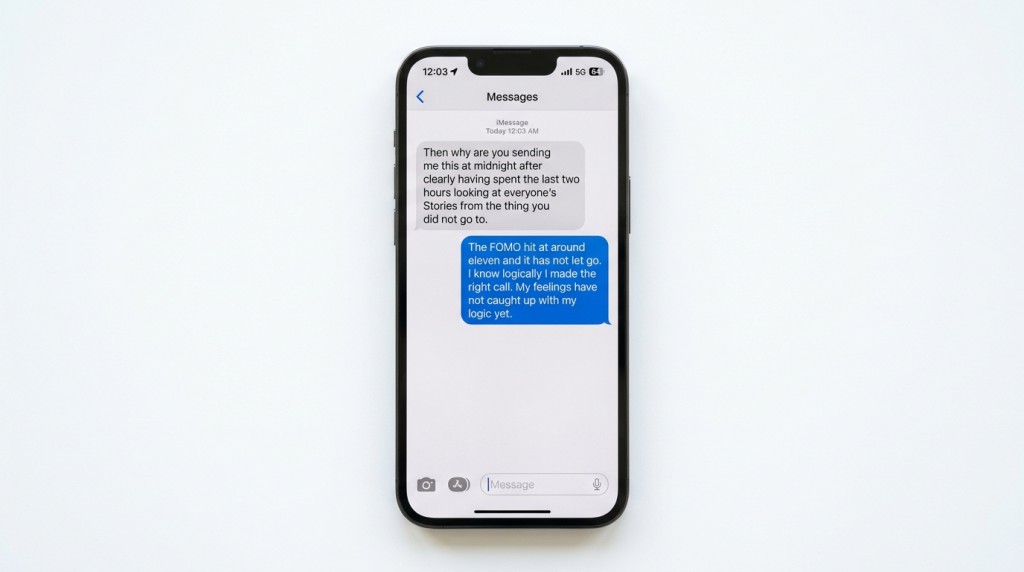
Example 1 — Genuine FOMO from watching others’ social media
Jordan: I made the right call staying home tonight because I was exhausted and needed rest
Alex: Then why are you sending me this at midnight after clearly having spent the last two hours looking at everyone’s Stories from the thing you did not go to
Jordan: The FOMO hit at around eleven and it has not let go. I know logically I made the right call. My feelings have not caught up with my logic yet
Example 2 — FOMO overriding a decision to stay in
Priya: I was literally in my pajamas and had decided not to go
Dana: And yet here you are
Priya: The FOMO got me. Someone sent a photo from inside and it looked incredible and I could not do it. I was in an Uber fifteen minutes later. I have no self-control and I am at peace with that
Example 3 — Social media FOMO about life broadly
Tyler: I need to delete Instagram for a while. I keep going on there and coming away feeling like everyone my age has their life together in a way I do not
Sam: That is textbook FOMO and the thing nobody says enough is that the people posting those lives are also experiencing FOMO about other people’s lives. The whole system runs on manufactured comparison. Nobody actually has it together. They just have a camera and good lighting
Example 4 — FOMO about a career or life path not taken
Keisha: I keep seeing people from my year who went into different fields and they seem so energized by what they do and I feel this low-level FOMO about the choices I made
Mia: That is a real thing and I think it deserves more attention than calling it FOMO and moving on. Is this actually about their careers or is this about something in your current situation that is not working for you
Example 5 — Using FOMO humorously to explain social behavior
Leo: I literally said I was not going to make any plans this weekend and was going to stay home and recover
Zara: And you have been out every single night since Thursday
Leo: FOMO is a disease and I am severely afflicted. I see any plan forming anywhere near me and something takes over. I am working on it. The work is slow
Example 6 — Used completely alone as the most efficient possible description
Group chat: [someone posts photos from an event that several group members are not at]
Reply: FOMO.
How to Use FOMO Correctly?
FOMO works most naturally as a subject or object in a sentence — as the thing being experienced, caused, felt, or overcome. It is a noun first and foremost, though it works adjectivally in constructions like “FOMO energy” or “full FOMO mode.”
FOMO as the subject (most common): “The FOMO hit me the moment I saw the first photo from inside.”
FOMO as the object: “I am really trying not to give in to FOMO this weekend and just rest.”
FOMO alone as a complete reaction: Someone posts something incredible that you are not present for. You reply: “FOMO.”
FOMO as an adjective or descriptor: “I am in full FOMO mode right now looking at these Stories.”
FOMO with self-aware humor: “FOMO got me again and now I am at a thing I said I definitely was not going to.”
The most honest and useful thing to understand about using FOMO correctly is that naming it does not automatically resolve it. FOMO is one of those feelings that benefits from being named because naming it creates enough distance from it to examine whether it is pointing at something real or simply reacting to the distorted mirror of social media. When FOMO appears in your own texting it is worth a moment’s reflection about what it is actually telling you — whether the thing you feel you are missing is something you genuinely value or something that only looks desirable through the specific lens of how it is being presented.
What Is the Difference Between FOMO and JOMO?
FOMO and JOMO (Joy Of Missing Out) are direct philosophical opposites that represent two completely different orientations toward the experience of not being present for everything that is happening.
FOMO is the anxious version — it says that not being somewhere, not doing something, or not having a specific experience is a loss. FOMO treats the experiences and opportunities not taken as deficits that diminish the quality of your life.
JOMO is the contented version — it says that not being present for something you were not part of choosing is actually fine, and that the choice to be quietly somewhere else, to rest, to be present in your own life rather than everyone else’s, is its own form of richness. JOMO is the deliberate, self-aware decision to be at peace with not attending, not participating, and not keeping up. JOMO says that missing out is not always a loss — sometimes it is exactly the right thing.
JOMO emerged as a cultural concept specifically in response to FOMO — as a way of naming and validating the alternative orientation. Neither is universally better. FOMO reminds us that experience has value and hesitation has costs. JOMO reminds us that not every opportunity needs to be taken and that there is real richness in presence rather than constant motion. The healthiest relationship with social life probably involves both — knowing when the FOMO is pointing at something genuinely worth pursuing and knowing when to let it pass and choose rest instead.
FOMO vs Similar Abbreviations — What Is the Difference?
| Abbreviation | Meaning | Key Difference |
| FOMO | Fear Of Missing Out | Anxiety about experiences not being had, driven by awareness of others’ lives |
| JOMO | Joy Of Missing Out | The contented, deliberate opposite of FOMO |
| YOLO | You Only Live Once | The bold antidote to FOMO — choosing experience over hesitation |
| ATP | At This Point | Accumulated exhaustion, not anxiety about missing things |
| NGL | Not Gonna Lie | Introduces personal honesty, often precedes a FOMO admission |
| IRL | In Real Life | The physical experiences that FOMO is often specifically about |
| WTM | What’s The Move | The practical social coordination that FOMO motivates |
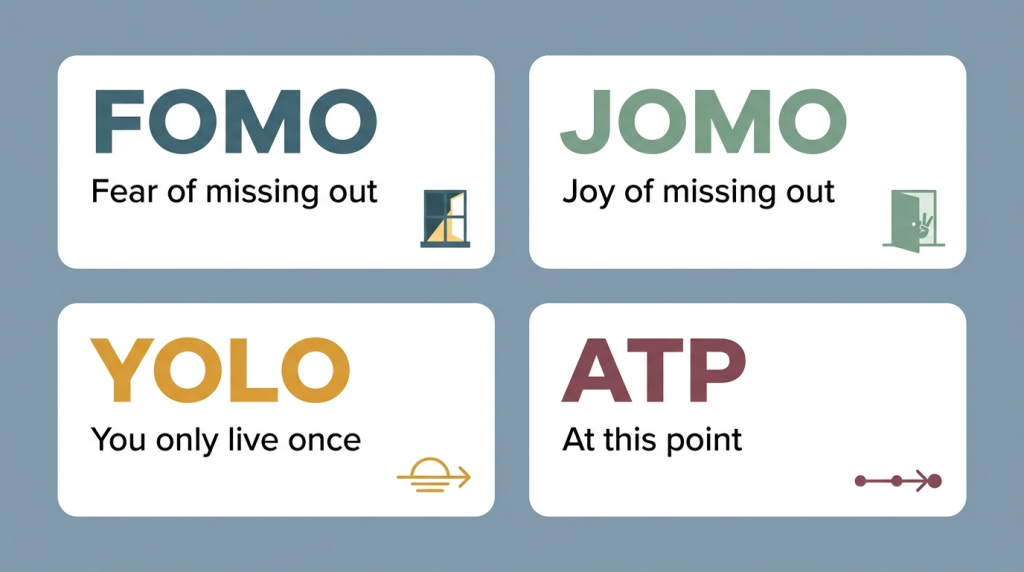
FOMO is unique in this list because it is the only abbreviation that describes a psychological state with genuine clinical and research backing rather than a simple emotion or communication function. Every other option is either a philosophy, a reaction, a communication tool, or a reality marker. FOMO is a documented psychological phenomenon that has been abbreviated into casual daily vocabulary — which says something remarkable about how thoroughly it has been absorbed into the texture of modern life.
Is FOMO a Modern Problem or Has It Always Existed?
This is one of the most genuinely interesting questions about FOMO and the answer requires separating the feeling from the conditions that have made it so pervasive today.
The underlying experience of FOMO — the awareness that other people are having experiences you are not, and the discomfort that creates — almost certainly predates social media by thousands of years. Humans are fundamentally social creatures and the anxiety of social exclusion has always been real and significant. Neighbors who could see each other’s celebrations from their windows, people who heard about parties they were not invited to, anyone who ever felt left out of something their social group was part of — all of these are pre-digital FOMO.
What social media did was not create FOMO but dramatically amplify and accelerate it in several specific ways. It made other people’s experiences visible in real time rather than after the fact. It presented those experiences in their most curated, aspirational form rather than in their full reality. It made the comparison pool effectively unlimited — instead of comparing yourself to a neighborhood or a workplace you are comparing yourself to everyone you have ever met plus everyone you follow. And it made this comparison available continuously rather than occasionally. The result is a qualitatively different experience of the same underlying feeling — chronic rather than episodic, broad rather than specific, and driven in large part by images and stories that are designed to produce exactly this response.
Frequently Asked Questions About FOMO
What does FOMO mean in a text from a girl?
When a girl mentions FOMO in a text she is naming an anxious feeling about something she is not present for — whether that is a social event, a cultural moment, or a broader life experience she feels she is missing. The self-awareness embedded in naming it as FOMO rather than simply acting on it is significant — she is creating enough distance from the feeling to examine it rather than just being driven by it. If she mentions FOMO about a specific event or gathering it often doubles as an indirect indication that she wishes she had gone or that she is considering whether to change her plans. If she mentions FOMO about something broader — a life path, a relationship type, a career choice — it is an invitation to a deeper conversation about what she actually wants.
What does FOMO mean in a text from a guy?
When a guy mentions FOMO he is acknowledging social anxiety about missing something — which for many guys requires a degree of self-awareness and emotional vocabulary that is worth recognizing. Guys who use FOMO in casual conversation have usually developed enough self-knowledge to name the feeling rather than just acting on it reflexively. In social contexts FOMO from a guy often comes paired with humor — the self-deprecating admission that the feeling overrode his intention to stay home, or that he is currently looking at social media and regretting his choices. In deeper conversations FOMO from a guy might be pointing at something more significant about the direction of his life and whether the path he is on is giving him what he actually wants.
Is FOMO a mental health issue?
FOMO exists on a spectrum that ranges from completely normal and mild social awareness all the way to a significant contributor to anxiety, depression, and problematic social media use. At its mild end FOMO is simply the normal human awareness that social life involves choices and that choosing one thing means not choosing another. This is universal, adaptive, and not pathological. At its more severe end — when FOMO is chronic, drives compulsive social media checking, significantly interferes with enjoyment of present experiences, produces real anxiety and unhappiness, or makes it impossible to choose rest or solitude — it starts to overlap meaningfully with anxiety disorders and may benefit from professional attention. The distinction is largely about whether the FOMO is occasional and situational or persistent and pervasive. If it is the latter and it is affecting quality of life, talking to a mental health professional is genuinely worthwhile.
What is the best way to deal with FOMO?
The most effective approaches to managing FOMO tend to share a common thread — they involve some form of reorienting attention from what is not present to what is. Reducing passive social media consumption — particularly the kind of scrolling that involves watching other people’s curated experiences without any actual social interaction — consistently reduces FOMO in research studies. Deliberately choosing to be fully present in whatever you are actually doing, rather than monitoring what you might be missing, is the behavioral practice that most directly counters FOMO’s mechanism. Developing what psychologists sometimes call “savoring” — actively noticing and appreciating good experiences as they are happening rather than documenting them for social media — also helps. And the self-awareness to distinguish between FOMO pointing at something genuinely worth pursuing and FOMO that is simply reacting to social media’s curated distortions is perhaps the most valuable skill of all.
What is the difference between FOMO and social anxiety?
FOMO and social anxiety are related but distinct. Social anxiety is primarily a fear about social situations — the worry that you will be judged, embarrassed, or rejected in social settings — which often leads to avoidance of social situations. FOMO is the opposite directional pull — it is anxiety about not being in social situations, the fear of exclusion and of missing experiences. Someone with high social anxiety might stay home from an event because being there feels threatening. Someone with high FOMO might go to the same event despite not wanting to because not going feels worse than the discomfort of attending. The two can coexist and sometimes do — producing the particularly uncomfortable experience of someone who dreads social situations but also dreads missing them. That conflict, if recognized, is worth exploring with a mental health professional.
Does FOMO always mean Fear Of Missing Out?
Yes — FOMO universally means Fear Of Missing Out across every platform, age group, and digital communication context currently in use. It is one of the most stable and consistently understood abbreviations in modern language — appearing not just in casual texting and social media but in academic research, journalism, therapeutic contexts, and everyday conversation. There are no alternative meanings for FOMO in mainstream use and no generational or platform-specific reinterpretations. Whether you encounter FOMO in a personal text, a social media caption, a news article, a psychology paper, or any other context, it means Fear Of Missing Out every single time.
See Also: wyd mean in text