What Does NSFW Mean in Text? Full Meaning Explained Simply (2026)
NSFW stands for “Not Safe For Work.” It is used in texting and social media as a warning label placed before or alongside content — a link, a video, an image, a story, or anything that contains material that would be inappropriate, embarrassing, or professionally damaging to view in a workplace, public space, classroom, or any environment where other people might see your screen. When someone sends NSFW they are doing you a courtesy — they are telling you to check your surroundings before you open whatever they just shared.
Quick Definition: NSFW at a Glance
| Detail | Info |
| Full Form | Not Safe For Work |
| Type | Content Warning Label |
| Tone | Cautionary, Considerate, Sometimes Playful |
| Used On | Text, Reddit, Twitter/X, Snapchat, TikTok, Instagram |
| Who Uses It | Gen Z, Millennials, and internet users of all ages |
| Safe for Work? | The abbreviation itself is — the content it labels is not |
What Does NSFW Mean in Text?
NSFW means Not Safe For Work and it is one of the most practically useful and socially considerate abbreviations in all of digital communication. People use it as a warning system — a heads-up that the content being shared contains something that could get you in trouble, cause embarrassment, or create an uncomfortable situation if viewed in the wrong context. NSFW is the digital equivalent of someone lowering their voice before showing you something and saying “you might want to make sure nobody is looking over your shoulder before you open this.”
What makes NSFW so valuable is that it respects the other person’s context and autonomy. Sharing content without warning that it contains potentially inappropriate material puts the recipient in an unfair position — they might open it in a meeting, on public transport, in a classroom, or anywhere that the content would create real social consequences. NSFW removes that risk by giving the person a moment to assess their surroundings before engaging with what has been shared. It is a small courtesy that carries significant practical value.
NSFW originated in the early culture of internet forums, message boards, and email chains where people would share content across mixed audiences without always knowing who was at their computer, where they were, or who might be looking. The label developed as an informal community standard — a way of flagging that something was about to be shown that required discretion about setting and audience. From those early online communities NSFW spread into mainstream digital vocabulary and today it is instantly understood by virtually every internet user regardless of age, platform, or cultural background. It is one of the rare internet abbreviations that has achieved true universal recognition.
What Does NSFW Signal in a Conversation?
NSFW always signals content that requires discretion but the specific nature of what makes content NSFW varies considerably:
- Sexually explicit or adult content — The most common association with NSFW — images, videos, or descriptions that are sexual in nature
- Graphic violence or disturbing imagery — Content that is shocking, gory, or disturbing in ways that would be inappropriate in professional settings
- Profanity-heavy content — Audio, video, or written content with heavy use of strong language that would be inappropriate to have audible in shared spaces
- Controversial or politically charged content — Content that could create professional awkwardness if viewed by colleagues or employers
- Dark or uncomfortable humor — Comedy that is edgy, offensive, or inappropriate enough to create problems if seen by the wrong person
- Personal or embarrassing content — Information shared between close friends that one or both parties would not want seen by others in a workplace context
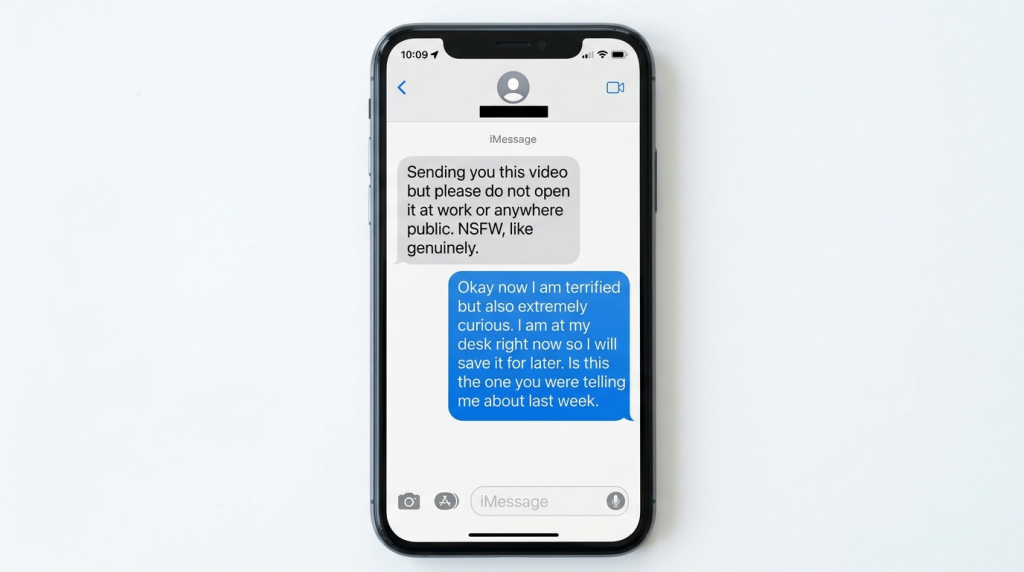
NSFW Meaning on Different Platforms
What Does NSFW Mean on Reddit?
Reddit is where NSFW functions most formally and systematically as a content classification tool. The platform has a built-in NSFW tagging system that both users and moderators can apply to posts and entire communities — subreddits dedicated to adult content are marked NSFW and require users to opt into viewing them by verifying their age and adjusting account settings. When a post on Reddit is tagged NSFW the thumbnail is blurred and a warning appears before the content loads. This systematic use of NSFW as a platform-level classification system makes Reddit the platform where the abbreviation carries the most technical and consequential weight — it is not just a social courtesy but a functional content gate.
What Does NSFW Mean on Twitter / X?
On Twitter, NSFW functions as both a formal content warning and a casual social signal depending on context. The platform has its own sensitive content settings that blur NSFW-tagged media behind a warning screen, and accounts that consistently post adult or sensitive content are required to mark their profiles accordingly. In casual Twitter usage NSFW also appears in tweets and replies as a simple text warning before links or descriptions of content — “NSFW but this video is wild” or “thread incoming, NSFW for language.” Twitter’s relatively permissive content policies compared to other major platforms mean that NSFW content is more present there and the warning label sees correspondingly more use.
What Does NSFW Mean on TikTok?
TikTok has stricter content moderation than most platforms and genuinely NSFW content is more likely to be removed than tolerated there — which means NSFW on TikTok often refers to content that is edgy, profanity-heavy, or mature-themed rather than explicitly adult. Creators will tag their videos NSFW in the caption when they contain strong language, dark humor, or content that parents might not want younger viewers to encounter. In comment sections NSFW appears as a warning to other users before linking to something elsewhere on the internet. Because TikTok’s audience skews younger, the social responsibility dimension of NSFW warnings carries additional weight on that platform.
What Does NSFW Mean in Text Messages?
In direct text messages between individuals, NSFW operates purely as a social courtesy warning — there is no technical enforcement mechanism, just the expectation that the person receiving the warning will use it to make an informed decision about when to open what is being shared. “Sending you this link but it is NSFW so maybe wait until you are home” or simply “[NSFW]” pasted before a link are both completely natural ways NSFW appears in personal texting. Between close friends who share content regularly, NSFW is one of the most considerate things someone can include — it shows awareness that the other person has a life and a context outside of the conversation and respects that accordingly.
Real Text Conversation Examples
These examples show the complete range of situations where NSFW appears — from the considerate link warning to the platform tagging to the casual heads-up between friends about content that requires discretion.
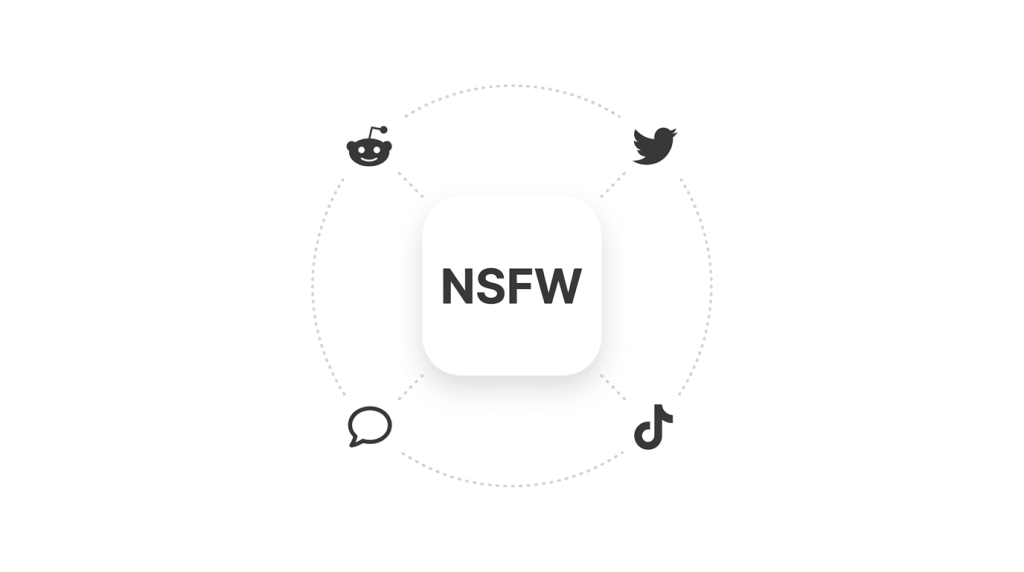
Example 1 — Responsible sharing with a clear warning
Jordan: Sending you this video but please do not open it at work or anywhere public. NSFW, like genuinely
Alex: Okay now I am terrified but also extremely curious. I am at my desk right now so I will save it for later. Is this the one you were telling me about last week
Example 2 — Casual NSFW warning before a link
Priya: NSFW but this is genuinely the funniest thing I have seen in months and you need to see it when you are somewhere appropriate
Dana: Saving this for when I get home tonight. The fact that you added “genuinely NSFW” and not just “a bit edgy” has raised my expectations considerably
Example 3 — NSFW warning for strong language content
Tyler: This podcast episode is incredible but fair warning it is extremely NSFW for language, like every other word
Sam: Perfect for my commute with headphones then. Thanks for the warning, I was almost going to listen through the car speakers with my parents in the vehicle
Example 4 — Someone forgetting to include a warning
Keisha: [sends a link with no warning]
Mia: I just opened that at my desk and I want you to know that my coworker was literally standing right behind me reading over my shoulder and we both saw everything simultaneously. A NSFW warning would have been appreciated
Keisha: I am so sorry I genuinely forgot. How bad was it
Mia: The coworker has not made eye contact with me since
Example 5 — Using NSFW for content that is embarrassing rather than explicit
Leo: I found your old MySpace and I am sending you the link but it is extremely NSFW for your dignity and sense of self
Zara: Under no circumstances. Delete that link. Burn your phone. We are never speaking of this again
Example 6 — Used as a standalone content warning before a message
Group chat: [someone is about to share something that requires a heads-up]
Message: NSFW but I have to show you all this.
How to Use NSFW Correctly
NSFW works most effectively when placed before the content it is warning about — either as the first word of a message, immediately before a link, or as a bracketed label that separates the warning from the content. The goal is to give the person receiving it time to make an informed decision before they encounter the material.
NSFW before a link (most common and most functional): “NSFW: [link]” — Clean, clear, gives the person a moment before they click.
NSFW at the start of a message with context: “NSFW but I need you to see this when you are somewhere private.”
NSFW as a bracketed label: “[NSFW] this video is absolutely unhinged and you will love it.”
NSFW with a specific qualifier (most helpful): “NSFW for language” or “NSFW for graphic content” or “NSFW just for being very weird” — Telling someone specifically what kind of NSFW they are about to encounter is more useful than the label alone and lets them make a more informed decision.
NSFW as a retroactive warning (when you forgot to include it): “Actually wait, NSFW, I should have said that before you opened it. I am sorry.”
The most important principle about NSFW is using it proactively rather than reactively. The entire value of the warning is that it arrives before the content does — a NSFW label after someone has already opened something accomplishes nothing except an apology. When in doubt about whether something warrants the warning, err on the side of including it. The social cost of an unnecessary NSFW warning is zero. The social cost of not including one when it was needed can be significant.
What Is the Difference Between NSFW and NWS?
NSFW and NWS (Not Work Safe) are functionally identical — both are content warning labels used to flag inappropriate material before sharing. The word order is reversed but the meaning is exactly the same.
NSFW is significantly more widely recognized and used — it is the established standard across virtually every platform, community, and cultural context where internet content warnings are used. NWS exists and is occasionally used but it never achieved the same cultural penetration as NSFW and is rarely encountered in everyday texting or social media.
If you see NWS it means exactly the same thing as NSFW. If you are creating a content warning yourself, NSFW is the version that will be immediately understood by essentially everyone. NWS is technically correct but unnecessarily obscure when the far more universally recognized alternative exists.
NSFW vs Similar Content Warning Terms — What Is the Difference?
| Term | Meaning | Key Difference |
| NSFW | Not Safe For Work | Broad content warning — sexual, violent, profane, or otherwise inappropriate for professional settings |
| NWS | Not Work Safe | Identical meaning to NSFW — reversed word order, much less commonly used |
| TW | Trigger Warning | Warns about potentially distressing content — mental health, trauma, violence — focused on emotional safety |
| CW | Content Warning | Broader than TW — can flag anything from spoilers to sensitive topics |
| 18+ | Adults Only | Specifically flags age-restricted content |
| Explicit | Contains Explicit Content | Platform-level label for sexual or very strong language content |
| Sensitive | Contains Sensitive Content | Platform label used by Twitter/X for graphic or potentially disturbing content |
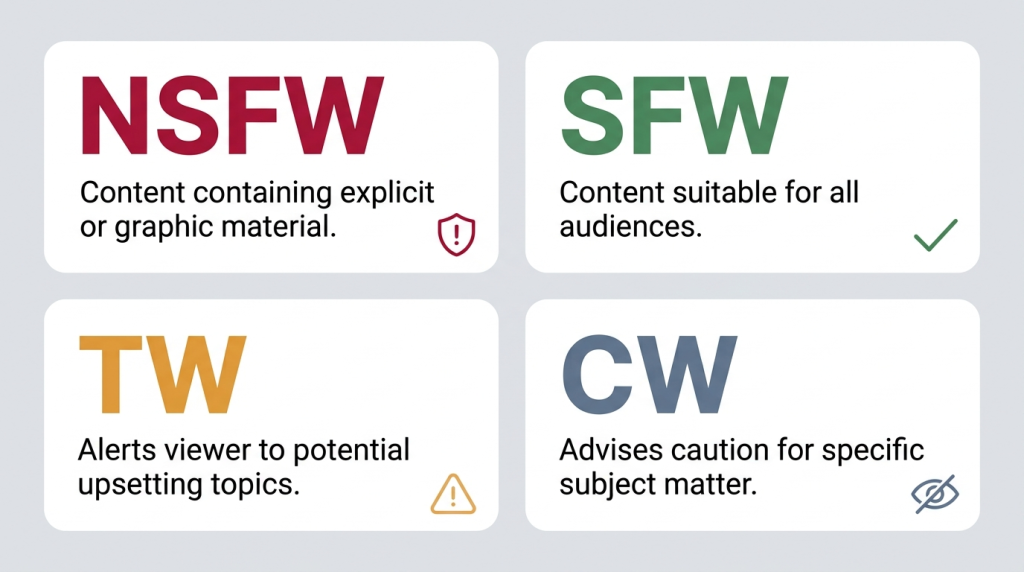
NSFW is unique in this list because it is the only term that specifically frames the content concern around professional and social context rather than emotional impact or age restriction. TW and CW are about the emotional experience of the viewer. 18+ and Explicit are about age appropriateness.
Is NSFW Only About Sexual Content?
NSFW is most strongly associated with sexually explicit content in popular culture — when people hear NSFW they often assume the content is adult in nature. But the abbreviation is and always has been broader than that, covering any material that would be inappropriate in a professional or public context regardless of whether it is sexual.
When NSFW is about sexually explicit content: The most common association and the most common use. Explicit images, videos, or descriptions that are clearly adult content.
When NSFW is about graphic violence: Violent, gory, or disturbing imagery that would be shocking and inappropriate to have visible on a work computer or in a public space.
When NSFW is about strong language: Audio or video content with heavy profanity that would be audibly inappropriate if played through speakers in a workplace, classroom, or public setting.
When NSFW is about controversial or politically charged content: Content that could create professional awkwardness, conflict, or HR issues if seen by employers or colleagues in a workplace context.
When NSFW is about dark humor: Comedy that is edgy, offensive, or inappropriate enough that being seen consuming it at work could create negative impressions or professional consequences.
When NSFW is used for embarrassing personal content: Material that one or both parties would find embarrassing if exposed to professional contacts — old photos, private jokes, personal confessions — that is NSFW in the sense of requiring discretion about audience rather than being objectively inappropriate.
Frequently Asked Questions About NSFW
What does NSFW mean in a text from a girl?
When a girl sends NSFW in a text she is flagging that what she is about to share or has just shared requires discretion about when and where you open it. The content of what she is sharing tells you everything — NSFW before a funny video means she has thought about your context and is being considerate about it. NSFW before something more personal or intimate means she is being deliberate about who has access to what she is sharing with you and when. Either way NSFW from anyone is a sign of social awareness and consideration — she is thinking about your situation and your context rather than just sending things without regard for the circumstances you might be in when you receive them.
What does NSFW mean in a text from a guy?
When a guy sends NSFW he is giving you a heads-up that you need to be aware of your surroundings before you open what he just shared. In casual friendship contexts this is almost always about funny, edgy, or explicit content that he wants to share but wants to make sure you see in an appropriate setting. The NSFW label is him being considerate about your context — knowing that you might be at work, in a public place, or near people who should not see whatever is coming. Guys who include NSFW warnings are demonstrating basic social awareness and respect for the other person’s situation, which is a small but genuine courtesy worth appreciating.
Can NSFW refer to content that is safe for most settings but not all?
Yes — and this is actually one of the more sophisticated uses of NSFW in practice. Not all NSFW content is universally inappropriate. Something might be NSFW in a conservative corporate environment but completely fine in a creative agency. Strong language content might be NSFW on a school computer but perfectly acceptable in most adult social settings. The “work” in NSFW is flexible enough to cover any shared professional or public context where the content would be inappropriate — it does not necessarily mean every workplace or every public space, but it signals that some environments exist where opening this content without checking first could cause problems. Adding a qualifier like “NSFW for language” or “NSFW depending on where you work” acknowledges this nuance and gives the recipient more useful information for making their decision.
Is there a safe for work equivalent of NSFW?
Yes — the opposite of NSFW is SFW (Safe For Work), which is used to indicate that content is appropriate for viewing in any professional or public setting. SFW is used less frequently than NSFW because content being appropriate for all audiences is the default assumption in most contexts — you only need to flag when that assumption does not hold. SFW appears most often when someone wants to specifically reassure a recipient that content is fine to open anywhere — particularly useful when sharing something that might look suspicious or potentially inappropriate based on the preview or context but is actually completely innocuous. “SFW I promise it is just a cooking video” in response to a confusingly titled link is a natural use of SFW.
Why does NSFW say “work” when it applies to many non-work contexts?
The “work” in NSFW is genuinely a product of where and when the term originated — early internet culture where many people accessed the internet primarily through workplace computers and the most salient context for content discretion was the professional one. Over time NSFW has expanded well beyond its original workplace-specific application and now functions as a general content warning for any shared, public, or semi-public context — schools, libraries, public transport, family settings, and anywhere else where having potentially inappropriate content visible on a screen could create social problems. The word “work” has effectively become shorthand for “any context where this could get you in trouble or cause embarrassment” rather than specifically referring to paid employment. The abbreviation stuck because it was already universally understood before the broader application developed.
Does NSFW always mean Not Safe For Work?
Yes — NSFW universally and exclusively means Not Safe For Work across every platform, age group, and digital communication context currently in use. It is one of the most stable, consistently understood, and broadly recognized abbreviations in the entire history of internet communication. There are no mainstream alternative meanings for NSFW and no generational or platform-specific reinterpretations that have changed what it means. Whether you encounter NSFW in a personal text, a Reddit post, a Twitter warning, a Discord server, a forum thread, or any other digital communication context, it means Not Safe For Work every single time without exception.
See Also: OFC Mean in Text