What Does ISTG Mean in Text? Full Meaning Explained Simply (2026)
ISTG stands for “I Swear To God.” It is used in texting and social media to add maximum emphasis to a statement — either to prove that something is completely true, to express that a person has reached their absolute limit with a situation, or to signal genuine urgency before an important message. When someone sends ISTG, they are demanding that you take what follows seriously.

Quick Definition: ISTG at a Glance
| Detail | Info |
| Full Form | I Swear To God |
| Type | Reaction / Emphasis Marker |
| Tone | Serious, Frustrated, Urgent, Sometimes Dramatic |
| Used On | Text, Snapchat, TikTok, Twitter/X, Instagram |
| Who Uses It | Gen Z, Millennials, and general texters |
| Safe for Work? | Use with caution |
What Does ISTG Mean in Text?
ISTG means I Swear To God and it is one of the most intense emphasis tools in modern texting. People use it when a plain statement does not feel strong enough — when they need the person reading their message to understand that they are being completely serious, that something is genuinely true, or that they have been pushed to the edge of their patience with a situation.
What makes ISTG different from most abbreviations is that it puts the speaker’s own credibility on the line. Every other emphasis tool in texting describes an emotion or reaction. ISTG goes one step further — it is a personal declaration that says “I am staking my word on this.” It is the texting equivalent of grabbing someone by the shoulders and saying “No, you do not understand — I am dead serious right now.”
ISTG has its roots in everyday spoken language where “I swear to God” has been used as a casual intensifier for decades. As texting culture developed through the 2010s the full phrase got abbreviated just like everything else.
By the mid 2010s ISTG was a staple of Gen Z communication and today it appears across every major platform and is immediately understood by anyone under 40.
What Emotions Does ISTG Convey?
ISTG is one of the most context-dependent abbreviations in texting. The same four letters can carry completely different emotional weight depending entirely on what surrounds them:
- Asserting truth — “ISTG I saw him there with my own eyes, I am not making this up”
- Deep frustration — “ISTG if he cancels on me one more time I am completely done”
- Serious warning — “ISTG do not touch my food in the fridge again”
- Urgent emphasis — “ISTG please just hear me out for one second”
- Dramatic exaggeration — “ISTG that was the funniest thing I have ever witnessed in my life”
- Genuine disbelief — “ISTG I cannot believe this is actually happening right now”
The emotion shifts entirely based on what follows ISTG in the sentence.
ISTG Meaning on Different Platforms
What Does ISTG Mean on Snapchat?
On Snapchat, ISTG is used constantly between close friends to emphasize personal stories, vents, and reactions. Because Snapchat conversations are fast, private, and informal, ISTG gets deployed freely sometimes with genuine intensity behind it and sometimes purely for dramatic comedic effect.
A friend snapping “ISTG my entire day was a disaster” is probably venting but not in crisis. The surrounding conversation and their overall tone tells you which it is. On Snapchat the line between serious and joking ISTG is thinner than anywhere else.
What Does ISTG Mean on TikTok?
On TikTok, ISTG floods comment sections under videos where something surprising, relatable, or completely unbelievable is happening on screen. Viewers drop “ISTG this is me every single morning” or “ISTG I said this exact thing two days ago” to signal maximum relatability.
Creators also use ISTG in their captions when they are making a point they want the audience to receive as genuine rather than performative. On TikTok ISTG signals authenticity and authenticity is everything on that platform.
What Does ISTG Mean on Twitter / X?
Twitter is where ISTG is used with the most genuine weight. A tweet that opens with ISTG is almost always expressing real frustration, actual outrage, or a very strong position on something. The platform’s culture of hot takes, callouts, and strong opinions makes ISTG a natural fit for statements where the person wants their seriousness and sincerity to cut through the noise. On Twitter ISTG is rarely ironic — when someone uses it there they usually mean it.
What Does ISTG Mean in Instagram DMs?
In Instagram DMs, ISTG moves between genuine and playfully dramatic depending on the relationship. Between close friends it often appears in exaggerated but affectionate statements — “ISTG you look incredible in this photo.” In more serious conversations it signals real emotion and asks the other person to genuinely pay attention to what comes next. I
n comments it works similarly to TikTok — used to signal relatability or strong agreement with something in a post.

Real Text Conversation Examples
Seeing ISTG across different scenarios shows just how wide its range actually is in real conversations.
Example 1 — Asserting that something is true
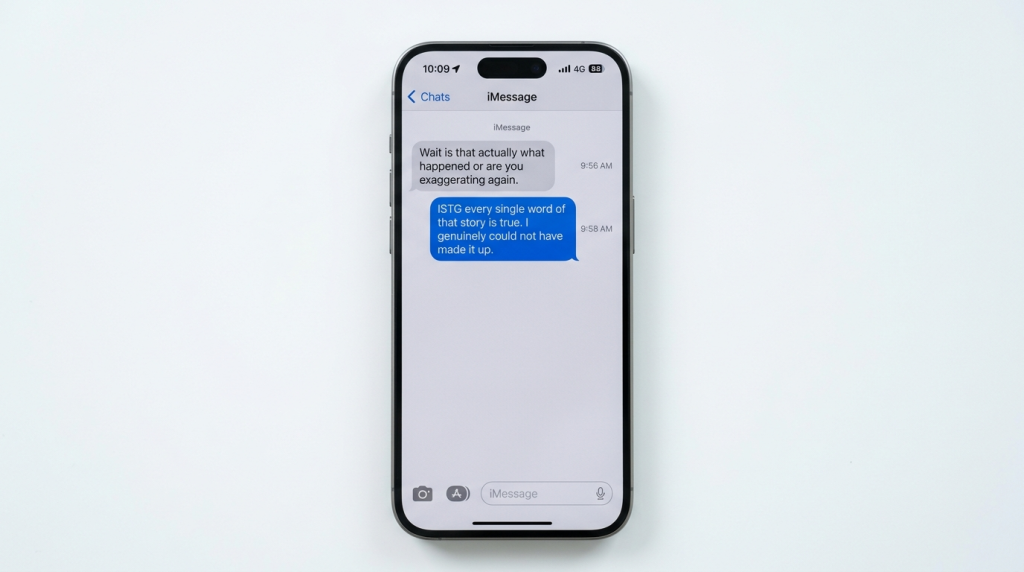
Jordan: Wait is that actually what happened or are you exaggerating again
Alex: ISTG every single word of that story is true. I genuinely could not have made it up
Example 2 — Reaching the limit of patience
Priya: How did the team meeting go today
Dana: ISTG if my manager talks over me one more time in front of everyone I am going to say something about it. I cannot keep letting it go
Example 3 — Serious warning between friends
Tyler: I may have eaten the leftovers that were in the fridge last night
Sam: ISTG Tyler those were literally my lunch for tomorrow. I had been thinking about that food all day. Do not do that again
Example 4 — Dramatic reaction to something funny
Keisha: Did you actually watch the season finale last night
Mia: ISTG I screamed so loud my neighbour knocked on my wall to check if I was okay. I was not prepared for any of that
Example 5 — Genuine emotional emphasis
Leo: Sometimes I feel like nobody in that group actually listens when I talk
Zara: ISTG I hear you every single time. You are not imagining it and you are not being too sensitive. I notice it too
Example 6 — Used completely alone as a reaction
Group chat: [someone shares a screenshot of an absolutely unbelievable situation]
Reply: ISTG
How to Use ISTG Correctly
ISTG is most powerful at the very beginning of a sentence because its entire job is to prime the reader before the main statement lands. Placing it first means the person reading absorbs the intensity before they even get to your actual message — which is exactly the effect you want.
ISTG at the start (most common and most effective): “ISTG if this happens one more time I am done talking about it.”
ISTG in the middle (for added dramatic effect mid-sentence): “She showed up two hours late and, ISTG, acted like nothing had happened at all.”
ISTG alone (maximum impact, no words needed): Someone shares something completely outrageous. You reply simply: “ISTG.”
The single most important rule with ISTG is not to overuse it. Because it carries such heavy emphasis, using it in every message drains it completely of power. ISTG lands hardest when it is reserved for moments where you genuinely have real emotion or real urgency behind the statement. When every text you send contains ISTG, none of them feel serious.
What Is the Difference Between ISTG and IRL Swearing?
A common question people have about ISTG is whether it counts as swearing or taking religious language in vain. The honest answer is that it sits in a gray area that depends entirely on who is reading it.
In modern texting culture ISTG functions as a pure intensity marker — the same way people have casually said “I swear to God” in everyday spoken conversation for decades without genuine religious intent behind it. For the vast majority of people who send and receive it, it reads as emphasis and nothing more. There is no oath being made. There is no religious statement being declared. It is simply the strongest emphasis tool available in casual digital communication.
That said, it is worth knowing your audience. Some people with strong religious beliefs may find the phrase disrespectful regardless of how casually it is intended. If you are texting someone you do not know well, or if you are in a conversation where religious values are a known factor, a different emphasis phrase might land better. Between close friends who are comfortable with each other, ISTG is almost universally received as casual slang with zero religious intent.
ISTG vs Similar Abbreviations — What Is the Difference?
| Abbreviation | Meaning | Key Difference |
| ISTG | I Swear To God | Personal declaration — puts speaker’s credibility on the line |
| OMG | Oh My God | Pure reaction to something surprising or shocking |
| NGL | Not Gonna Lie | Signals an honest opinion is coming, much softer than ISTG |
| FR | For Real | Confirms something is genuine, less intense than ISTG |
| SMH | Shaking My Head | Quiet disapproval reaction, very different energy to ISTG |
| SMDH | Shaking My Damn Head | Stronger disapproval but still a reaction not a declaration |
| IKR | I Know Right | Enthusiastic agreement with someone else, opposite direction to ISTG |
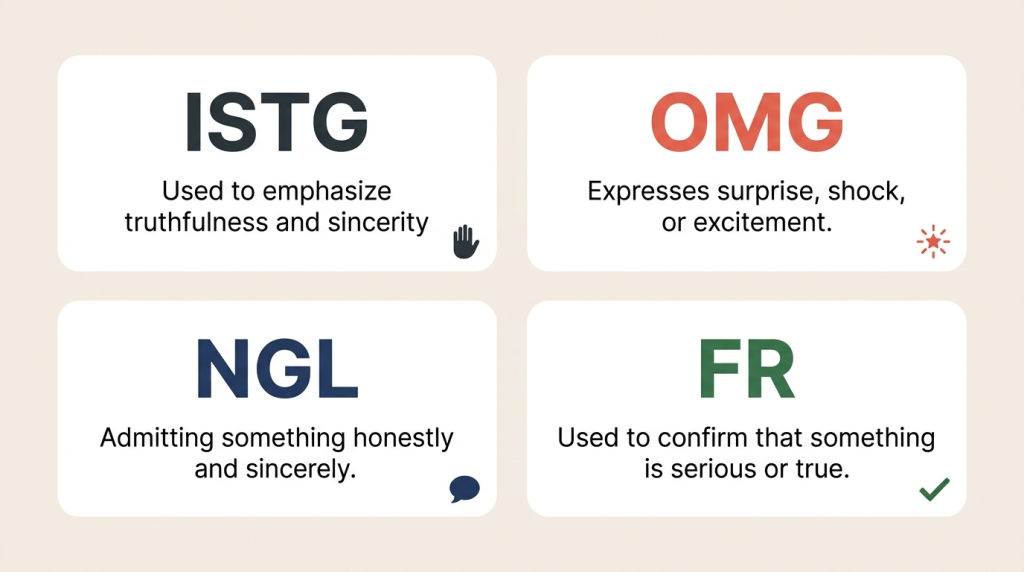
ISTG stands alone as the only common texting abbreviation that puts the speaker’s personal sincerity and credibility on the line. Every other abbreviation in the list above is either a reaction to something external or a framing device for an opinion. ISTG is a declaration about the truth or intensity of what the speaker themselves is saying.
Is ISTG Negative, Positive, or Neutral?
ISTG on its own is completely neutral — it is a pure intensity amplifier and carries no inherent emotional direction. The feeling behind it comes entirely from the statement that follows it. This makes ISTG uniquely flexible compared to abbreviations like SMH or FR which carry a built-in emotional lean.
When ISTG is clearly negative: Expressing frustration, issuing a serious warning, or venting about a situation that has pushed someone past their limit. “ISTG I cannot keep dealing with this.”
When ISTG is positive: Emphasizing a genuine compliment or expressing real excitement about something. “ISTG that performance was one of the best things I have ever seen.”
When ISTG is used for humor: Applying maximum seriousness to something obviously trivial for comedic effect. “ISTG this is the greatest sandwich ever assembled by human hands.” The humor comes from the mismatch between the intensity of ISTG and the low stakes of the subject.
Frequently Asked Questions About ISTG
What does ISTG mean in a text from a girl?
When a girl sends ISTG in a text she is signaling that what follows is something she wants you to take seriously either she is asserting that something is completely true, expressing that she has reached her limit with a situation, or reacting to something with genuine intensity.
Pay close attention to what comes after ISTG because that is where the real message lives. ISTG itself is just the signal that the volume is turned up on whatever she is about to say. If her message reads as frustrated, she probably is. If it reads as dramatic or funny, she is likely being playfully exaggerated for effect.
What does ISTG mean in a text from a guy?
When a guy sends ISTG he is putting his credibility behind whatever statement follows either because he expects to be doubted, because he is genuinely at his limit with something, or because he needs you to understand the depth of what he is feeling.
Guys tend to use ISTG most often before frustration vents or before statements they feel strongly about and do not want dismissed. It is his way of saying “I need you to understand I am not exaggerating right now.”
Is ISTG rude to send someone?
ISTG is not inherently rude but the statement that follows it can absolutely be rude depending on what it is. ISTG used before a frustrated warning or a direct callout can feel aggressive to someone on the receiving end, especially if you do not have a very close relationship with them.
ISTG used before a genuine compliment or an emotional admission is warm and not rude at all. The abbreviation itself is neutral your intent and the words that follow it determine whether the message lands as rude or not.
Can ISTG be funny?
Absolutely — ISTG is one of the most commonly used abbreviations in Gen Z humor precisely because of how well it works for ironic exaggeration. The joke is always the same formula: apply maximum seriousness to something completely trivial.
“ISTG this is the best episode of television ever made in the entire history of human civilization” is funny because the extreme weight of ISTG is wildly disproportionate to the subject. When used this way it reads as self-aware and playful rather than intense or serious.
What is the difference between ISTG and OMG?
OMG (Oh My God) and ISTG both borrow religious language as emphasis tools but they function very differently in practice. OMG is a reaction — it looks outward at something that just happened and expresses surprise, shock, or excitement in response to it.
ISTG looks inward — it is a declaration about what the speaker is saying or feeling, and it puts their personal credibility behind it. OMG is a gasp. ISTG is a sworn statement. You say OMG when something surprises you. You say ISTG when you need someone to believe you or understand how serious you actually are.
Does ISTG always mean I Swear To God?
Yes. Unlike some texting abbreviations that carry different meanings across different communities and platforms, ISTG is universally understood to mean I Swear To God in every texting and social media context currently in use.
There are no widely recognized alternative meanings for ISTG in mainstream digital communication. If you see ISTG in a text message, a comment section, or a social media caption, it means I Swear To God without exception
See Also: Hmu mean in text