
What Does DTR Mean in Text? Full Meaning Explained Simply (2026)
DTR stands for “Define The Relationship.” It is used in texting and social media to refer to a specific conversation — one of the most significant and sometimes most anxiety-inducing conversations in modern dating — where two people who have been spending time together, developing feelings, or operating in romantic ambiguity decide to put words to what they actually are to each other. When someone mentions DTR they are talking about the moment when the undefined becomes defined and the unspoken becomes spoken.
Quick Definition: DTR at a Glance
| Detail | Info |
| Full Form | Define The Relationship |
| Type | Relationship Term / Conversation Reference |
| Tone | Serious, Sometimes Nervous, Sometimes Hopeful, Sometimes Relieved |
| Used On | Text, TikTok, Twitter/X, Snapchat, Instagram |
| Who Uses It | Gen Z, Millennials, and general texters |
| Safe for Work? | Yes |
What Does DTR Mean in Text?
DTR means Define The Relationship and it is one of the most emotionally significant abbreviations in modern dating vocabulary. People use it to reference the conversation that clarifies what two people actually are to each other — whether they are exclusive, whether they are dating, whether what they have been building is a relationship or something else, and what both people actually want going forward. DTR is the conversation that takes an undefined situation and gives it a name.
What makes DTR so culturally relevant is the particular anxiety it carries in modern dating culture. In a world where the stages between meeting someone and being officially in a relationship are increasingly blurred and increasingly extended — where people can be texting every day, spending significant time together, and developing genuine feelings while still technically being undefined — the DTR conversation has become one of the most discussed and most dreaded moments in early romantic development.
DTR entered mainstream vocabulary through dating culture discussions on social media and in popular media — a clean abbreviation for a conversation that had always existed but that perhaps needed a name as the ambiguous middle stages of modern dating became longer and more complicated.
Today DTR is understood universally across every demographic and platform as shorthand for the conversation that changes the nature of a connection from undefined to defined.
What Does DTR Signal in a Conversation?
DTR always references a conversation about relationship status but the context and emotional weight varies:
- Announcing you need to have the conversation — “We need to DTR, this has gone on long enough”
- Describing a conversation that happened — “We DTR’d last night and we are officially together”
- Seeking advice before having it — “I want to DTR but I am terrified of how it might go”
- Processing the outcome of one — “The DTR did not go the way I hoped”
- Cultural commentary — “Modern dating would be so much simpler if people DTR’d earlier”
- Recognizing someone is avoiding it — “They keep avoiding the DTR and I do not know what to make of that”
DTR Meaning on Different Platforms
What Does DTR Mean on Snapchat?
On Snapchat, DTR appears in close friend conversations where people are seeking support, advice, or simply an audience as they navigate the nerve-wracking process of deciding when and how to have the defining conversation with someone they care about. Because Snapchat is where the most personal and unfiltered conversations happen, DTR there is almost always about a real and specific situation. Friends use Snapchat to talk through their fears about the DTR, rehearse what they might say, and process whatever outcome follows. On Snapchat DTR conversations are among the most emotionally genuine exchanges on any platform.
What Does DTR Mean on TikTok?
TikTok is where DTR culture is most publicly examined and discussed. Creators make content analyzing when to have the DTR conversation, how to have it, what the avoidance of it signals, and what modern dating’s extended ambiguous phase says about how people relate to vulnerability and commitment. These videos generate enormous engagement because the experiences being described are so widely shared — the anxiety, the hope, the relief or disappointment that follows. Comment sections become communal processing spaces where thousands of people share their own DTR experiences and outcomes.
What Does DTR Mean on Twitter / X?
On Twitter, DTR is discussed both in personal contexts and as cultural commentary on modern dating. Personal tweets about needing to DTR, dreading the DTR, or having finally had it generate strong engagement because the experiences are universally recognizable.
Cultural commentary on DTR examines what modern dating’s ambiguity phases say about attachment avoidance, communication norms, and what people actually want from relationships versus what they feel safe admitting to wanting.

What Does DTR Mean in Instagram DMs and Captions?
On Instagram, DTR appears in DMs as part of genuine personal conversations between close friends navigating their romantic lives. In captions and public content DTR appears in relationship advice content, dating culture commentary, and the kind of candid personal storytelling that performs well on the platform. Instagram DTR content often takes a slightly more reflective and philosophical angle — examining what the conversation means, why it is hard, and what it takes to be honest about what you want.
Real Text Conversation Examples
These examples show the complete range of DTR — from the nervous anticipation before the conversation to the relief or complication after it.
Example 1 — Deciding it is time to have the conversation
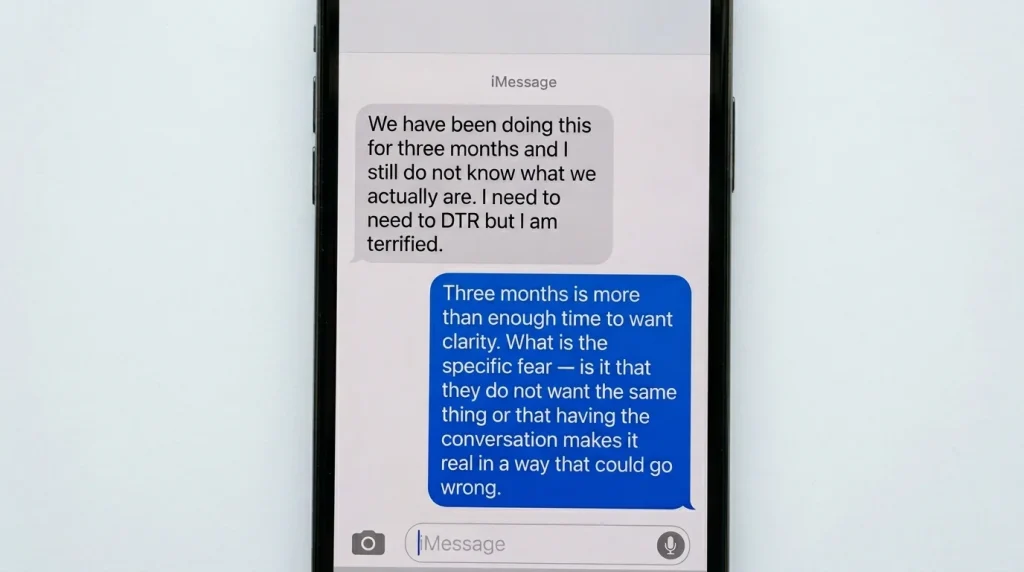
Jordan: We have been doing this for three months and I still do not know what we actually are. I need to DTR but I am terrified
Alex: Three months is more than enough time to want clarity. What is the specific fear — is it that they do not want the same thing or that having the conversation makes it real in a way that could go wrong
Example 2 — After the DTR went well
Priya: We DTR’d last night. I cannot believe I was that nervous because it was so much easier than I thought it was going to be
Dana: I am so happy. What happened and what did they say and are you officially together and give me every detail
Example 3 — Processing a DTR that did not go as hoped
Tyler: The DTR happened. They want to keep things undefined for now. I do not really know what to do with that
Sam: That is genuinely hard and I am sorry. Do you feel like their answer was honest or were they buying time? And more importantly — is undefined actually something you can live with right now
Example 4 — Recognizing that someone is avoiding the conversation
Keisha: Every time I try to bring up where we are going they change the subject. I think they are deliberately avoiding the DTR
Mia: That avoidance is its own kind of answer even if it is not the one you want. Someone who wants the same thing you want does not usually avoid the conversation that would give them it
Example 5 — Cultural observation between friends
Leo: I genuinely do not understand why people drag out the ambiguous phase for so long. Just DTR and you both know where you stand
Zara: Because DTR requires vulnerability and vulnerability requires trusting that the other person will meet it with equal honesty. Not everyone feels safe enough to do that early and not everyone has been given reason to
Example 6 — Used completely alone as a complete description
Group chat: [someone announces they finally had the big conversation with the person everyone has been asking about]
Reply: DTR! How did it go?
How to Use DTR Correctly
DTR functions as both a noun — the conversation itself — and a verb — to have that conversation. Both uses are completely natural in everyday texting.
DTR as a noun: “We need to have the DTR before this goes any further.”
DTR as a verb: “We finally DTR’d and I feel so much better now that I know where things stand.”
DTR in a question: “Have you two DTR’d yet or are you still in the undefined phase?”
DTR as the subject of broader discussion: “The DTR gets harder the longer you wait to have it.”
DTR with honest reflection: “I keep putting off the DTR because part of me does not want to know the answer.”
The most important thing about DTR in real life — beyond its use as an abbreviation — is understanding why it is so hard and what makes it easier. The DTR is hard because it requires admitting what you want to someone who could say they want something different. What makes it easier is recognizing that the clarity it provides — even when the answer is not what you hoped — is always better than the extended uncertainty of not knowing.
See Also: FWIW Mean in Text
What Is the Difference Between DTR and Ghosting?
DTR and ghosting sit at completely opposite ends of the relationship communication spectrum — one represents the most honest and direct thing two people can do in an ambiguous romantic situation, the other represents the complete avoidance of that honesty.
DTR is the courageous choice — to have a difficult conversation, to be honest about what you want, to give the other person the same honesty and the same respect. DTR acknowledges that the other person deserves a real answer rather than continued ambiguity.
Ghosting is the avoidant choice — to end contact without explanation, to leave the other person without the closure or understanding that a real conversation would have provided. Ghosting prioritizes the avoider’s comfort over the other person’s dignity. DTR is a vulnerability in service of connection. Ghosting is avoidance in service of comfort.
DTR vs Similar Relationship Terms — What Is the Difference?
| Term | Meaning | Key Difference |
| DTR | Define The Relationship | The conversation that clarifies what two people are to each other |
| FWB | Friends With Benefits | A specific arrangement that DTR sometimes clarifies or evolves from |
| Talking | Early romantic interest phase | The undefined phase that typically precedes the DTR conversation |
| Exclusive | Committed to each other but perhaps not officially labeled | One possible outcome of a successful DTR |
| Ghosting | Ending contact without explanation | The avoidant alternative to having the DTR |
| Situationship | Undefined romantic connection that lingers | What happens when the DTR is perpetually avoided |
| OTP | One True Pairing | The ideal romantic match — what DTR sometimes reveals you have found |
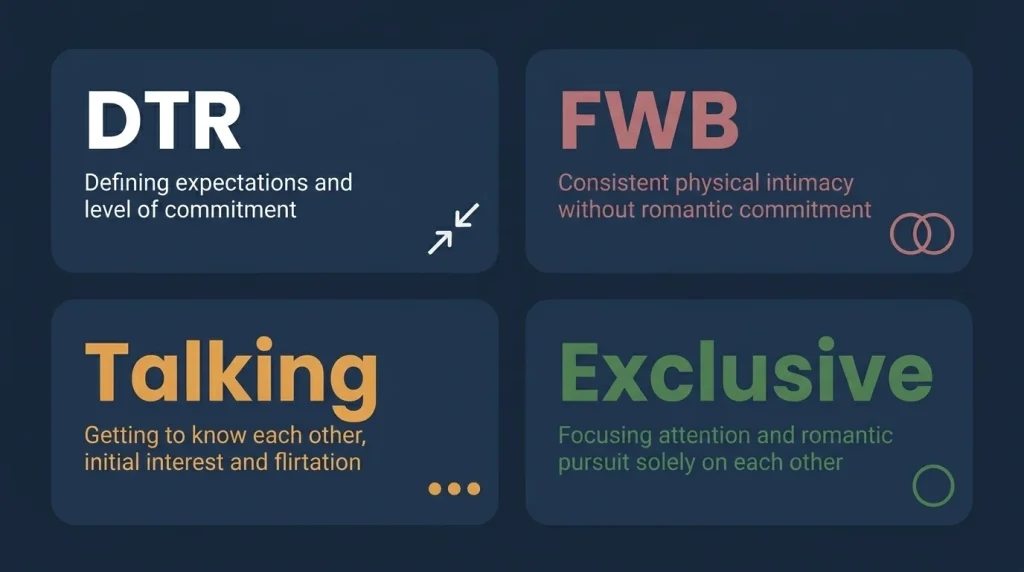
DTR is unique in this list because it is the only term that refers specifically to a single definitive conversation rather than to a type of arrangement, a phase of connection, or a behavior pattern. DTR is the moment rather than the state.
Why Is the DTR Conversation So Hard?
This is worth addressing directly because the difficulty of the DTR is real and deserves honest examination rather than dismissal.
The vulnerability it requires: DTR means admitting what you want to someone who might want something different. That exposure — saying “I want this to be real and I want to know if you do too” — requires a willingness to be seen and potentially rejected that many people find genuinely difficult.
The stakes it creates: Before the DTR the situation is undefined and in undefined situations hope is still intact. The DTR makes things real in a way that both clarifies and risks. Knowing is better than not knowing but the moment before knowing carries its own particular suspense.
What avoidance costs: The longer the DTR is delayed, the more emotionally invested both people typically become in the undefined situation — which makes the eventual conversation both more necessary and more loaded. Avoiding the DTR does not prevent the feelings it would surface. It just means those feelings accumulate more before anyone acknowledges them.
The modern dating context: In an era where extended ambiguity has become a normalized phase of early relationships, having the DTR can feel like jumping the gun — asking for something too early, being too direct, disrupting something that might have been fine if left undefined. This cultural pressure against clarity creates genuine confusion about when the DTR is appropriate.
Frequently Asked Questions About DTR
What does DTR mean in a text from a girl?
When a girl mentions DTR she is either processing the need to have the conversation, seeking support around an upcoming one, or sharing the outcome of one that happened. In any case she is engaging with one of the most significant moments in early romantic development and deserves genuine engagement rather than a dismissive response.
What does DTR mean in a text from a guy?
When a guy mentions DTR he is doing the same — and the fact that he is naming it directly rather than avoiding the topic entirely is often itself a meaningful signal about how seriously he is engaging with the situation.
How do you know when it is time to DTR?
When the ambiguity is causing more anxiety than the conversation would — when not knowing has become more difficult than the risk of knowing — it is time. The right time for the DTR is when both people would benefit more from clarity than from continued undefined connection.
What if the DTR does not go the way you hoped?
An honest answer you did not want is still better than continued uncertainty because it allows you to make real decisions about your situation rather than decisions based on hope. A DTR that reveals different wants is painful but freeing — it gives both people accurate information to work from.
Can the DTR happen over text?
It can but it often should not. The DTR is one of the most significant conversations in early romantic development and the nuance, tone, and genuine connection that the conversation deserves is better served in person or at minimum over a phone or video call where both people can hear and feel the full weight of what is being said.
Does DTR always mean Define The Relationship?
Yes — DTR universally means Define The Relationship in texting and social media contexts. It is one of the most consistently understood relationship abbreviations in modern digital communication with no mainstream alternative meanings.